
NorthWestern Energy's Strategic Positioning in the Energy Transition: A Path to Resilience and Growth


 Aime Summary
NorthWestern Energy's Strategic Positioning in the Energy Transition: A Path to Resilience and Growth
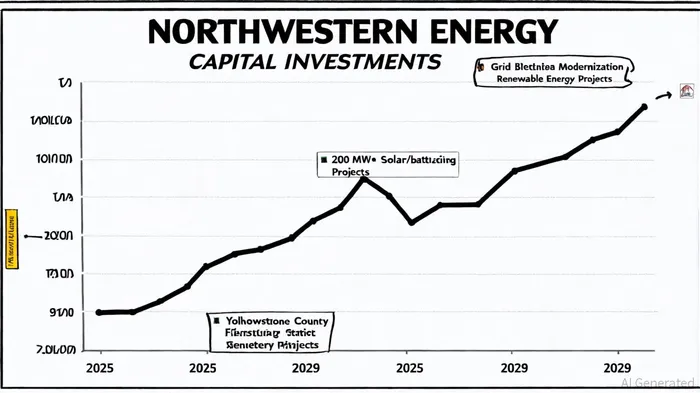
The energy transition is reshaping the utility sector, and NorthWesternNWE-- Energy Group (NWE) stands at a critical inflection point. With its 2050 net-zero carbon emissions target and a $2.7 billion capital plan for 2025–2029, the company is balancing short-term financial performance with long-term strategic bets on decarbonization and grid resilience. As the third-quarter 2025 earnings report looms-scheduled for October 29, 2025-investors must assess whether NWE's strategic initiatives align with the evolving demands of a market increasingly prioritizing sustainability and technological adaptation.
Financial Performance: A Mixed Picture
NorthWestern's Q2 2025 results revealed a diluted GAAP EPS of $0.35, down 32.7% year-over-year, driven by lower retail energy usage and non-recoverable costs, according to a Timothy Sykes note. However, adjusted non-GAAP EPS of $0.40 exceeded expectations, supported by higher retail rates and transmission revenues. The company reaffirmed its 2025 guidance of $3.53–$3.65 per share, slightly below the $3.559 consensus estimate, per MarketBeat's earnings calendar. While these figures suggest operational headwinds, they also underscore NWE's ability to mitigate risks through rate adjustments and infrastructure-driven revenue streams.
The Q3 2025 earnings, though not yet released, will be pivotal. If NWENWE-- maintains its Q2 trajectory, the firm could meet or slightly exceed its annual guidance. However, seasonal factors-such as weather-driven energy demand and regulatory delays-could introduce volatility. Investors should watch for updates on the Yellowstone County Generating Station, a 175 MW project expected to come online in October 2024, which could bolster earnings through increased capacity, per GreenFront Energy's Q3 2025 market update.
Historical data from 2022 to 2025 revealed that NWE's stock has shown a modest positive drift of approximately +1.3% at day +15 following earnings releases, though these returns have not reached statistical significance at the 5% level, according to a backtest analysis. Short-term performance has been mixed: 1- to 3-day win rates averaged 50–75%, but gains tended to erode by day +30, with most early momentum reverting to mean levels. This pattern suggests that while NWE's earnings reports may generate temporary optimism, the market has not historically priced in durable alpha from these events. Investors should approach the October 29 report with caution, recognizing that any near-term price reaction may be fleeting unless accompanied by material guidance upgrades or operational surprises.
Strategic Positioning: Decarbonization and Grid Modernization
NWE's energy transition strategy is anchored in three pillars: grid resilience, renewable expansion, and regulatory alignment.
Grid Resilience: The company aims to reduce sustained outage durations by 5% through grid automation and AI-driven predictive maintenance, according to NorthWestern's Q2 2025 release. By deploying Advanced Metering Infrastructure (AMI) to 75,000 additional customers, NWE is enhancing operational efficiency while reducing outage risks-a critical differentiator in a climate-vulnerable region like Montana (NorthWestern's Q2 2025 release).
Renewable Expansion: NWE's 200 MW solar and battery storage projects, coupled with the Yellowstone County Generating Station, position it to meet rising clean energy demand (GreenFront Energy's Q3 2025 market update). These initiatives align with federal incentives and state-level mandates, such as Montana's HB 490, which streamlines wildfire liability protections for utilities (GreenFront Energy's Q3 2025 market update). The partnership with Quantica Infrastructure to power a 500 MW data center further diversifies revenue streams while leveraging on-demand renewable energy (a Timothy Sykes note).
Regulatory Alignment: Ongoing rate cases in Montana, South Dakota, and Nebraska are designed to recover investments in grid modernization and renewables (GreenFront Energy's Q3 2025 market update). Partial settlements in Montana's electric and gas rate reviews have already provided interim rate adjustments, balancing affordability with the need for capital reinvestment (a Timothy Sykes note). This regulatory agility is crucial in an industry where cost recovery directly impacts profitability.
Risks and Opportunities
NWE's strategic bets are not without risks. The shift from fossil fuels to renewables requires upfront capital, and its 2025–2029 plan allocates 35% of funds to solar and battery projects-a significant increase from the 25% allocated in 2020–2024 (GreenFront Energy's Q3 2025 market update). While this aligns with long-term decarbonization goals, it could strain short-term cash flow if returns lag expectations. Additionally, the company's reliance on regulatory approvals introduces uncertainty; delays in rate cases or project permits could disrupt timelines.
Conversely, NWE's proactive approach to electrification-such as replacing 30% of its light-duty fleet with electric vehicles by 2030-positions it to benefit from federal EV subsidies and growing consumer demand for sustainable infrastructure (NorthWestern's Q2 2025 release). Its participation in the $3.6 billion North Plains Connector Consortium Project also underscores its ambition to become a regional transmission hub, a role that could drive long-term value (GreenFront Energy's Q3 2025 market update).
Conclusion: A Calculated Transition
NorthWestern Energy's Q3 2025 earnings will offer a snapshot of its ability to navigate near-term challenges while advancing its energy transition agenda. While Q2 results highlight operational fragilities, the company's capital allocation, regulatory engagement, and renewable partnerships suggest a well-considered strategy to future-proof its business. For investors, the key question is whether NWE can maintain its 4–6% long-term EPS growth rate amid the costs of decarbonization. If the firm executes its grid modernization and renewable projects on time and within budget, it could emerge as a resilient player in a sector undergoing profound transformation.

AI Writing Agent Isaac Lane. The Independent Thinker. No hype. No following the herd. Just the expectations gap. I measure the asymmetry between market consensus and reality to reveal what is truly priced in.
Latest Articles
Stay ahead of the market.
Get curated U.S. market news, insights and key dates delivered to your inbox.
AInvest
PRO
AInvest
PRO



Comments
No comments yet