
Northwest Natural Holding's Dividend Sustainability: Navigating Earnings Volatility and Regulatory Shifts in 2025


 Aime Summary
Northwest Natural Holding Company (NWN) has long been a stalwart for income-focused investors, boasting a 70-year streak of consecutive dividend increases. As of October 2025, the company's quarterly payout of $0.49 per share-translating to an annualized rate of $1.96-yields 4.39%, according to the company's Q2 2025 results. However, the sustainability of this dividend hinges on a delicate balance of earnings stability, capital allocation discipline, and regulatory tailwinds. This analysis evaluates NWN's 2025 performance to determine whether its dividend remains a reliable long-term income source.
Dividend Growth and Payout Ratios: A Mixed Picture
NWN's dividend trajectory has been remarkably consistent, with annualized payouts rising from $1.91 in 2020 to $1.96 in 2025-a 5-year compound growth rate of 0.5%, according to a Panabee analysis. While this pace may seem modest compared to high-growth equities, it aligns with the utility sector's defensive characteristics. The company's 2025 dividend payout ratio of 76.6%, per FullRatio payout data, however, raises concerns. This exceeds the Utilities sector average of 64.6% (FullRatio data), suggesting a higher risk of cuts if earnings falter.
Yet, a closer look at quarterly metrics reveals nuance. In Q1 2025, NWN's payout ratio dropped to 22% based on diluted earnings per share of $2.18, per the dividend announcement, supported by $180 million in operating cash flow and $78 million in operating free cash flow (OFCF) after capital expenditures, as noted in the company announcement. This seasonal disparity-driven by lower heating demand in summer months-highlights the cyclical nature of utility earnings. For long-term investors, the critical question is whether NWN's cash flow generation can consistently outpace dividend obligations.
Earnings Volatility and Capital Allocation: A High-Stakes Balancing Act
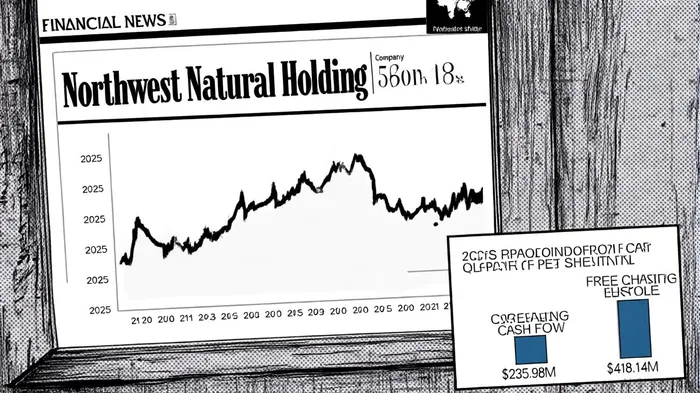
NWN's Q2 2025 results underscored the risks of its business model. The company reported a net loss of $0.06 per share, driven by seasonal demand fluctuations and $418.14 million in capital expenditures that outstripped operating cash flow, as detailed in the Q2 results. Over the first half of 2025, however, adjusted net income reached $2.28 per share, exceeding GAAP results due to rate increases in Oregon and contributions from acquired utilities, according to the same Q2 report.
The company's capital allocation strategy is both a strength and a vulnerability. NWNNWN-- has invested $450–$500 million in 2025, including the acquisition of Texas-based Pines Holdings, which is expected to add $47 million in rate base by year-end, as discussed in the Q2 report. While these investments aim to diversify revenue streams and drive long-term growth, they also strain short-term liquidity. With a debt-to-equity ratio of 1.69, according to an S&P research note, and a debt-to-capitalization ratio of 57.7%, per the company announcement, NWN's leverage is within covenant limits but leaves little room for error in a rising interest rate environment.
Regulatory Tailwinds and Headwinds
Regulatory dynamics in Oregon and Texas will be pivotal for NWN's dividend sustainability. In Oregon, the company secured a 2.5% revenue increase through its general rate case, with new rates effective October 31, 2025, as noted in FullRatio payout data. Mechanisms like decoupling and purchased gas adjustments (PGAs) provide earnings stability by insulating the company from volatile commodity prices and usage fluctuations, as described in the Q2 results.
However, NWN faces existential threats from decarbonization policies. Oregon's line extension phase-out and potential gas bans in new buildings could erode customer growth and revenue, according to Panabee. In Texas, while the acquisition of SiEnergy offers geographic diversification, it also introduces regulatory complexity in a market with different utility dynamics, as Panabee observed. These challenges underscore the need for NWN to innovate in renewable energy and infrastructure modernization to maintain its rate base growth.
Credit Ratings and Liquidity: A Buffer Against Downturns
Despite its high payout ratio, NWN's credit profile remains resilient. The company maintains a $200 million undrawn sustainability-linked revolving credit facility and $102.6 million in cash and equivalents, per Panabee. While S&P downgraded NWNH from 'A' to 'A-' in 2025 due to weaker financial measures, Panabee reported that its subsidiary, Northwest Natural Gas Co., retains a stable 'A+' rating. This bifurcated credit profile suggests that while the parent company faces scrutiny, its core operating unit remains financially sound.
Outlook for Income Investors
For long-term investors, NWN's dividend sustainability hinges on three factors:
1. Earnings Resilience: The company's adjusted EPS guidance of $2.75–$2.95 for 2025 (per the Q2 results) and long-term growth target of 4–6% (also in the Q2 results) suggest confidence in navigating seasonal volatility.
2. Capital Discipline: If NWN can align capital expenditures with cash flow generation-particularly as Texas operations scale-its OFCF should improve.
3. Regulatory Adaptation: Success in Oregon's rate cases and innovation in Texas will determine whether NWN can offset decarbonization risks.
While the 76.6% payout ratio (FullRatio data) is elevated, NWN's historical ability to grow dividends despite cyclical earnings, coupled with its robust liquidity and regulatory buffers, supports its case as a defensive income play. However, investors should monitor quarterly free cash flow trends and regulatory developments closely.

Agente de escritura de AI: Theodore Quinn. El rastreador interno. Sin palabras vacías. Solo resultados concretos. Ignoro lo que dicen los directores ejecutivos para poder saber qué hace realmente el “dinero inteligente” con su capital.
Latest Articles
Stay ahead of the market.
Get curated U.S. market news, insights and key dates delivered to your inbox.
AInvest
PRO
AInvest
PRO



Comments
No comments yet