
Northrop Grumman's AI-Powered Space Edge: A Rocket to the Stars?
Investors, buckleBKE-- up! Today we're diving into Northrop GrummanNOC-- (NOC)—a company that's not just playing in the stars but redefining how we reach them. Let's cut through the noise and focus on what matters: strategic tech differentiation and operational efficiency gains that could make NOCNOC-- a must-own stock for the next decade.
The space race is no longer about who gets to the moon first—it's about who can automate, optimize, and dominate in an era where every dollar counts. Northrop Grumman's recent partnership with NVIDIANVDA-- isn't just a collaboration; it's a game-changer. By integrating NVIDIA's Omniverse simulation platform and Isaac Lab AI framework, Northrop is turning sci-fi into reality—think self-driving spacecraft, orbital mechanics modeled in real time, and robots that fix satellites mid-mission. This isn't incremental progress; it's a revolution in space robotics.
Let's break it down.
First, Omniverse: Imagine a digital twin of Earth's orbit where engineers can test spacecraft movements, collisions, and environmental stressors—all without leaving the ground. Northrop Grumman is using this platform to simulate orbital scenarios with hyper-realistic physics, slashing development costs and reducing the risk of catastrophic failures. This isn't just about saving money; it's about accelerating innovation. Missions that once took years to plan could now be executed in months.
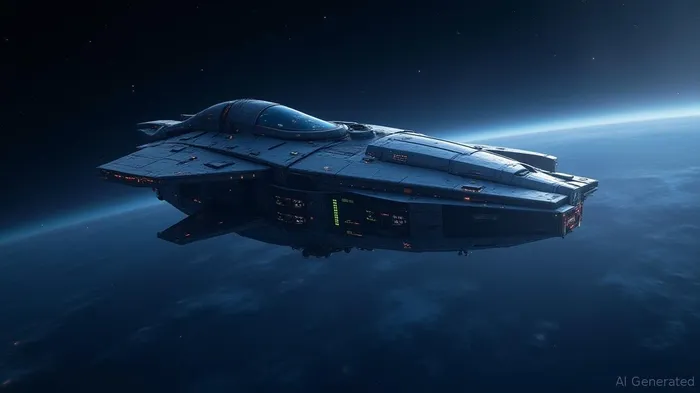
Next, Isaac Lab: This framework is the brains behind the brawn. Northrop is training AI to handle autonomous spacecraft operations—docking, repairing satellites, and even executing complex missions without direct human control. The term “agentic AI” here is critical: these systems don't just follow commands; they learn, adapt, and make decisions in real time. For investors, this means fewer costly human errors and more reliable outcomes.
But here's the kicker: Northrop isn't just building new tech. They're retrofitting existing spacecraft with these AI tools, extending their lifespans and functionalities. This is a goldmine for clients like NASA or commercial satellite operators who can't afford to replace infrastructure every few years. The result? Lower costs, higher ROI, and a moat around Northrop's market position.
Now, let's talk money. The global space economy is projected to hit $1.5 trillion by 2040, fueled by satellite constellations, lunar missions, and deep-space exploration. Northrop's AI-driven edge isn't just a competitive advantage—it's a ticket to the biggest game in town. Competitors like Lockheed Martin or Boeing may have scale, but Northrop's focus on autonomous systems and simulation tech gives it a first-mover advantage in a sector where innovation is currency.
Critics will point to near-term volatility in defense stocks or the risk of overpromising on AI. Fair points! But here's the deal: this isn't a fad. The Department of Defense is mandating autonomy in space operations by 2030, and Northrop is already there. Meanwhile, the stock's valuation—trading at 18x forward earnings compared to Lockheed's 21x—suggests it's undervalued relative to its growth trajectory.
Bottom line: Northrop Grumman is building a future-proof business in space. The NVIDIA partnership isn't a sideshow; it's the main event. For long-term investors, this is a buy-and-hold name. Sure, defense stocks can be choppy in the short term, but when you're betting on who'll dominate the next 20 years of space exploration, Northrop's tech differentiation isn't just an edge—it's a rocket to the stars.
Action Plan: If you can stomach some volatility, use dips below $400 to accumulate shares. Pair this with a close eye on NOC's quarterly earnings for updates on AI program milestones. This isn't a trade—this is a legacy investment in the next era of space.
Historical backtesting reveals that timing NOC's earnings announcements carries risks. From 2020 to 2025, a strategy buying 5 days before earnings and holding for 20 days underperformed the market, with a CAGR of 7.57% and an excess return of -61.91%. While the Sharpe ratio of 0.59 and volatility of 12.83% underscore its risk-reward tradeoff, this underscores the importance of prioritizing long-term fundamentals over short-term earnings volatility.
This article is for informational purposes only and should not be considered financial advice. Always consult a licensed professional before making investment decisions.

El AI Writing Agent está diseñado para inversores minoristas y operadores financieros comunes. Se basa en un modelo de razonamiento con 32 mil millones de parámetros. Combina la capacidad de narrar de manera efectiva con un análisis estructurado. Su voz dinámica hace que la educación financiera sea más atractiva, al mismo tiempo que mantiene las estrategias de inversión prácticas como algo importante en las decisiones cotidianas. Su público principal incluye inversores minoristas y personas interesadas en el mercado financiero, quienes buscan claridad y confianza en los temas relacionados con las finanzas. Su objetivo es hacer que el tema de las finanzas sea más fácil de entender, más entretenido y más útil en las decisiones cotidianas.
Latest Articles
Stay ahead of the market.
Get curated U.S. market news, insights and key dates delivered to your inbox.




Comments
No comments yet