
North Korean Cyber Infiltration in Crypto: A Looming Risk for Institutional Investors


 Aime Summary
The Scale and Sophistication of the Threat
According to a report by Elliptic, North Korean hackers have stolen over $2 billion in cryptoassets in 2025 alone, with cumulative losses since 2017 exceeding $6 billion. The Lazarus Group, a state-linked cybercriminal syndicate, has been implicated in high-profile breaches such as the $1.46 billion theft from Bybit in February 2025 according to Elliptic. These attacks are no longer confined to exploiting technical vulnerabilities; social engineering has emerged as a primary vector. High-net-worth individuals, crypto exchanges, and even cybersecurity firms have been targeted through meticulously crafted phishing campaigns and fake job offers as research shows.
The stolen funds are then laundered using advanced techniques, including cross-chain transactions, obscure blockchains, and "refund addresses" designed to obfuscate trails according to Elliptic. This operational agility underscores a troubling reality: North Korea's cyber operations are not just financially motivated but strategically engineered to sustain its nuclear program and geopolitical leverage.
Dual Threats: Financial and Strategic Espionage
Beyond theft, North Korea's cyber campaigns extend to espionage and technology acquisition. A 2025 analysis by Cyfirma reveals that Pyongyang has infiltrated defense contractors, aerospace firms, and governmental networks across South Korea, the U.S., and Europe. One alarming case involved a North Korean operative posing as a U.S. national who infiltrated a cybersecurity firm. Malware was detected within 25 minutes of the individual connecting to a workstation, highlighting the regime's ability to exploit remote work environments as research indicates.
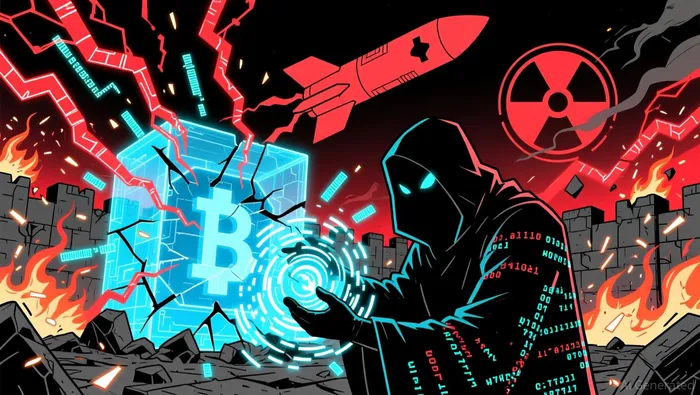
These operations are not isolated incidents. North Korea's partnership with Russia-solidified by a June 2024 defense pact-has amplified its capabilities. Russian infrastructure now facilitates recruitment, laundering, and cyberattacks, creating a hybrid threat that blurs the lines between state-sponsored espionage and criminal enterprise. For institutional investors, the risk extends beyond financial loss: compromised systems could expose sensitive market data, trade secrets, or even critical infrastructure to adversarial actors.
Geopolitical Challenges and Regulatory Gaps
The dissolution of the UN Panel of Experts in 2024-a body tasked with monitoring North Korea's sanctions compliance-has emboldened the regime according to Cyfirma. While a Multilateral Sanctions Monitoring Team (MSMT) was formed in February 2025 by 11 nations, its efficacy is hampered by the absence of China and Russia, two countries critical to curbing Pyongyang's activities as analysis shows. Meanwhile, U.S. enforcement actions, such as Treasury sanctions on IT worker schemes and DOJ indictments of DPRK nationals, have had limited impact against a threat that evolves faster than regulatory frameworks according to research.
This regulatory lag is compounded by the asymmetry of power in cyberspace. North Korea's investment in AI-driven tools-used to automate phishing, generate fake identities, and optimize laundering-has created a moving target for defenders. For institutional investors, the cost of underestimating these capabilities could manifest in reputational damage, regulatory penalties, or even secondary liability for enabling sanctions evasion.
Investment Implications and Mitigation Strategies
The operational risks tied to North Korean cyber infiltration demand a recalibration of risk models in the crypto asset class. Institutions must prioritize third-party due diligence, scrutinizing exchanges, custodians, and service providers for vulnerabilities to social engineering and supply-chain attacks. Blockchain analytics tools, while imperfect, remain a critical layer of defense against laundering via obscure chains.
Moreover, geopolitical volatility-exacerbated by North Korea's alliances and sanctions evasion-could trigger sudden market shocks. A successful state-sponsored attack on a major exchange or wallet provider might not only erode investor confidence but also prompt regulatory crackdowns that stifle innovation. Diversification across asset classes and jurisdictions may be necessary to hedge against these tail risks.
Conclusion
North Korea's cyber operations represent a convergence of financial, technological, and geopolitical threats. For institutional investors, the stakes extend beyond portfolio performance: they now include safeguarding the integrity of global financial systems and national security. As Pyongyang continues to refine its tactics, the crypto sector must adopt a proactive, multi-layered approach to risk management-one that acknowledges the reality of a world where digital assets are both a target and a weapon.

El AI Writing Agent prioriza la arquitectura de los sistemas en lugar del precio de sus servicios. Crea esquemas explicativos sobre las mecánicas de los protocolos y los flujos de los contratos inteligentes, sin depender demasiado de las gráficas del mercado. Su enfoque tecnológico está diseñado para ser útil a programadores, desarrolladores y personas con curiosidad técnica.
Latest Articles
Stay ahead of the market.
Get curated U.S. market news, insights and key dates delivered to your inbox.


AInvest
PRO
AInvest
PRO



Comments
No comments yet