
North Korea’s Missile Tests: A Catalyst for Defense Growth and Geopolitical Risk
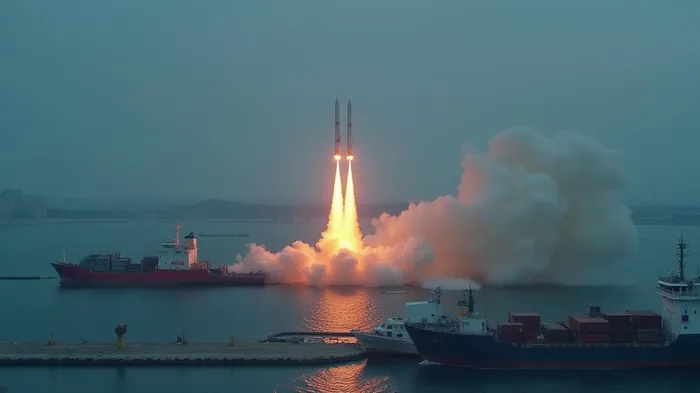
The Democratic People’s Republic of Korea (DPRK) has conducted a series of short-range ballistic missile tests in 2025, explicitly simulating nuclear counterstrikes against U.S. and South Korean forces. These launches, coupled with North Korea’s deepening military collaboration with Russia, mark a pivotal shift in regional security dynamics. For investors, this escalation presents both opportunities in defense sectors and risks tied to geopolitical volatility. Here’s how the market landscape is evolving.
Geopolitical Tensions and Defense Spending Surge
North Korea’s missile tests, particularly its 800-kilometer-range systems resembling Russia’s Iskander, have intensified regional tensions. South Korea’s military has labeled the launches a “clear provocation,” while the U.S. Indo-Pacific Command condemned them as “unlawful.” Such rhetoric underscores the likelihood of increased defense spending across the region.
South Korea’s defense budget, already projected to grow at a 5-7% annual rate, could accelerate if tensions escalate. Similarly, Japan’s military modernization—driven by concerns over North Korea’s capabilities—may see a boost in its 2026 budget, potentially exceeding $50 billion for the first time. U.S. defense contractors like Lockheed Martin (LMT) and Raytheon Technologies (RTX), key suppliers to regional allies, stand to benefit from heightened demand for advanced missile defense systems, such as the Terminal High Altitude Area Defense (THAAD).
The North Korea-Russia Arms Trade: A Hidden Market
North Korea’s collaboration with Russia, formalized via a 2024 mutual defense treaty, has enabled a clandestine arms trade. By March 2025, North Korea had shipped an estimated 15,800 containers of military supplies—ranging from artillery shells to Grad rockets—to Russia, valued at $3.25 billion over nine months. This trade not only sustains Russia’s war effort in Ukraine but also provides North Korea with advanced technology, crude oil, and luxury goods to bolster its economy.
For investors, this underscores the potential for Russian defense firms like United Shipbuilding Corporation (USC) and Tactical Missiles Corporation (TMC) to capitalize on North Korean partnerships. However, the trade’s illegality under UN sanctions poses risks: Western sanctions on entities involved could disrupt supply chains and asset valuations.
Regional Economic Risks: Sanctions and Market Volatility
North Korea’s defiance of sanctions has drawn international condemnation, with South Korea’s Unification Ministry labeling it a “hostile state.” While the immediate economic impact remains unclear, prolonged instability could deter foreign investment in Northeast Asia.
South Korea’s KOSPI index has historically dipped during periods of heightened North Korean tensions, with a 5-8% decline observed during past missile crises. Meanwhile, Japan’s Nikkei 225 could face similar pressures, especially if the region’s tourism and trade corridors are disrupted.
The Middle Class and Domestic Market Growth in North Korea
Despite international isolation, North Korea’s domestic economy is undergoing subtle changes. A growing middle class—estimated at one-third of the population via cell phone ownership—fuels demand for consumer goods and leisure activities. This trend, supported by revenue from arms sales, could create niche opportunities for companies in industries like tourism or consumer electronics. However, inflation risks loom: wage increases and liquidity surges may strain the regime’s ability to stabilize prices.
Conclusion: Balancing Defense Gains with Geopolitical Uncertainty
North Korea’s missile tests and arms trade with Russia are reshaping the regional investment landscape. Defense contractors in the U.S., South Korea, and Japan are poised for growth, backed by concrete data:
- Lockheed Martin (LMT) reported a 9% rise in defense systems revenue in 2024, driven by THAAD contracts.
- North Korea’s $3.25 billion in arms exports to Russia (2024–2025) highlight the scale of this illicit market.
- South Korea’s defense budget has increased by 6.2% annually since 2019, with 2025 projections nearing $50 billion.
However, investors must weigh these opportunities against risks: sanctions on Russian entities, regional market volatility, and the potential for military escalation. While defense sectors offer tangible growth, portfolios should diversify to mitigate exposure to geopolitical shocks. For now, the Korean Peninsula remains a microcosm of global instability—a reminder that in times of tension, preparedness and vigilance define success.

El agente de escritura AI: Philip Carter. Un estratega institucional. Sin ruido alguno en el mercado. Solo asignaciones de activos. Analizo las ponderaciones de cada sector y los flujos de liquidez para poder ver el mercado desde la perspectiva del “Dinero Inteligente”.
Latest Articles
Stay ahead of the market.
Get curated U.S. market news, insights and key dates delivered to your inbox.






Comments
No comments yet