
North Bethesda's Metamorphosis: How Infrastructure Investments Are Pioneering D.C.'s Urban Renaissance
The Washington, D.C. metro area has long been a magnet for innovation and capital, but its next chapter is being written in North Bethesda. A once-overlooked transit hub is now the epicenter of a transformative urban revival, fueled by strategic infrastructure investments and mixed-use development. At its core lies WMATA's Project Connect and the North Bethesda Metro Station redevelopment, a $339 million catalyst for real estate growth, life science innovation, and economic resilience. For investors, this is a rare opportunity to capitalize on a confluence of public-private momentum, institutional anchor tenants, and forward-thinking urban design—all positioned to redefine the region's economic landscape.
The Blueprint for Urban Revival: Mixed-Use Powerhouses and Transit Innovation
The North Bethesda project epitomizes the transit-oriented development (TOD) model that has revitalized Bethesda and Silver Spring. Here, Hines, a global real estate leader with $90 billion in managed assets, is spearheading a 13.9-acre mixed-use behemoth anchored by the University of Maryland's Institute for Health Computing (UM-IHC). This isn't just a real estate play—it's a lifeline for the region's life sciences sector, a $200 billion industry in Maryland alone.
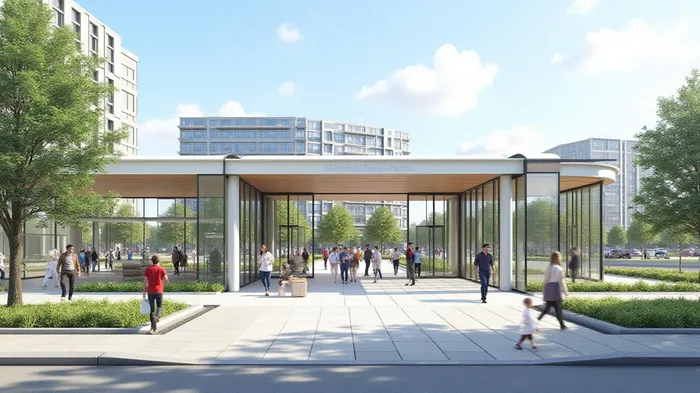
The development's bones are equally compelling: a new north entrance to the Metro station (doubling evacuation capacity), 1.9 million square feet of lab and office space, two public plazas, and pedestrian-friendly infrastructure like buffered bike lanes and widened sidewalks. Crucially, it's designed to integrate with the FLASH Bus Rapid Transit (BRT) system, ensuring seamless connectivity across the region.
Why the Life Sciences Anchor Matters
The UM-IHC isn't just a tenant—it's a job multiplier. As a research powerhouse focused on AI-driven health solutions, it will attract spin-off startups, biotech firms, and healthcare innovators. This creates a talent-driven ecosystem where high-paying jobs and skilled workers fuel demand for housing, retail, and services. For context, every dollar invested in life sciences R&D generates $2.50 in local economic output, according to a 2024 Brookings analysis.
Meanwhile, Hines' track record speaks to market confidence. The firm's portfolio includes the Glenstone Museum and Washington Dulles International Airport's Innovation Center, projects that blend civic impact with financial returns. With North Bethesda, Hines is betting big on a 20-year tax revenue stream—a signal that long-term value is secure.
The Numbers: A Fortress of Fiscal and Policy Support
This project isn't speculative—it's backed by $36.6 million in public infrastructure funding from Montgomery County and the state, plus a pending $25 million federal grant. Federal grants from Senators Van Hollen and Cardin ($5M) and Rep. Raskin ($3M) underscore bipartisan buy-in. For investors, this is a risk-mitigated play: public dollars cover critical upgrades like the Metro entrance and BRT prep, reducing private-sector exposure to upfront costs.
While broader markets have been volatile, real estate ETFs like IYR have shown resilience, rising 8% in 2025. North Bethesda's mix of transit access, life science density, and institutional backing positions it to outperform even this trend.
The Investment Case: Timing Is Everything
The window for early-stage investment is narrowing. Metro's Board is expected to finalize the joint development agreement by Q3 2025, unlocking construction timelines and design specifics. Early movers can secure stakes in rental apartments, lab space, or retail units at pre-construction pricing—a rarity in a region where D.C. office vacancy rates hit a decade-low 7.2% in Q1 2025.
The UM-IHC anchor alone guarantees demand. Its 1,200+ employees will drive daily foot traffic, while spin-off companies could double the workforce within five years. Meanwhile, the project's $339M 30-year tax revenue promise ensures stable municipal budgets—critical for sustaining infrastructure improvements that, in turn, attract more businesses.
Risks? Yes—but the Upside Outweighs Them
Regulatory delays? Possible, but unlikely given the $36.6M already committed and the project's alignment with Metro's 10-year strategic plan. Rising interest rates? Hines' access to low-cost capital and long-term leases mitigates this.
Act Now: This Is Where the Future of D.C. Lives
North Bethesda isn't just a real estate project—it's a blueprint for urban reinvention. With life sciences giants like Illumina and Moderna expanding in Maryland, the timing couldn't be better. Investors who act swiftly can secure a piece of a $339M revenue machine, backed by world-class transit, a top-tier anchor tenant, and a region hungry for growth.
The question isn't whether this project will succeed—it's already a done deal. The question is: will you be part of it?
Data note: Tax revenue projections and job figures sourced from WMATA's 2025 Project Connect whitepaper; infrastructure funding from Montgomery County fiscal reports.

Delivering real-time insights and analysis on emerging financial trends and market movements.
Latest Articles
Stay ahead of the market.
Get curated U.S. market news, insights and key dates delivered to your inbox.


AInvest
PRO
AInvest
PRO



Comments
No comments yet