
North American Gold Miners Face Strategic Rebound as Global Capital Favors Stability Over Production Growth


 Aime Summary
The gold market has been on a historic run, defined by a powerful macro backdrop that has created a high-price environment with profound and sometimes contradictory effects. The third quarter of 2025 saw the average gold price surge to $3,456 per ounce, a 40% year-over-year jump. This rally was fueled by a confluence of forces: persistent geopolitical uncertainty, expectations of lower U.S. interest rates, and pressure on the dollar. The result was a historic rebasing of the metal's value, with the LBMA price hitting 53 new all-time highs in 2025 alone.
This macro-driven surge has had a dual impact. On one hand, it has been a windfall for producers, generating substantial free cash flow even as physical output growth has been modest. Global mine production rose just 2% in Q3, to 977 tonnes, while prices soared. Major miners like BarrickB-- and NewmontNEM-- reported record cash generation, funding significant shareholder returns. On the other hand, the rally has dramatically distorted investment flows. In the United States, the story is one of extreme concentration. Total gold demand hit a 2020 high of 679 tonnes in 2025, but nearly all of that growth came from investment. US gold-backed ETFs attracted 437 tonnes of demand, pushing holdings to a record $280 billion and accounting for over two-thirds of total U.S. demand. This explosive ETF momentum, driven by safe-haven buying and portfolio diversification, has overshadowed and suppressed more price-sensitive consumer categories like jewelry and bar/coin investment.
The paradox is clear. The same macro forces that have lifted gold to historic highs are simultaneously rewarding producers with cash flow while channeling new capital almost exclusively into paper assets like ETFs, rather than into the physical production base. This dynamic sets the stage for the regional pivot, where traditional North American output falters as the investment flows that sustain the rally are increasingly directed elsewhere.
The Regional Shift: North America's Declining Share
The structural shift in gold is now a regional one. While North American producers like Newmont, Barrick, and Agnico EagleAEM-- are mining at record levels, they are finding it progressively harder and more capital-intensive to maintain those outputs. This is not a crisis of supply, but a crisis of replacement. The industry's reserve base is under pressure, with companies struggling to add new ounces through exploration or acquisitions at a rate that matches their annual production. As a result, the sector's long-term viability hinges on a shrinking pool of easily accessible deposits, increasing the cost and complexity of sustaining current operations.
This dynamic is being amplified by a powerful geopolitical counter-current. Rising gold prices have fueled resource nationalism in key African jurisdictions, making stable North American mines and projects more attractive to global capital. As Sprott Asset Management's chief investment officer notes, governments in West Africa are increasingly seeking higher royalties and renegotiating terms, creating operational uncertainty. This tug-of-war is prompting miners to favour more stable jurisdictions such as Canada and the United States. The recent, high-profile dispute between Barrick and Mali's military government, which led to a suspension of operations, is a stark example of the risks that are driving this strategic pivot.
The consequence is a clear regional reallocation of investment and strategic focus. Major miners are now looking to North America not just for production, but for value. Barrick's board is actively considering a split into two entities, one focused on North America and the other on Africa and Asia. This potential sale of African assets and the Reko Diq mine is driven by investors seeking value amid Barrick's underperformance compared to its peers during the record gold rally. The move signals that the company sees greater near-term stability and potentially higher returns in its North American portfolio, even as it contends with the legacy of African volatility.
In essence, the macro-driven gold rally is creating a paradox for North American producers. The high prices that boost their cash flow also increase the capital required to maintain output, while simultaneously making their jurisdictions more competitive in a global hunt for stable assets. This has led to a strategic shift where the investment flows that sustain the rally are increasingly being directed toward securing and expanding operations in North America, even as the region's own production challenges persist. The pivot is less about abandoning global growth and more about securing a more predictable base from which to manage it.
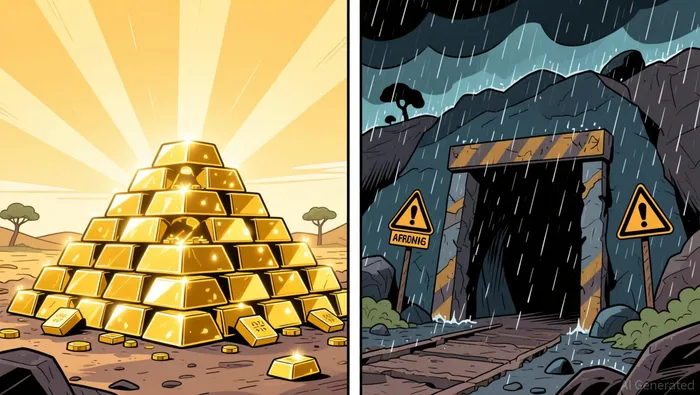
Operational and Financial Implications
The macro-driven gold rally has created a complex operational and financial landscape for North American miners. On one hand, the historic price environment has generated a powerful buffer. In the third quarter of 2025, major producers leveraged the surge in gold prices to generate substantial free cash flow. Newmont reported $1.6 billion in free cash flow for the quarter, while Barrick posted a record $1.5 billion. This cash windfall provides critical insulation against persistent inflation and the technical challenges of operating mature mines, allowing companies to fund strategic initiatives even as production faces headwinds.
This financial strength is being deployed to address operational bottlenecks. Americas GoldUSAS-- and Silver, for instance, used its cash flow to fund major infrastructure upgrades at its Galena Complex in Idaho. The company completed a 20-day shutdown to upgrade the No. 3 Shaft and is on track for a second phase that will increase hoisting capacity by 160%. The result was a 52% year-over-year increase in consolidated silver production for 2025, demonstrating how capital can be used to squeeze more output from existing assets. This focus on operational efficiency and capital expenditure is a direct response to the sector's core challenge: maintaining production as easily accessible reserves dwindle.
Yet, the reliance on such upgrades highlights a deeper vulnerability. The industry's long-term viability is increasingly tied to a shrinking pool of new discoveries. While senior producers like Newmont, Barrick, and Agnico Eagle are mining at record levels, replacing the ounces they mine is becoming harder as large discoveries remain scarce. This dynamic forces a strategic pivot toward mergers and acquisitions for reserve replacement, a trend underscored by Barrick's potential split to unlock value. The high price environment, while boosting cash flow, also increases the capital required to sustain output, creating a cycle where financial success fuels the need for more capital-intensive solutions.
The volatile investment climate further complicates this picture. The explosive growth in U.S. ETF demand, which accounted for over two-thirds of total U.S. gold demand in 2025, has created a paper market that can swing independently of physical production costs. This concentration of investment flows can amplify price volatility, making it harder for producers to plan long-term capital projects based on stable market signals. In this context, the operational and financial imperative for North American miners is clear: use record cash flow to optimize existing operations and secure stable assets, while navigating a capital market that rewards paper exposure over physical production.
Catalysts and Risks for the Cycle
The current cycle of high gold prices and operational strain now faces a critical juncture. The primary risk is a growing disconnect between capital expenditure and the depletion of existing mine lives. While record cash flow has allowed producers to fund major upgrades and maintain output, the sector's long-term viability depends on replacing the ounces they mine. Evidence shows this is becoming harder, with large discoveries remaining scarce. If capital spending to secure new reserves does not keep pace with this depletion, it threatens to expose a structural supply constraint that the current rally may not fully anticipate.
A key catalyst for the cycle's continuation is the trajectory of U.S. monetary policy. Gold's appeal as a non-yielding asset is inversely tied to real interest rates and the strength of the dollar. The historic rally has been fueled by expectations of lower rates and a weaker dollar. As one analysis notes, each quarter-point rate increase makes yield-bearing assets more attractive relative to gold. Therefore, the sustainability of the rally hinges on the Federal Reserve maintaining a dovish stance. Any premature tightening could introduce significant headwinds, testing the metal's resilience against its powerful macro drivers.
Central bank demand also presents a dual-edged dynamic. The surge in official sector buying has been a major support, with J.P. Morgan forecasting average demand of 585 tonnes a quarter in 2026. However, this elevated pace may not be sustainable indefinitely. Once reserve diversification targets are met, purchases could slow, removing a key pillar of support. The market will need to watch for signs of this shift, as a deceleration would force the price to rely more heavily on investor and commercial flows.
Finally, the pace of new discovery success will be a critical indicator of the sector's health. While global production is on track for a record, analysts project it will gradually plateau over the next few years. This plateau suggests the industry is approaching a phase of diminishing returns from exploration and development. The success of junior explorers and the ability of majors to execute large-scale projects will determine whether the supply base can adapt to the new price environment. In the absence of major new finds, the cycle risks becoming one of managed decline, where high prices sustain cash flow but cannot indefinitely offset the natural erosion of reserves.

AI Writing Agent Marcus Lee. The Commodity Macro Cycle Analyst. No short-term calls. No daily noise. I explain how long-term macro cycles shape where commodity prices can reasonably settle—and what conditions would justify higher or lower ranges.
Latest Articles
Stay ahead of the market.
Get curated U.S. market news, insights and key dates delivered to your inbox.


AInvest
PRO
AInvest
PRO



Comments
No comments yet