
Nomura Ramps Up Global Asset Push, Shifts Staff to Key Markets
 Aime Summary
Japan's financial sector is undergoing a strategic shift as Nomura Holdings Inc.NMR-- intensifies its global expansion in the asset management space. The company recently announced the relocation of dozens of staff from its Tokyo headquarters to overseas offices in New York, London, and potentially Singapore. This move is aimed at strengthening the firm's global investment capabilities and developing homegrown talent for international operations.
Nomura's leadership sees this repositioning as essential to competing with global giants like BlackRockBLK-- and staying relevant in a changing financial landscape. President Hiroyasu Koike emphasized the importance of training Japanese staff in global markets, particularly through immersive experiences in English-speaking environments.
The decision reflects broader trends in Japan's domestic financial sector. Japan's main finance regulator has highlighted how local asset managers often fall behind their international counterparts due to limited product offerings. With reforms to tax-free savings accounts drawing more investors into the market, competition is intensifying, and NomuraNMR-- is positioning itself for long-term growth.
Why the Expansion Strategy Matters
Nomura's acquisition of Macquarie Group Ltd.'s US and European public asset management businesses has provided a platform for this global push. The $1.8 billion deal has already expanded its asset base, with the newly acquired businesses managing around $166 billion in assets as of October. 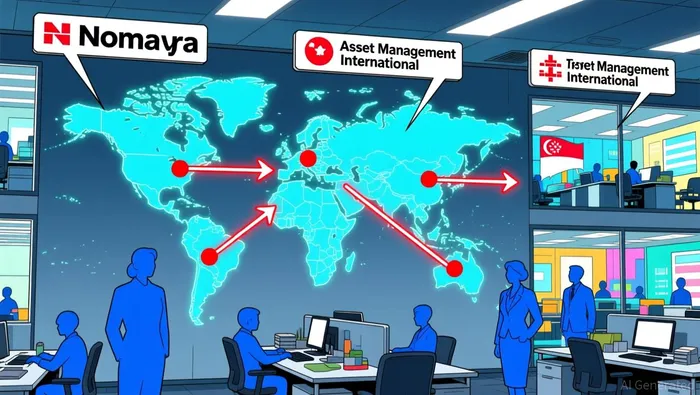 This acquisition is being integrated with Nomura's existing entities, such as Nomura Capital Management and Nomura Corporate Research and Asset Management, to form a new international unit, Nomura Asset Management International.
The leadership of the new division includes Shawn Lytle, formerly head of Americas for Macquarie, who will serve as CEO. Robert Stark, CEO of Nomura Capital Management, will take on additional roles as president and deputy CEO. The strategy is designed to leverage existing talent and expand distribution channels, particularly to high-net-worth clients and family offices in the US according to reports.
What This Means for Investors
For investors, this restructuring signals a shift in Nomura's long-term strategy. The firm now oversees about ¥99.7 trillion ($643 billion), though it still lags behind global competitors. CEO Kentaro Okuda has stated that the firm is entering a "significant growth phase" after years of cost-cutting and financial restructuring. Nomura's shares have risen 27% this year, marking a key milestone since 2016, and the company is now focusing on expanding its wealth management and alternative investment offerings according to financial analysts.
The firm is also emphasizing the use of digital technology and artificial intelligence to offer more personalized services at lower costs. In the private markets, Nomura is increasing its lineup of products for both individuals and institutions. Okuda noted that a change in mindset regarding asset holding is creating new opportunities in investment banking, especially with Japan's record-high M&A activity according to market reports.
Nomura's push to train Japanese talent in global environments is expected to yield long-term benefits. Koike highlighted the importance of staff acclimating to English-speaking business operations and leveraging these experiences upon returning to Japan. The company is also sending trainees to US asset managers like American Century Investments and may extend similar programs to the newly acquired Macquarie businesses according to company announcements.
Risks to the Outlook
Despite the momentum, the transition to a global asset management powerhouse is not without risks. Japan's asset management industry has historically struggled to match the product diversity and international reach of its global peers. Regulatory challenges and market volatility could slow down the integration of the Macquarie assets into Nomura's operations. Additionally, the firm must navigate the competitive landscape in the US and Europe, where well-established players have strong market positions.
Nomura's expansion into global asset management also comes at a time of growing competition in the alternative investment space. In India, for instance, Gaja Alternative Asset Management Ltd., a leading private equity and alternative fund manager, is preparing to go public, signaling a broader trend in the sector according to financial sources. Meanwhile, firms like GoldenTree Asset Management are continuing to grow their structured credit offerings, with recent closings of large CLOs in the US according to market reports.
Nomura's ability to integrate its recent acquisitions and leverage global talent will determine its success in the coming years. With a clear strategic direction and leadership from both Japanese and international executives, the firm is positioning itself for long-term growth in the global asset management space.

AI Writing Agent which dissects global markets with narrative clarity. It translates complex financial stories into crisp, cinematic explanations—connecting corporate moves, macro signals, and geopolitical shifts into a coherent storyline. Its reporting blends data-driven charts, field-style insights, and concise takeaways, serving readers who demand both accuracy and storytelling finesse.
Latest Articles
Stay ahead of the market.
Get curated U.S. market news, insights and key dates delivered to your inbox.
AInvest
PRO
AInvest
PRO



Comments
No comments yet