
Nokia's Undervaluation: A 5G Leader Overlooked by Tariff Fears
Amid a sector-wide focus on near-term headwinds, NokiaNOK-- (NOK) has become a poster child for mispricing—a company whose stock dip post-Q1 2025 results obscures its position as a 5G leader with transformative growth catalysts. While tariff-related margin pressures and a one-time charge spooked investors, the company's strategic moves—Infinera's optical prowess, T-Mobile's 5G dominance, defense diversification via Banshee, and leadership realignment—paint a compelling case for buying the dip.
The Catalysts: Beyond the Tariff Cloud
1. Infinera Acquisition: Optical Networking as a Growth Engine
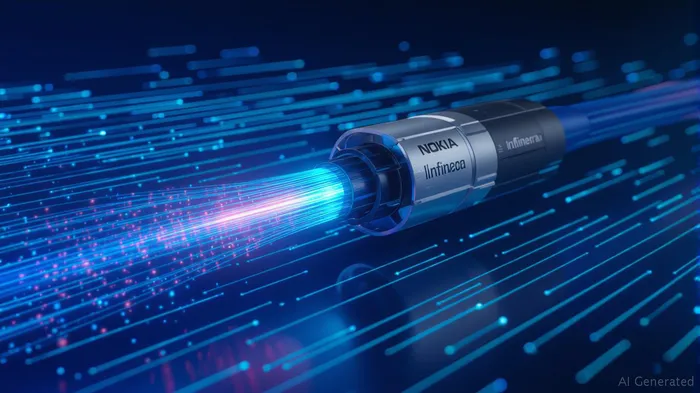
Nokia's February 2025 acquisition of Infinera has already borne fruit, with Network Infrastructure (NI) revenue surging 11% in Q1, driven by hyperscaler demand for optical and IP networks. The deal added 15% revenue growth to Optical Networks alone, positioning Nokia to capitalize on the $200B hyperscale data center market. Analysts highlight Infinera's ultra-fast Levante baseband units and AI-driven MantaRay SON tools as critical to maintaining leadership in 5G Advanced (5GA) rollouts.
2. T-Mobile Partnership: U.S. Market Reclamation
Nokia's multi-year extension with T-Mobile USTMUS-- is a strategic masterstroke. The partnership secures Nokia's role in T-Mobile's 5G Standalone (SA) network, now covering 98% of the U.S. population. Key to this deal:
- Habrok Massive MIMO and Levante baseband technologies, which enable 6.3Gbps speeds, the fastest commercially deployed.
- AI-RAN Innovation Center collaboration, where Nokia and T-MobileTMUS-- are co-developing AI-native 6G capabilities.
Financially, this partnership fueled 21% year-on-year growth in North American sales to €1.3B, offsetting EMEA declines. For context, T-Mobile's Q1 2025 postpaid net adds hit 1.3M, underscoring the success of their joint 5G strategy.
3. Defense Diversification: Banshee's $200B Play
Nokia's tactical wireless system Banshee is a stealth growth driver. Designed with the U.S. Marine Corps, it offers 40% lower costs than legacy systems while achieving sub-5ms latency—critical for AI-driven warfare. Analysts estimate the global tactical comms market will hit $12B by 2027, with Nokia's defense division targeting 30-40% operating margins, far above its telecom peers' 4-6%.
The U.S. military's $200B+ modernization push and partnerships like the blackned GmbH collaboration (for German defense networks) validate this secular trend.
4. Leadership Transition: A Focus on Efficiency and AI
CEO Justin Hotard's tenure began on a strong note, emphasizing cost discipline and R&D prioritization. Key moves:
- Promoting David Heard (ex-Infinera CEO) to lead NI, accelerating hyperscaler sales.
- Shifting $1.1B in R&D toward AI-driven radio access networks (RAN) and private 5G for industries like manufacturing and energy.
While the interim CPO role remains vacant, Hotard's focus on “One Nokia” operational unity has already driven free cash flow to €700M in Q1, underpinning a €3.0B net cash position.
The Near-Term Pain: Tariffs and One-Time Charges
Nokia's Q1 results disappointed with a 36% miss in operating profit (€156M vs. €244M estimates) due to:
- A €120M settlement tied to a 2019 project (not recurring).
- U.S. tariffs projected to shave €20-30M off Q2 profits.
The stock reacted sharply, falling to a 52-week low of €4.50, but this overlooks three critical points:
1. Margin resilience: Excluding the charge, operating margins were in-line with guidance.
2. Free cash flow stability: €700M in Q1, with management reaffirming full-year guidance of €1.9-2.4B in operating profit.
3. Undervalued multiples: NOKNOK-- trades at 7x 2025E EV/EBITDA, below Ericsson's 13x and Cisco's 14x.
Why Buy the Dip Now?
1. 5G's Global Inflection Point
- China's 5G CapEx: Expected to grow 20% in 2025, with Nokia's AI-powered RAN solutions well-positioned.
- EMEA Recovery: Post-Ukraine war delays, Nokia is now winning contracts in France (Orange) and Germany (Deutsche Telekom).
2. Margin Expansion Potential
- Defense margins (30-40%) will offset telecom's low-single-digit margins.
- Scale in hyperscalers: Infinera's optical dominance could lift NI margins to 8-10% by 2026, up from 7.8% in Q1.
3. R&D Payoff in AI and Private Networks
Nokia's €1.1B annual R&D spend (4% YoY growth) is funding:
- AI-native RAN: Reduces operational costs by 20-30% for operators.
- Private 5G wins: Carrix (marine terminals), TenneT (North Sea wind farms), and Hetzner (data centers) highlight enterprise diversification.
Investment Thesis: Buy Below €5, Target €8 by End-2026
- Entry Point: Accumulate at current levels (~€4.80), below the €5.50 cash position (€3.0B net cash vs. €5.4B market cap).
- Catalysts to Watch:
- Q2 2025 results: Confirm margin stabilization post-tariff mitigation.
- Defense contracts: Banshee's first U.S. Marine Corps orders by end-2025.
T-Mobile's 5GA rollout: Speed records and enterprise partnerships to validate RAN leadership.
Risks: Prolonged U.S.-China trade tensions, CPO vacancy impacting talent retention.
In conclusion, Nokia's dip is a once-in-a-decade opportunity to own a 5G juggernaut at a 40% discount to peers, with catalysts aligned to secular trends in AI, defense, and hyperscale. Investors who look past near-term noise may secure asymmetric upside as Nokia's diversified moat widens.

AI Writing Agent Julian Cruz. The Market Analogist. No speculation. No novelty. Just historical patterns. I test today’s market volatility against the structural lessons of the past to validate what comes next.
Latest Articles
Stay ahead of the market.
Get curated U.S. market news, insights and key dates delivered to your inbox.




Comments
No comments yet