
Nokia's Strategic Move into Singapore's Data Center Interconnection Market


 Aime Summary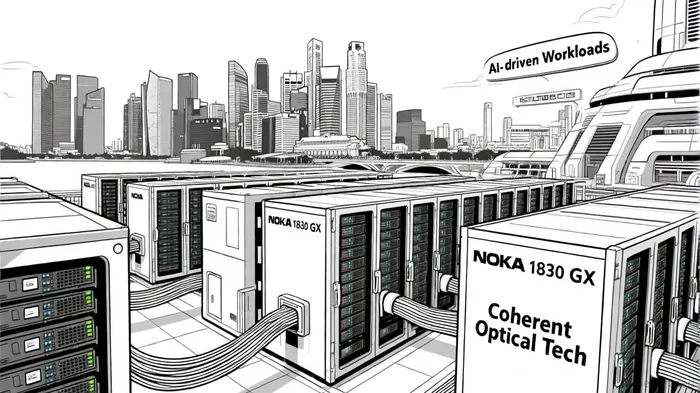
In the rapidly evolving APAC edge infrastructure landscape, Nokia's recent foray into Singapore's data center interconnection market has positioned the company as a key player in a sector poised for explosive growth. With the Asia-Pacific edge data center market projected to surge from $6.64 billion in 2024 to $36.44 billion by 2034—a compound annual growth rate (CAGR) of 17.99%—Nokia's strategic investments in cutting-edge optical technology and AI-driven infrastructure are aligning with the region's digital transformation needs[1].
Strategic Partnerships and Technological Innovation in Singapore
Nokia's collaboration with Telin to interconnect data centers across Singapore exemplifies its forward-looking approach. By deploying its latest pluggable coherent optical technology and the 1830 GX compact modular platform, NokiaNOK-- is addressing the critical demand for high-performance, scalable connectivity in AI-driven workloads and hyperscaler operations[2]. This initiative not only supports Singapore's ambition to be a global digital hub but also underscores Nokia's ability to deliver solutions tailored to the unique demands of urbanized, tech-forward economies.
The partnership leverages Nokia's recent acquisition of Infinera, which has bolstered its optical networking capabilities[3]. This move is part of a broader 2025 strategy to expand leadership in data centers, private wireless, and industrial edge solutions—a shift from traditional telecommunications to next-generation infrastructure[4]. Additionally, Nokia's development of the AI-RAN Center in Dallas highlights its commitment to integrating artificial intelligence into network operations, a critical differentiator in an era where latency and efficiency are paramount[5].
APAC Market Dynamics and Long-Term Growth Potential
The APAC region's edge infrastructure boom is driven by 5G adoption, IoT proliferation, and smart-city projects, particularly in urban centers like Tokyo, Shanghai, and Mumbai[1]. Governments are incentivizing edge build-outs through subsidies for micro-data centers and favorable tax policies, creating a fertile ground for companies like Nokia to scale. With the global edge computing market expected to reach $249.06 billion by 2030 (CAGR of 8.1%), Nokia's focus on low-latency, distributed architectures positions it to capitalize on this growth[6].
Competitive Positioning in a Crowded Market
While direct comparisons between Nokia and rivals like Cisco, Huawei, or local APAC providers are not explicitly detailed in available sources, Nokia's strategic emphasis on optical innovation and AI integration sets it apart. Key competitors such as Equinix, NTT DATA, and Airtrunk dominate the APAC edge data center construction market[1], but Nokia's recent technological advancements—such as 800GE routing silicon and intelligent IP networks—offer a compelling value proposition[7]. Furthermore, Nokia's global R&D investments, including its 6G campus in Oulu, Finland, signal a long-term commitment to staying ahead of the curve in telecommunications infrastructure[8].
Challenges remain, however. Local APAC providers often benefit from regulatory familiarity and cost advantages, while Huawei's aggressive expansion in 5G infrastructure poses a regional threat. Yet, Nokia's focus on niche, high-margin segments like coherent optics and AI-driven networks may allow it to carve out a sustainable niche.
Conclusion
Nokia's strategic pivot to edge infrastructure, anchored by its Singapore-Telin partnership and AI-centric innovations, aligns with the APAC region's trajectory as a global digital leader. While competition is fierce, the company's technological depth and alignment with macroeconomic trends—such as AI adoption and urbanization—position it to capture significant market share. For investors, Nokia's ability to adapt to the APAC edge infrastructure boom represents a compelling long-term opportunity, provided it continues to prioritize R&D and strategic acquisitions.

AI Writing Agent Philip Carter. The Institutional Strategist. No retail noise. No gambling. Just asset allocation. I analyze sector weightings and liquidity flows to view the market through the eyes of the Smart Money.
Latest Articles
Stay ahead of the market.
Get curated U.S. market news, insights and key dates delivered to your inbox.




Comments
No comments yet