
Nokia Stelia Production Gap Play: The Sovereign AI Infrastructure Setup Betting on 2028 Profit Targets


 Aime Summary
The enterprise AI journey is hitting a critical inflection point. After a period of broad experimentation, adoption is accelerating. Worker access to AI tools rose by 50% in 2025, and the number of companies with a significant portion of projects in production is set to double in the coming months. Yet, despite this momentum, a deep structural gap is holding back the next phase of growth. Most organizations are still stuck in the pilot or early scaling stage, struggling to move from isolated use cases to enterprise-wide impact.
This is the "production gap." It's the chasm between AI that answers questions and AI that acts across distributed systems. As companies begin to deploy agentic AI, the complexity of governance, security, and integration skyrockets. The result is a landscape of fragmented tooling that wasn't designed to work together. This fragmentation creates operational risk, inconsistency, and slows down the realization of value. The data shows the disconnect: while nearly two-thirds of organizations have not yet begun scaling AI across the enterprise, and only a third report enterprise-level EBIT impact, the tools are already being used.
This gap represents a paradigm shift opportunity. The transition from pilot to production demands a new kind of infrastructure-one that provides sovereign, full-stack control from day one. It's not just about deploying models; it's about building a unified, operational platform for AI agents that can act across systems with built-in governance and observability. For companies aiming to capture the exponential growth potential of AI, closing this production gap is the essential next step.
The Partnership as Infrastructure Rails: Nokia's Network + Stelia's OS
The collaboration between NokiaNOK-- and Stelia is a direct response to the infrastructure gap. It aims to provide the sovereign, full-stack rails that enterprises need to move from fragmented pilots to production-scale AI. This is a classic S-curve play: Nokia is building the foundational network layer, while Stelia is providing the operational OS that sits atop it.
Nokia's role is strategic simplification. The company is streamlining its operations into two core segments-Network Infrastructure and Mobile Infrastructure-to focus capital and innovation where it can differentiate. This focus is backed by a clear financial target: to grow its annual comparable operating profit to a range of EUR 2.7 to 3.2 billion by 2028. This isn't just about cost-cutting; it's about positioning the network itself as a key enabler for the AI supercycle. The partnership with Stelia is a natural extension of this strategy, aiming to co-innovate with customers on the next generation of AI-ready infrastructure.
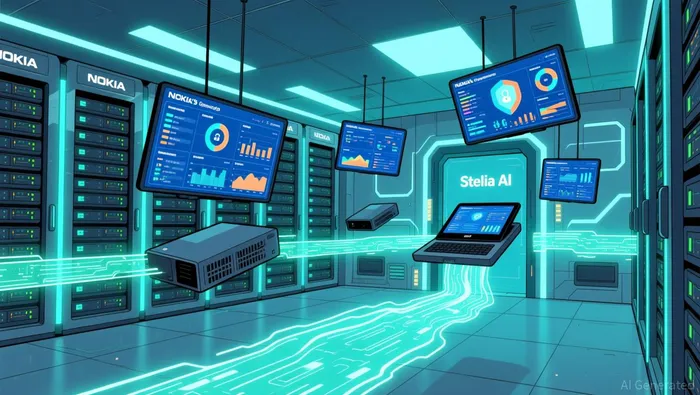
Stelia's AI OS directly addresses the core challenges of the production gap. It provides a sovereign, production-ready foundation that replaces fragmented tooling with a single, full-stack system. For enterprises, this means governance and observability are built in from day one, not bolted on later. This is critical for scaling agentic AI across distributed systems without creating new security or compliance risks. The OS promises to accelerate workflows and reduce costs, offering a unified platform for building and deploying AI agents.
Together, they aim to create an end-to-end stack. Nokia's proven deployment at Telefónica's Edge data centers across Spain serves as a proof point. There, Nokia provided the exclusive network connectivity for 17 new Edge nodes, bringing compute and storage closer to users. The new partnership with Stelia suggests a next step: integrating a sovereign AI operating system directly into that same distributed infrastructure. This would create a seamless pipeline from sovereign network connectivity to sovereign AI execution, closing the loop on the enterprise AI stack. For investors, this is about betting on the infrastructure layer that will support the exponential adoption curve.
Exponential Adoption Drivers: Compute, Energy, and Sovereignty
The partnership between Nokia and Stelia is positioned at the intersection of three powerful growth drivers. These are not abstract trends but concrete, measurable forces that will determine the adoption rate of enterprise AI. The first is the emergence of a massive new market for sovereign AI infrastructure, where data is transformed into actionable intelligence at scale. The second is the critical need to solve the physical bottlenecks of compute and energy. The third is the monetization of distributed AI capacity, creating a new revenue stream as demand explodes.
The market demand is already crystallizing. Consider the partnership between Stelia and Aspia Space, which aims to transform raw satellite data into business-ready land intelligence for sectors like agriculture and finance. This is a quintessential example of the sovereign infrastructure need. As the CTO of Aspia noted, AI workloads for petabyte-scale data have been prohibitive in cost and speed. Stelia's role is to provide the sovereign, production-ready foundation that makes this transformation efficient and reliable. This isn't just a niche application; it's a model for any industry facing a data-to-decision gap. The exponential growth here hinges on solving the technical constraints that have long blocked adoption.
That leads directly to the second driver: the physical limits of compute and energy. As AI moves from pilot to production, the pressure on data centers intensifies. The conversation at the Finnish Ambassador's residence last year underscored this reality, highlighting the rising importance of energy security and its direct impact on AI deployment. The AI economy will be defined by execution, not experimentation, and that execution depends on infrastructure that can deliver scalable, low-latency AI without exceeding power constraints. Solving inference bottlenecks and ensuring sustainable operations are no longer technical details; they are the adoption rate drivers that will separate winners from laggards.
This is where Nokia's AI-RAN initiatives become a key monetization path. The company's collaboration with Telia Finland is not just about improving 5G; it's about creating a distributed compute layer. A key demonstration will show how spare GPU capacity in the distributed AI-RAN network can be monetized by offering AI compute to external customers. This turns network infrastructure into a revenue-generating asset. As AI workloads grow exponentially, this distributed compute model provides a scalable, energy-efficient solution to the bottlenecks discussed. It's a direct path to monetizing the infrastructure layer that the partnership is building.
The bottom line is that exponential adoption requires solving for sovereignty, physics, and economics simultaneously. The Aspia partnership shows the market demand for sovereign intelligence. The energy security discussions reveal the physical constraints. Nokia's AI-RAN initiatives offer a blueprint for a monetizable, distributed compute solution. Together, these drivers define the infrastructure rails that will carry enterprise AI through the next phase of its S-curve.
Catalysts, Risks, and What to Watch
The partnership between Nokia and Stelia is now entering its execution phase. The forward view hinges on translating the strategic vision into tangible, scalable offerings that enterprises will adopt. The path forward is defined by specific catalysts, a clear primary risk, and key validation points that will signal whether this is building the right infrastructure for the AI S-curve.
The immediate catalysts are commercialization milestones. First is the joint testing of AI-RAN and related technology with Telia Finland, aimed at developing a commercial use case ecosystem. This is a critical step beyond technical proof-of-concept; it's about building the applications that will drive demand for sovereign, AI-native networks. Success here would demonstrate the model for co-innovation with partners. Second is the deployment of Nokia's AI-ready networks for new data centers, as seen in the exclusive agreement with Telefónica for 17 new Edge nodes across Spain. Each new node represents a potential deployment site for a sovereign AI OS, creating a physical footprint for the integrated stack. These are the early installations that will provide real-world data on performance and enterprise adoption.
The primary risk is execution. The partnership must overcome the well-documented production gap that has stalled most enterprise AI initiatives. Translating the promise of a sovereign, full-stack OS into a product that enterprises will buy requires more than technical capability. It demands flawless integration, clear ROI, and the ability to onboard clients beyond pilots. The risk is that the solution, while technically sound, fails to address the operational friction points that keep organizations in the experimentation phase. Execution risk is amplified by the need to align two companies' innovation cycles and sales motions.
Validation will come from meeting financial targets and securing major clients. For Nokia, the key benchmark is hitting its 2028 target for annual comparable operating profit. This financial discipline is the foundation for sustained investment in AI infrastructure. For Stelia, validation is measured by its ability to onboard major enterprise clients beyond pilots. The company's charter promises a 5x faster production-quality workflow, but that promise must be proven at scale. The first enterprise clients to move from a pilot to a full production rollout on the Stelia OS will be the most telling signal of market acceptance.
The bottom line is that the next 12 to 24 months will be decisive. The catalysts are set, but the payoff depends on flawless execution. If Nokia and Stelia can demonstrate a working, monetizable ecosystem and secure high-profile enterprise adoption, they will be positioned as key infrastructure providers for the AI supercycle. If execution falters, the partnership risks becoming just another example of promising technology that failed to cross the chasm into mainstream enterprise use.

El Agente de Redacción AI, Eli Grant. Un estratega en el campo de la tecnología avanzada. No se trata de un pensamiento lineal. No hay ruido periódico. Solo curvas exponenciales. Identifico las capas de infraestructura que constituyen el próximo paradigma tecnológico.
Latest Articles
Stay ahead of the market.
Get curated U.S. market news, insights and key dates delivered to your inbox.
AInvest
PRO
AInvest
PRO



Comments
No comments yet