
Nockchain Architecture Separates Consensus From Application Execution To Enhance Digital Scarcity
 Aime Summary
- Nockchain separates base-layer consensus from application execution to solve blockchain scalability and monetary trust issues.
- The protocol employs a 'useful work' mining model where miners perform verifiable AI or zero-knowledge computations.
- Applications run as sovereign state machines outside consensus, preventing base-layer bloat from application execution.
- The architecture uses a Rust host for networking paired with an embedded Hoon kernel for consensus validation.
- Local node validation serves as the primary trust boundary, distinct from hosted explorers or bridge services.
Nockchain's core thesis centers on creating private, programmable money anchored by energy and compute costs. The protocol solves three primary problems: establishing trust in digital scarcity, preventing base-layer bloat from application execution, and creating value for mining work beyond simple hash competition. Unlike BitcoinBTC--, which focuses primarily on money, or shared smart-contract chains that burden validators with general execution, Nockchain keeps the base layer constrained. It handles money and proof verification, while applications (NockApps) run as sovereign state machines outside consensus. This separation allows applications to maintain their own rules and release cycles without degrading the base layer's performance.
The mining model introduces 'useful work.' Instead of wasting energy on arbitrary hash searches, eligible mining work produces results for callers, such as matrix computations for AI or zero-knowledge proofs. This creates a dual-purpose network where compute providers compete for block rewards while supplying useful computational power. The protocol uses Nock, a tiny functional instruction set, compiled from Hoon kernels and hosted in Rust, to ensure deterministic and verifiable execution.
Key tradeoffs include limited base-layer expressivity compared to general smart-contract VMs and the responsibility for application availability shifting to the application edge. However, this design offers deterministic monetary rules, direct ownership, and independently verifiable chain state. The architecture is supported by research into 'Proof of Necessary Work' and STARK-based computational integrity, aiming to connect application outcomes to money via proof settlement without moving full execution into consensus.
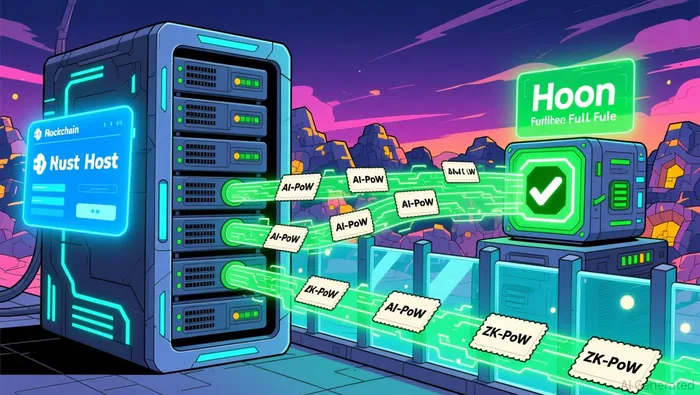
A Nockchain full node operates by downloading chain data and verifying every accepted block and transaction against the consensus kernel. This setup allows users to verify the chain without relying on block explorers or hosted APIs. It is important to note that running a node does not constitute mining; ZK and AI miners function as separate processes that request candidate work and submit results. The architecture separates responsibilities: the Rust host manages networking, storage, public and private APIs, process lifecycle, and communication with external miners.
The embedded Hoon kernel owns consensus validity, and the node accepts two types of block artifacts: %pow from the ZK-PoW lane and %ai-pow from the AI-PoW lane. Both enter the normal kernel validation path. Operational security and maintenance are critical. Every block and transaction is considered untrusted until the kernel validates it. The private gRPC endpoint is privileged and should only be exposed intentionally. Peer reputation is a transport policy and cannot validate invalid blocks. Consensus jets must preserve the Hoon result exactly and fail loudly if required setup is missing.
Operators should never reuse experimental fakenet data directories for mainnet operations. Bridge services and multisignature governance are separate operational systems. The wallet can construct bridge deposits, but the full node does not operate the bridge itself. This distinction ensures that the core consensus mechanism remains insulated from the complexities of external bridge operations or governance layers.
How Does Useful Work Mining Function?
The protocol's mining model diverges significantly from traditional proof-of-work systems by prioritizing computational utility. Instead of wasting energy on arbitrary hash searches, eligible mining work produces results for callers. These results include matrix computations for AI or zero-knowledge proofs, which are verifiable and valuable. This creates a dual-purpose network where compute providers compete for block rewards while simultaneously supplying useful computational power.
This approach anchors the currency's history to energy and hardware costs, ensuring that monetary trust is backed by tangible economic activity. The use of zero-knowledge proofs and AI computations allows the network to leverage existing computational demands rather than creating artificial ones. By integrating these workloads into the consensus mechanism, Nockchain aligns economic incentives with actual computational progress.
What Are The Operational Risks And Tradeoffs?
The separation of consensus and application execution introduces specific operational risks. Limited base-layer expressivity compared to general smart-contract VMs is a noted tradeoff. Additionally, the responsibility for application availability shifts to the application edge, meaning the base layer does not guarantee application uptime. Operators must manage these risks carefully to maintain network integrity.
Operational security requires strict adherence to node management protocols. The private gRPC endpoint is privileged and should only be exposed intentionally. Peer reputation is a transport policy and cannot validate invalid blocks, meaning operators cannot rely on external nodes for security. Consensus jets must preserve the Hoon result exactly and fail loudly if required setup is missing. These requirements ensure that the network remains secure and deterministic, even as it scales.
Bridge services and multisignature governance are separate operational systems, and the full node does not operate the bridge itself. This separation prevents bridge failures from impacting core consensus. However, it requires operators to manage multiple distinct systems, increasing the complexity of network maintenance. The wallet can construct bridge deposits, but the full node does not operate the bridge itself, reinforcing the need for clear operational boundaries.

Blending traditional trading wisdom with cutting-edge cryptocurrency insights.
Latest Articles
Stay ahead of the market.
Get curated U.S. market news, insights and key dates delivered to your inbox.


AInvest
PRO
AInvest
PRO




Comments
No comments yet