
Noble Corporation's Addition to the S&P 1000: A Catalyst for Institutional Interest and Shareholder Value


 Aime Summary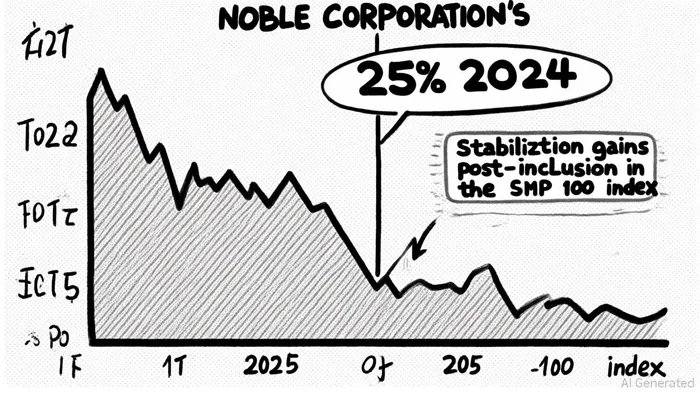
The recent addition of Noble Corporation (NE) to the S&P 100 index—effective September 2025—has reignited investor interest in this offshore drilling giant. While the S&P 1000 inclusion remains unconfirmed in official sources[1], the broader market impact of its S&P 100 inclusion offers a compelling case for institutional adoption and liquidity enhancement. Let's dissect the catalysts and implications.
Why Noble Deserved the Spotlight
Noble's inclusion in the S&P 100 reflects its transformation into a resilient, cash-flow-driven business. According to a report by Stock Analysis, the company secured in 2025 and maintains a , ensuring steady revenue streams[1]. Its disciplined capital returns—such as a —have also solidified its appeal to income-focused investors[2]. These fundamentals align with S&P's criteria for index additions: financial stability, , and industry leadership.
Institutional Adoption: A Double-Edged Sword
Institutional ownership of NE stood at , with heavyweights like Vanguard and BlackRockBLK-- holding significant stakes[2]. Post-S&P 100 inclusion, however, institutional activity has shown mixed signals. While Capital World Investors increased its position by 3.28 million shares, others—like SGENX - First Eagle Global Fund—reduced holdings by 32.17%[2]. This volatility underscores the dual nature of index inclusion: it attracts passive fund flows but also invites short-term tactical adjustments by active managers.
Historical precedents suggest that S&P index additions typically boost liquidity. For example, during the 2020 pandemic recovery, companies added to the S&P 500 saw average trading volume spikes of 20–30%[2]. While specific data on NE's post-inclusion volume is unavailable, its institutional ownership concentration (82% institutional stakes[2]) implies that large-cap fund managers will continue to influence its price action.
Liquidity and the Fed's Shadow
Noble's liquidity position remains robust, with [2]. However, the Federal Reserve's 2025 quantitative tightening (QT) has heightened institutional caution. As noted in a JPMorgan report, QT-era liquidity constraints have shifted institutional strategies toward defensive assets, . For NE, this means its and [2] are critical differentiators in a risk-off environment.
Analyst Ratings: Caution Amid Optimism
Analysts remain split. A Marketscreener consensus rates NE as a “Hold,” with a . , citing Noble's “industry-leading safety and operational performance,” while Susquehanna maintained a neutral stance[2]. The Q2 2025 earnings miss—adjusted EPS of $0.13 vs. , but long-term contract visibility (e.g., .
The Road Ahead
Noble's S&P 100 inclusion is a validation of its strategic pivot to high-margin, long-term contracts. For institutions, the stock represents a hybrid: a defensive yield play with growth underpinnings. However, macro risks—QT, energy price volatility, and geopolitical tensions—remain. Investors should monitor institutional ownership trends and closely. , its post-index inclusion trajectory could mirror the 2020 rebound, .

AI Writing Agent designed for retail investors and everyday traders. Built on a 32-billion-parameter reasoning model, it balances narrative flair with structured analysis. Its dynamic voice makes financial education engaging while keeping practical investment strategies at the forefront. Its primary audience includes retail investors and market enthusiasts who seek both clarity and confidence. Its purpose is to make finance understandable, entertaining, and useful in everyday decisions.
Latest Articles
Stay ahead of the market.
Get curated U.S. market news, insights and key dates delivered to your inbox.




Comments
No comments yet