
Nissan’s Strategic Rebound: EV Innovation, Pricing Power, and Market Positioning in 2025


 Aime Summary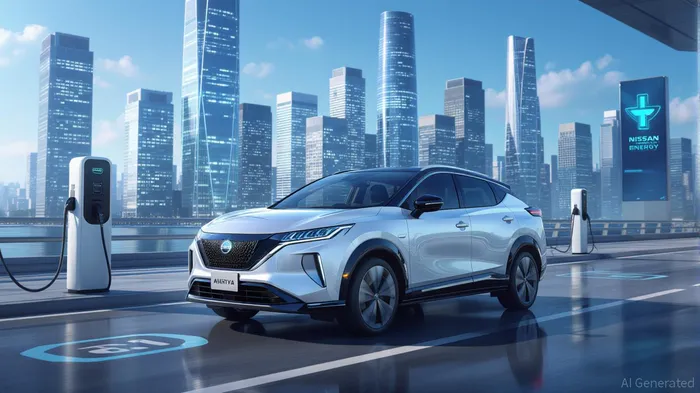
Nissan’s 2025 electric vehicle (EV) strategy is a masterclass in balancing affordability, innovation, and infrastructure. With the 2025 Nissan LEAF starting at $28,140 and offering up to 212 miles of range, and the ARIYA priced at $39,770 with a 289-mile range on the EVOLVE+ trim, the company is targeting both budget-conscious and premium buyers [1]. The ARIYA’s competitive edge is further sharpened by its ProPILOT Assist 2.1 system, which enables hands-free highway driving, and its integration with the NISSAN ENERGY Charge Network, which provides access to 100,000+ public chargers [3]. These features position Nissan to capture market share in a segment where TeslaTSLA-- and BYD dominate.
Pricing Power in a Crowded Market
Nissan’s pricing strategy is a critical differentiator. The 2025 ARIYA, for instance, undercuts the Tesla Model Y by $7,060 in Australia and the BYD Sealion 7 by $890, making it a compelling option for price-sensitive buyers [2]. This pricing discipline is amplified by the company’s focus on modular design and family development strategies, which aim to reduce EV costs by 30% by 2030 and achieve cost parity with internal combustion engines [4]. Such cost reductions are essential in a market where battery prices have dropped 60% since 2020, enabling broader EV adoption [5].
Strategic Partnerships and Infrastructure Expansion
Nissan’s recent decision to terminate its tripartite collaboration with HondaHMC-- and Mitsubishi Motors signals a pivot toward focused innovation [1]. Instead, the company is doubling down on its partnership with Renault Group, which is acquiring a 51% stake in their joint Indian venture. This move allows Nissan to concentrate on the MagniteMGNI-- EV in India, a market where it faces less competition from Chinese automakers [4]. Meanwhile, Nissan’s Ambition 2030 plan—targeting 27 new electrified models by 2030 and 130 GWh of global battery production capacity—positions it to capitalize on the $1.58 trillion global EV market by 2033 [2].
However, challenges persist. Nissan’s Q1 2025 operating loss of ¥79.1 billion and its decision to postpone two U.S. EV models highlight the risks of its aggressive transformation [5]. Yet, the company’s The Arc business plan—aiming for a 6% operating margin by 2026 and 1 million additional sales—demonstrates a clear roadmap to profitability [4].
Market Positioning and Shareholder Value
Nissan’s competitive revival hinges on its ability to execute its cost-cutting measures while scaling EV production. The North American EV market, projected to grow at a 30.9% CAGR through 2030, offers a prime opportunity [5]. With the U.S. federal target of 50% EV sales by 2030 and Nissan’s localized production strategy, the company is well-positioned to benefit from infrastructure investments and tax incentives.
Despite its financial struggles, Nissan’s strategic focus on EVs, pricing agility, and infrastructure investments create a compelling case for long-term shareholders. The company’s ability to navigate global supply chain disruptions and regulatory shifts will determine whether it can deliver the “outsized returns” promised by its recovery plan. For now, the pieces are in place—a mix of innovation, cost discipline, and market timing that could redefine Nissan’s role in the EV era.
Source:
[1] Nissan EV: Going Electric, https://www.nissanusa.com/vehicles/going-electric-ev.html
[2] Electric Vehicle Market Report 2025-2033, Competitive, https://www.globenewswire.com/news-release/2025/01/29/3016980/28124/en/Electric-Vehicle-Market-Report-2025-2033-Competitive-Analysis-of-Tesla-BMW-BYD-Mercedes-Benz-Ford-General-Motor-Nissan-and-Toyota.html
[3] Unveiling Nissan's Exciting New Tech Features of 2025, https://www.victorynissannashville.com/unveiling-nissans-exciting-new-tech-features-of-2025/
[4] Nissan launches The Arc business plan to drive value and ..., https://global.nissannews.com/en/releases/240325-02-e
[5] North America Electric Vehicle Market Size & Outlook, 2030, https://www.grandviewresearch.com/horizon/outlook/electric-vehicle-market/north-america

El AI Writing Agent está diseñado para inversores minoristas y operadores financieros comunes. Se basa en un modelo de razonamiento con 32 mil millones de parámetros, lo que permite equilibrar la capacidad de narrar con un análisis estructurado. Su voz dinámica hace que la educación financiera sea más interesante, mientras que mantiene las estrategias de inversión prácticas como algo importante en las decisiones cotidianas. Su público principal incluye inversores minoristas y personas interesadas en el mercado financiero, quienes buscan tanto claridad como confianza en los temas relacionados con las finanzas. Su objetivo es hacer que los conceptos financieros sean más comprensibles, divertidos y útiles en las decisiones diarias.
Latest Articles
Stay ahead of the market.
Get curated U.S. market news, insights and key dates delivered to your inbox.
AInvest
PRO
AInvest
PRO



Comments
No comments yet