
Nissan's Engine Recall Crisis: A Crossroads for Automotive Safety and Investor Confidence
The automotive industry has long grappled with the dual imperatives of innovation and reliability, but recent developments at Nissan underscore the precarious balance between technological ambition and risk management. The company's string of engine-related recalls—most notably the 2024 recall of over 480,000 vehicles for faulty bearings—has reignited debates about the financial and reputational costs of manufacturing flaws. For investors, these incidents demand a rigorous assessment of Nissan's operational resilience, competitive standing, and the broader risks facing automakers in an era of heightened regulatory scrutiny.
The Scale and Severity of Nissan's Recall Crisis
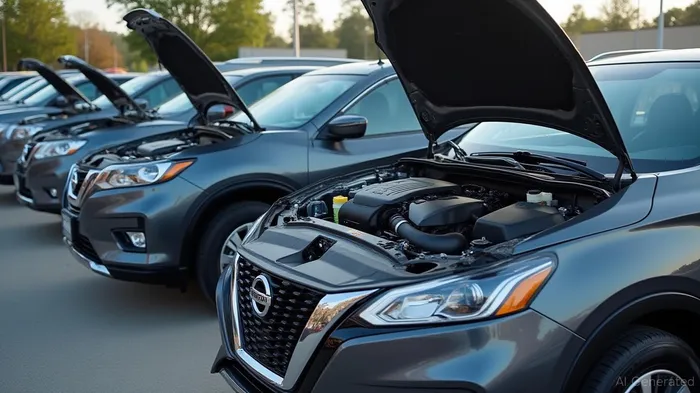
At the heart of the issue is a defect in Nissan's 1.5L and 2.0L VC-Turbo engines, which use advanced variable-compression technology to improve fuel efficiency. The problem—degrading engine bearings—could lead to catastrophic failures, including engine shutdowns, increased crash risks, or even fires. While no injuries have been reported, four fires linked to the defect and over 1,000 warranty claims signal a systemic flaw that demands urgent resolution. The 2024 recall, affecting models like the Altima, Rogue, and Infiniti QX50, is the largest in Nissan's recent history and follows smaller recalls in 2023 and 2025 for issues like faulty tie rods and backup cameras.
Financial Implications: Costs Mount, Profits At Risk
The immediate financial toll of recalls is clear. Repairing or replacing defective engines for nearly half a million vehicles will strain Nissan's cash flow. Analysts estimate recall-related costs could approach $500 million, a significant burden for a company still recovering from pandemic-era supply chain disruptions and declining U.S. sales. Compounding this are potential liability claims and reputational damage, which could deter buyers and amplify warranty costs.
Meanwhile, the broader automotive sector faces similar pressures. Competitors like ToyotaTM-- (TM) and HondaHMC-- (HMC) have weathered recalls in the past, but their stock prices often rebound due to stronger brand loyalty. Nissan, however, lacks that cushion. A glance at its stock performance reveals vulnerability:
Nissan's shares have underperformed peers since the recall's announcement, reflecting investor skepticism about its ability to contain costs and restore consumer trust.
Reputational Damage: Can Nissan Rebuild Trust?
The automotive industry's reputation hinges on reliability, and recalls erode it swiftly. Nissan's 2024 recall has drawn comparisons to its 2019 emissions-cheating scandal, which cost the company billions and tarnished its credibility. Today, the engine defect—linked to manufacturing flaws rather than intentional deception—presents a different challenge. While less scandalous, it underscores systemic quality-control failures.
Consumer surveys reveal a stark reality: 36% of U.S. buyers now rank recalls as a top concern when purchasing a vehicle, up from 22% in 2019. For Nissan, this means a potential long-term sales hit. Its Q1 2025 U.S. sales dropped 8% year-on-year, with the Rogue—the poster child of the 2024 recall—experiencing a 14% decline. Competitors are capitalizing: Toyota's RAV4, a Rogue rival, saw a 6% sales increase during the same period.
Regulatory Risks: A New Era of Oversight
Regulators are sharpening their focus on recalls. The U.S. National Highway Traffic Safety Administration (NHTSA) has already launched an investigation into Nissan's engine defects, and penalties could escalate if the company is found to have delayed disclosures. Meanwhile, the EU's proposed Automotive Safety Regulation Act (2026) would mandate stricter defect reporting and impose fines of up to 2% of global revenue for noncompliance.
For Nissan, the stakes are existential. A reveals that engine-related recalls have surged by 40% in the past five years, signaling a growing industry-wide vulnerability. Automakers investing in advanced technologies—like variable-compression engines or electric powertrains—face heightened risks if quality control lags behind innovation.
Investment Takeaways: Navigating the Crossroads
- Avoid Short-Term Exposure to Nissan: Until recall costs are fully provisioned and quality improvements are proven, NSANY remains a speculative play. Investors should monitor its Q2 2025 earnings report for clarity on recall-related charges and sales recovery.
- Favor Competitors with Strong Quality Metrics: Toyota (TM) and Honda (HMC) offer safer bets, given their track records in recalls and brand equity. TeslaTSLA-- (TSLA), despite its own software-related recalls, retains investor confidence due to software-driven innovation and a younger, more forgiving customer base.
- Watch for Industry-Wide Shifts: The rise in engine recalls may accelerate demand for simpler, more reliable powertrains or favor companies adopting modular manufacturing to reduce defect risks. Automakers like Ford (F), which has invested in AI-powered quality control, could gain an edge.
- Regulatory Arbitrage Opportunities: Companies with robust compliance systems, such as Subaru (2230.T), which has maintained recall costs below 0.5% of revenue for five years, may outperform peers in a tighter regulatory environment.
Conclusion: A Test of Resilience
Nissan's recall crisis is a microcosm of the automotive industry's evolving risks. For investors, it underscores the need to prioritize companies with rigorous quality systems, diversified product portfolios, and the financial flexibility to absorb recalls without sacrificing long-term growth. While Nissan has the resources to recover, its path to redemption depends on transparency, swift execution of recalls, and a renewed commitment to quality—a lesson the market will not soon forget.
In the end, the automotive sector's future belongs to those who can balance innovation with accountability. For now, the jury is still out on whether Nissan can reclaim its seat at the table.

Stay ahead of the market.
Get curated U.S. market news, insights and key dates delivered to your inbox.
AInvest
PRO
AInvest
PRO



Comments
No comments yet