
Nissan's Bold Bet on the Future: Closing Oppama to Rebuild in the EV Era
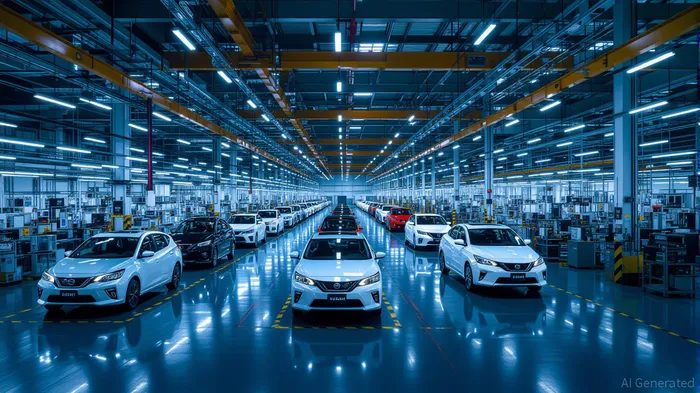
The decision to shutter its iconic Oppama plant—a symbol of Nissan's 64-year manufacturing legacy—marks a pivotal moment in the automaker's quest to survive in an industry undergoing seismic shifts. By moving production to a more modern facility in southwestern Japan, Nissan is betting its future on cost discipline and electric vehicles (EVs). This move, steeped in necessity, reflects broader trends reshaping the automotive sector: the relentless march toward electrification, the scramble to cut costs amid thinning margins, and the existential threat posed by rising global competitors.
The Strategic Shift: Cutting Costs to Compete
Nissan's plan to reduce global production capacity by 30% (from 3.5 million to 2.5 million units) and consolidate 17 plants into 10 is a stark acknowledgment of its financial fragility. A net loss of ¥670.9 billion ($4.5 billion) in fiscal 2024, driven by declining sales in China and the U.S., underscores the urgency. The Oppama plant, operating at just 40% capacity—far below the breakeven threshold of 80%—symbolized the overcapacity that has plagued Japanese automakers for years. By shifting production to Kyushu, Nissan aims to achieve a 100% utilization rate, slashing fixed costs and freeing capital for EV development.
The restructuring also targets a 15% global workforce reduction (20,000 jobs), though the 2,400 workers at Oppama will remain employed until production halts in 2028. This gradual transition, coupled with promises of retraining and transfers, aims to avoid labor strife—a critical consideration in Japan's union-heavy auto industry.
Cost-Cutting in a Costly Industry
The automotive sector's profit margins have been squeezed by rising raw material costs, supply chain disruptions, and the staggering expenses of EV development. Nissan's plan to cut parts complexity by 70% and consolidate platforms from 13 to 7 is a bid to regain control. By focusing on high-margin EVs—which command 15–20% higher gross margins than internal combustion engine vehicles—Nissan hopes to reverse its losses. Its target of a 5–7% operating profit margin by 2027 hinges on this shift.
But cost-cutting alone isn't enough. Competitors like TeslaTSLA-- and Chinese automakers (e.g., BYD, NIO) are racing to dominate EV markets, while legacy automakers like Ford and GM are pouring billions into electrification. Nissan's alliance with Renault and Mitsubishi on battery technology offers a lifeline, but execution will determine its survival.
The EV Transition and Japanese Automakers' Viability
Nissan's legacy as the pioneer of the mass-market EV—the LEAF—hasn't translated into dominance. While Tesla's global market share of EVs tops 20%, Nissan's share has dwindled to single digits. Its new strategy aims to reverse this by doubling EV sales to 40% of global volume by 2030. The Kyushu plant, with its advanced automation and focus on shared platforms, will be central to this push.
However, Japanese automakers face systemic challenges. Their reliance on gas-powered vehicles in saturated markets, inflexible supply chains, and slow adoption of EV tech have left them trailing. ToyotaTM--, for example, has delayed its EV pivot, while HondaHMC-- has struggled with battery shortages. Nissan's move to prioritize Kyushu's efficiency over tradition is a rare admission of the need to modernize.
Risks and Challenges
The Oppama closure carries risks. Locally, the plant's closure could spark political backlash in a region economically tied to Nissan. Globally, the automaker must avoid disruptions during the two-year transition and ensure Kyushu's capacity isn't overburdened. Moreover, EV competition is intensifying: Tesla's new Shanghai plant, BYD's global expansion, and Ford's F-150 Lightning are all vying for market share.
Investment Implications: A High-Risk, High-Reward Gamble
Nissan's restructuring presents a contrarian opportunity for investors willing to bet on a turnaround. Key metrics to watch:
- Margin Improvement: Achieving 5%+ operating margins by 2027 will validate cost-cutting efforts.
- EV Momentum: A surge in EV sales (e.g., a 30%+ annual growth rate) could reposition Nissan as a credible player.
- Execution: Smooth consolidation of plants and labor agreements without delays or strikes.
Recommendation:
- Buy: Consider a gradual accumulation of Nissan stock (ticker: 7201.T) with a stop-loss at 10% below current prices. The stock trades at a P/E ratio of 7.5x, below peers like Toyota (12.3x), suggesting undervaluation if margins improve.
- Caution: Monitor geopolitical risks (e.g., U.S. tariffs) and EV competition. A failure to meet 2026 cost-cutting targets or EV sales goals could trigger a selloff.
Conclusion
Nissan's closure of Oppama is more than a cost-cutting move—it's a last-ditch effort to adapt to an industry no longer defined by gas engines and sprawling factories. The success of Re:Nissan will hinge on whether the automaker can leverage its EV heritage, modernize its operations, and outpace rivals in a market where innovation and efficiency are existential. For investors, it's a gamble on a phoenix rising—or a lesson in the perils of underestimating the speed of change.

Stay ahead of the market.
Get curated U.S. market news, insights and key dates delivered to your inbox.
AInvest
PRO
AInvest
PRO



Comments
No comments yet