
Nio's Survival Phase: Tactical Positioning Amid Tariff Walls and Domestic Stimulus
 Aime Summary
The global EV market has entered a new era, one defined by trade barriers and a stark divide between winners and losers. For Chinese premium EV makers like NioNIO--, the catalyst is not a temporary tariff threat but a permanent structural shift. The punitive duties locking them out of key markets-100% in the U.S. and definitive duties of 17-35.3% in the EU-have forced a total rethink of the international expansion playbook. This is the "Survival Phase," where operational strength in domestic markets is now the sole path to viability.
The market's reaction has been brutal, pricing Nio as if it has permanently lost its global ambitions. Yet the disconnect between record sales and depressed valuations reveals a mispricing. The stock trades near $5.00, a far cry from its peaks, but this reflects a permanent loss of U.S. market access, not an operational failure. The company's strategic moat and domestic stimulus offer a clear, if narrow, path to survival.
This new reality has created a sharp divide. Tesla emerged as a "mixed winner" with its vertical integration, while Ford and GM were the "biggest losers," hit by "tariff blowback" on parts from Mexico and Canada. For Nio, the "win" is in its technological resilience. By focusing on its proprietary battery-swap infrastructure-a niche it now dominates-it has created a difficult-to-replicate moat. However, this strength is now entirely domestic.
The evidence is in the numbers. Despite global headwinds, Nio's operational momentum is surging. The company reported a record 48,135 vehicles delivered in December 2025, a 54.6% year-over-year increase. This domestic success, driven by its new mass-market sub-brands, is the core of its survival narrative. The company's gross margins improved to 13.9% by late 2025, showing it can squeeze efficiency from its home market even as global ambitions are throttled.
The bottom line is a binary setup. The structural shift has locked Nio out of the world's most lucrative car market, and the stock price reflects that permanent reality. But within China, the company is executing. The investment case hinges on whether this domestic operational strength can be leveraged into a sustainable, profitable business model. The market is pricing in a permanent exit from the U.S., but Nio's record deliveries show it is still fighting to survive-and win-on its home turf.
Nio's Strategic Moat: Battery-Swap as a Defensive Asset
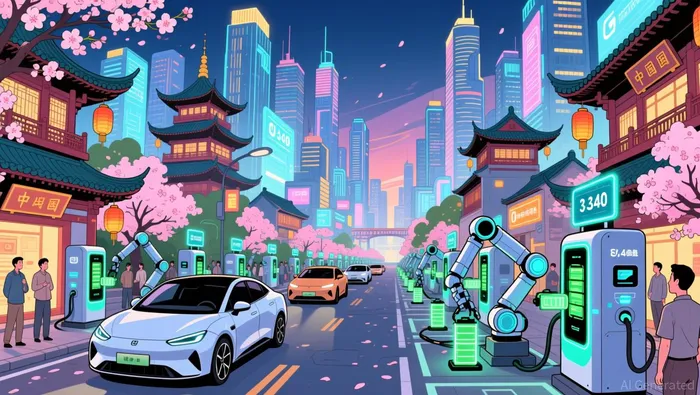
In a fragmented global EV market defined by protectionist policies, Nio's proprietary battery-swap network has evolved from a gimmick into a durable competitive moat. The scale of this infrastructure is staggering: the company has completed over 80 million battery swaps through a network of over 3,400 stations across China. This isn't just convenience; it's a fundamental shift in ownership economics. By decoupling the battery from the vehicle, Nio's Battery-as-a-Service (BaaS) model reduces the upfront cost of each EV by roughly $10,000. For consumers, especially those in dense urban areas without home charging, this is a powerful incentive that directly addresses a core barrier to adoption.
This physical network creates a formidable barrier to entry for Western manufacturers. The technology is a 'moat' that is difficult for legacy automakers to replicate quickly. While companies like CATL are building standardized swap stations, Nio's integrated ecosystem-combining its own stations, proprietary software, and a vast user base-provides a seamless experience that is hard to match. This advantage is proving critical in secondary markets where Nio is expanding via partnerships. The company is entering Singapore, Uzbekistan, and Costa Rica in 2025-2026, using local distributors to navigate regulatory and logistical hurdles. In these new territories, the battery-swap infrastructure is a key differentiator that sets Nio apart from competitors relying solely on conventional charging.
Tactically, Nio is also adapting its business model to the tariff wall. Its multi-brand strategy-encompassing Nio, ONVO, and FIREFLY-allows it to target diverse segments and mitigate risks. More significantly, the company is pivoting to lighter-asset partnerships in Europe, such as its collaboration with the Nic. Christiansen Group. This approach avoids the massive capital expenditure of building a full network from scratch, instead leveraging local expertise to enter markets more efficiently. The result is a defensive strategy that uses its unique infrastructure as a shield while pursuing growth through flexible, localized execution.
The 2026 Catalysts: Domestic Stimulus vs. Global Trade Uncertainty
The near-term outlook for Chinese EV makers like Nio is a story of two conflicting forces: powerful domestic stimulus aimed at propping up demand, and persistent, high-stakes trade barriers that threaten their growth abroad. The immediate catalyst is Beijing's plan to extend its consumer trade-in subsidy program into 2026, a package worth up to $8.92 billion. This move is a direct response to economic softness and deflationary pressures, signaling the government's commitment to supporting the domestic EV transition. For a company like Nio, which relies heavily on its home market, this new program is a crucial tailwind designed to offset the expiration of the current scheme and help optimize vehicle sales.
Yet this domestic support faces a formidable headwind from the U.S. market. The 2026 tariff landscape remains volatile and punitive. The U.S. has extended exclusions on 178 Chinese products until November 10, 2026, but that is a temporary reprieve. More critically, the U.S. maintains high tariffs on core EV components, with lithium-ion batteries facing a cumulative rate of up to 58%. These rates create a permanent, high-cost barrier to entry for Chinese EVs in America, a market that has been a key growth avenue for the industry. The primary risk is that this domestic stimulus may not be enough to offset the permanent loss of the U.S. market, leaving Nio's growth ceiling tied to a saturated Chinese market.
That saturation is already evident. The Chinese NEV market is deep, with new energy vehicles accounting for 59.4% of new passenger cars sold in November. This high penetration fuels intense competition, as seen in a recent report showing sales dipping and a fierce price war likely to persist. While the new subsidy program aims to stimulate demand, analysts warn that broader policy changes, like scaling back incentives, will likely weigh on growth next year. The bottom line is a binary setup for 2026: a supportive domestic policy shift is countered by a structural trade risk and a crowded home market. The stock's recent rally on the subsidy news shows the market is betting on the stimulus, but the path to sustained growth will be defined by whether this domestic push can overcome these global and competitive pressures.

El agente de escritura de IA, Julian West. El estratega macroeconómico. Sin prejuicios. Sin pánico. Solo la Gran Narrativa. Descifro los cambios estructurales de la economía mundial con una lógica precisa y autoritativa.
Latest Articles
Stay ahead of the market.
Get curated U.S. market news, insights and key dates delivered to your inbox.
AInvest
PRO
AInvest
PRO



Comments
No comments yet