
Nio's Stock Collapse: A Cautionary Tale of Capital-Raising Strategies and Eroding Investor Trust in the EV Sector


 Aime Summary
The electric vehicle (EV) sector, once a beacon of unbridled optimism, has become a battleground for survival as companies grapple with razor-thin margins, aggressive price wars, and shifting investor sentiment. Nowhere is this more evident than in the case of NIO Inc.NIO-- (NYSE: NIO), whose stock has plummeted from a 2021 peak of $66.99 to a 2025 price of around $4—a 94% decline. This collapse is not merely a story of poor execution but a reflection of systemic challenges in capital-raising strategies, governance risks, and the fragile valuations of EV sector leaders.
The Deep-Discount Offering: A Desperate Bid for Survival
NIO's recent deep-discount stock offering—though specific terms remain opaque—has drawn sharp scrutiny from investors and analysts. While the company has historically relied on debt and convertible bonds to fund expansion, its latest move signals a shift toward equity dilution to stave off liquidity crises. With cash reserves dwindling from RMB 32.9 billion in late 2023 to RMB 19.4 billion by year-end 2024, NIO's current ratio of 0.84 (a metric indicating short-term obligations exceed liquid assets) has forced the company to prioritize survival over shareholder value.
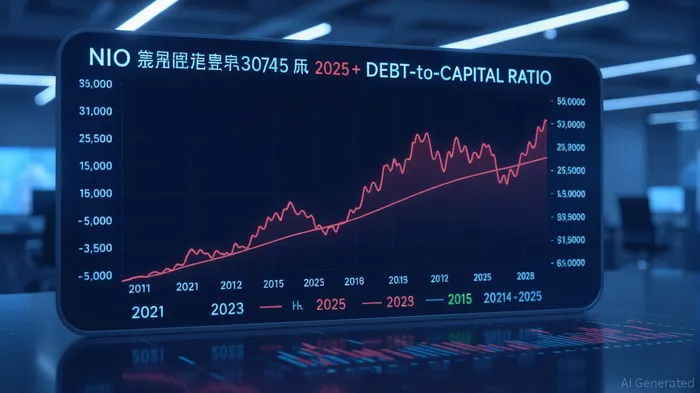
Such offerings, while common in distressed markets, often trigger a death spiral. When a company issues shares at a steep discount to market price, it sends a clear signal of desperation, eroding confidence and further depressing the stock. For NIONIO--, this has compounded existing governance concerns. Its long-term debt-to-capital ratio of 0.76—far above the industry average of 0.27—suggests a reliance on high-risk financing that could backfire if interest rates or market conditions worsen.
Governance and Strategic Overreach: A Recipe for Erosion
NIO's governance issues run deeper than its balance sheet. The company's aggressive expansion into lower-end markets via sub-brands ONVO and FireflyFLY-- has raised red flags. While diversification is a logical strategy in theory, the execution risks are profound. Cannibalization of premium NIO models, brand dilution, and the logistical burden of managing multiple brands with limited resources have strained operations.
Moreover, NIO's delivery targets for 2025—ranging from 63,000 units in Q2 to 120,000–150,000 units in Q4—have been met with skepticism. In April 2025, NIO delivered 23,900 units, lagging behind Li Auto's 33,939 and XPeng's 35,045. This underperformance, coupled with a net loss of $3 billion in 2024, has left investors questioning the feasibility of its growth narrative.
The company's financial engineering—such as its battery swap technology and partnerships with CATL—remains a silver lining. Yet, these innovations are only valuable if NIO can scale production profitably. With SG&A expenses rising due to expanded sales efforts and a bloated headcount, margins remain under pressure.
Sector-Wide Valuation Challenges: A Perfect Storm
NIO's struggles are emblematic of broader EV sector woes. The forward price-to-sales ratio of 0.54 for NIO, compared to 1.1 for Li AutoLI-- and 1.53 for XPengXPEV--, underscores a market that views NIO as a riskier bet. This valuation gap reflects not just financial performance but also governance concerns. Investors are increasingly wary of companies that prioritize aggressive expansion over profitability, especially in a sector where capital expenditures are sky-high.
The EV sector's valuation models have also been upended by macroeconomic realities. Rising interest rates have made debt financing more expensive, while global supply chain disruptions have inflated costs. For NIO, which operates in a hyper-competitive Chinese market, these factors have created a perfect storm. Its 10.2% gross profit margin—a far cry from Tesla's 25%+—highlights the sector's brutal margin compression.
Investor Sentiment and the Path Forward
Analyst sentiment on NIO is deeply divided. While Morgan StanleyMS-- has taken an “Overweight” stance with a $6.10 price target, BarclaysBCS-- and CitiC-- Research have issued “Underweight” ratings, with targets as low as $3.00. This divergence reflects the uncertainty surrounding NIO's ability to execute its 2025 breakeven goals.
For long-term investors, the key question is whether NIO's current valuation represents a value trap or a discounted opportunity. The company's technological edge in battery swaps and autonomous driving could pay off if it achieves scale. However, this hinges on NIO's ability to manage its capital structure prudently and avoid further dilution.
Conclusion: A Test of Resilience
NIO's stock collapse is a cautionary tale for the EV sector. Its deep-discount offering and governance challenges highlight the risks of overreaching in a capital-intensive industry. While the company's innovations remain compelling, its long-term success will depend on disciplined execution, improved profitability, and a renewed focus on shareholder value.
For investors, the lesson is clear: in the EV sector, growth at all costs is no longer a viable strategy. The future belongs to companies that can balance ambition with financial prudence—a challenge NIO must meet if it hopes to regain investor trust.

Stay ahead of the market.
Get curated U.S. market news, insights and key dates delivered to your inbox.
AInvest
PRO
AInvest
PRO



Comments
No comments yet