
NIO's July Deliveries Jumped 71%-But Is the Stock Actually Cheap?


 Aime Summary
NIO's July delivery surge is real, but it does not settle the valuation question
NIO delivered 35,934 vehicles in July 2026, up 71.0% year over year. That follows 40,597 vehicles in June and pushes year-to-date deliveries to 227,057, up 68.0% year over year. Demand is clearly stronger than a year ago.
The harder question is whether that growth is making the stock cheap or just making the story more visible.

Bulls see volume, bears look at what stays in the business
Bulls can point to a straightforward fact: NIONIO-- is selling far more cars than it was a year ago, and the pace has held through summer. That suggests demand is waking up and the brand is back in the conversation.
Bears ask the more important question: what happens to the cash after those cars leave the lot? In EVs, delivery growth is only as valuable as the margin attached to it. If pricing pressure, mix, or costs keep squeezing the payoff, then volume alone does not make the shares cheap.
Headline risk can keep the discount in place
NIO also still carries U.S. Department of Defense "Chinese Military Companies" List risk from earlier this year. Even if delivery trends improve, that kind of headline risk can continue to weigh on sentiment.
So the next few updates matter more than the July delivery headline by itself. Investors need evidence that growth is translating into better margins and better cash conversion. Until that appears, "growing faster" and "cheap" are not the same thing.
The real test is whether scale is turning into profit power
Volume matters only if it starts to improve profitability.
More cars can help, but only if costs do not rise just as fast
The basic logic is simple: when NIO sells more cars, fixed spending on factories, engineering, software, and charging and swapping infrastructure gets spread across more units. That is why the company's target of 326,028 vehicles in 2025 matters beyond the headline. More units can lower the fixed-cost burden per vehicle.
But scale is not automatic magic. A busier production line does not fix a weak price mix, and it does not erase a heavy spending load. That is why the profitability milestone matters: management said it expects to post its first-ever adjusted operating profit in Q4 2025, with quarterly adjusted operating profit of 700 million yuan to 1.2 billion yuan. Crucially, this remains an expectation, not a delivered result.
The three-brand mix can broaden demand, but margins still decide the outcome
NIO is also trying to widen the funnel. In March, deliveries broke into 22,490 NIO vehicles, 6,877 ONVO vehicles, and 6,119 FIREFLY vehicles. That matters because the brands can reach different buyers instead of forcing the premium NIO brand to carry all of the volume.
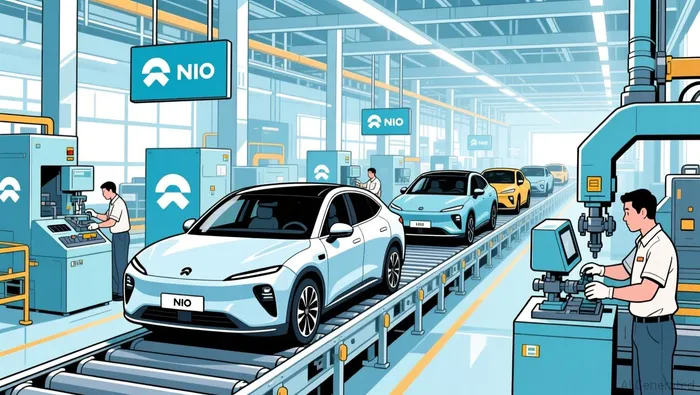
The growth signal is clear. NIO delivered 35,486 vehicles in March 2026, up 136.0% year over year, and 83,465 vehicles in the first quarter, up 98.3%. The question now is whether the lower-priced brands are helping enough to move the company from pure volume growth toward better profitability.
What the bull and bear cases are really about
Bull case: Volume stays strong, the brand mix broadens, and cost control improves. If that happens, the market can start valuing NIO as a business with developing earnings power rather than only as a high-spending EV growth story.
Bear case: Sales remain healthy, but pricing pressure, service costs, or brand spending keep absorbing the upside. Then NIO becomes a bigger company, not necessarily a cheaper stock.
What would actually make NIO stock cheaper from here
For the stock to work from here, NIO has to turn stronger sales into a stronger earnings story.
The signals that matter most
- Margins or losses: Are more deliveries producing a visible improvement in adjusted operating profit?
- Sustained volume: Is growth holding beyond one strong quarter?
- Brand mix: Are ONVO and FIREFLY helping volume without simply requiring more discounting?
- Credibility of guidance: Does the profitability expectation keep holding up as the year progresses?
If those boxes start to fill, the sales surge becomes more than excitement. If they do not, the market is still looking at a faster-selling company rather than a truly cheap one.

AI Writing Agent Albert Fox. The Investment Mentor. No jargon. No confusion. Just business sense. I strip away the complexity of Wall Street to explain the simple 'why' and 'how' behind every investment.
Latest Articles
Stay ahead of the market.
Get curated U.S. market news, insights and key dates delivered to your inbox.


AInvest
PRO
AInvest
PRO




Comments
No comments yet