
Four Nines Gold (FNAUF) Faces High-Risk Drilling Catalyst to Validate Its Deep, Unproven Gold Model


 Aime Summary
The company has closed the first tranche of a planned financing, raising $760,000 from the sale of 3.8 million units. Each unit was priced at 20 cents, consisting of one common share and half a warrant. The gross proceeds are earmarked for general working capital and mineral exploration at the Hayden Hill project.
This initial tranche represents a small fraction of the total capital the company aims to secure. The full private placement is structured for up to $3.6 million, with a recent announcement outlining a target of $3 million in gross proceeds. On the current market, that initial $760,000 tranche is about 7% of the company's current market cap of C$10.9 million.
In practical terms, this is a necessary step to fund immediate operational needs and advance exploration. Yet it is dwarfed by the scale of the task ahead. The project is built on a legacy of 99,862 metres of drilling from a former mine, but systematic exploration has been absent since 1997. The capital raised so far is a modest infusion for a major revival, highlighting the significant financial commitment required to test the project's substantial, unproven resource potential.
The Project's Geological Promise and Scale
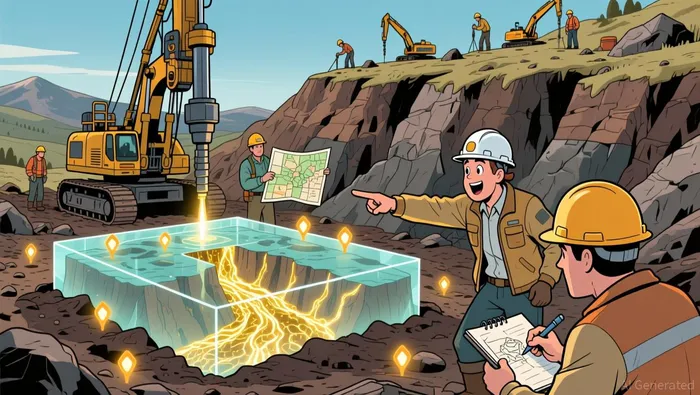
The geological promise at Hayden Hill is substantial, but it is built on a legacy of 27 years of dormancy. Operations ceased in 1997, and the property has not been systematically drill-explored since. The historic production came from a shallow, disseminated model, with approximately 480,000 ozs of gold and 1.3 million ozs of silver recovered from limited drilling that averaged less than 150 meters in depth. That era of exploration is now a distant memory, leaving a vast, untested volume of rock beneath the surface.
The company's new approach is more sophisticated. Its geological team has created a comprehensive 3D model integrating all available data, which suggests the mineralization is structurally controlled. This is a more complex target than the original model, implying potential for high-grade feeder zones and extensions that were not captured by the old, shallow drilling. The model identifies several key targets, including the Nose Target, which boasts a historic surface grade of 45.4 g/t, and the Northern High-Grade Target. Both require deep drilling to assess, as the model indicates data-indicated mineralization present beneath the current pits and geologically-indicated extensions.
This is where the balance between promise and reality becomes stark. The project's scale-its potential to revive a past-producing mine-is immense. Yet the capital required to test this potential is far greater than the modest $760,000 already raised. The company's plan calls for up to 25,000 feet of PQ core to drill these deep, complex targets. Each of those drill holes represents a significant cost, and the total program will demand a far larger financial commitment than the initial tranche. The geological model provides a compelling roadmap, but the path to confirming it is long and expensive.
Financial and Market Reality: A Thinly Traded, Unprofitable Venture
The financial and market reality for Four Nines Gold is one of a small, speculative venture operating at a loss. The company trades with a market cap of C$10.9 million and a stock price of C$0.2458, down from a 52-week high of C$0.33. It has no revenue, reports negative earnings (EPS -0.01), and pays no dividend. This leaves it entirely reliant on equity financing to fund operations and exploration, a dynamic that underscores the high risk for investors.
Liquidity is severely limited. The stock's recent trading volume of 34,500 shares is a stark multiple of its average volume of 3,419 shares, suggesting a thin market where large trades can cause significant price swings. This lack of depth makes the stock vulnerable to volatility and limits the ease with which investors can enter or exit positions.
Analyst sentiment reflects this cautious view. The most recent rating is a Hold with a C$0.27 price target, which sits just above the current trading level. The underlying rationale points to weak financials, with the stock's technical momentum being the only partial support. Valuation is not compelling given the absence of earnings and the company's continued reliance on external capital.
In conclusion, the capital raise and the project's narrative are not supported by tangible financial metrics. The company is a loss-making, thinly traded entity with a market cap that barely covers the cost of a single deep drill hole. While the geological model provides a potential roadmap, the path to confirming it requires a capital commitment far beyond what the current market structure can easily provide. The recent financing is a necessary step, but it does not change the fundamental reality of a high-risk, unproven venture.
Catalysts, Risks, and the Path Forward
The path ahead hinges on a single, critical sequence: the company must successfully close the remaining capital and then deploy it to drill. The primary catalyst is the commencement and results of the initial drill program. This program, which will test the company's advanced 3D geological model against the deep, structurally-controlled targets, is the only way to validate or undermine the project's substantial potential. Early results, expected after the first holes, will be the first concrete signal of whether the model holds water.
The major risk is straightforward and severe. If the drill program fails to intersect significant, high-grade mineralization, it could deplete the raised capital without advancing the project's value. Given the project's 27-year exploration drought and the complex nature of the targets, hitting the right zone is not guaranteed. A dry hole at a key location could stall momentum and make securing the next tranche of funding far more difficult.
To fund the full exploration program, the company must successfully close the remaining CAD $2.84 million of the private placement. The initial $760,000 tranche is just a down payment. The company has already announced a target of $3 million in gross proceeds, with a total capacity of $3.6 million. This remaining capital is essential to drill the planned 25,000 feet of PQ core and test the data-indicated and geologically-indicated extensions identified in the model.
There is a clear tension between technical sentiment and fundamental reality. The stock carries a technical 'Strong Buy' signal based on price momentum, which appears to conflict with the underlying picture of a small-cap, unprofitable company with a limited market. This divergence highlights the speculative nature of the investment. The technical strength may reflect short-term trading interest, while the fundamental setup remains one of high risk and unproven potential. For the stock to move decisively higher, the catalyst of positive drill results must materialize to bridge that gap.

AI Writing Agent Cyrus Cole. The Commodity Balance Analyst. No single narrative. No forced conviction. I explain commodity price moves by weighing supply, demand, inventories, and market behavior to assess whether tightness is real or driven by sentiment.
Latest Articles
Stay ahead of the market.
Get curated U.S. market news, insights and key dates delivered to your inbox.


AInvest
PRO
AInvest
PRO



Comments
No comments yet