
Nike Inc.'s Stock Valuation and Near-Term Outlook: RBC's Downgrade as Risk or Opportunity?


 Aime Summary
In late 2024 and early 2025, RBC Capital Markets became one of the most vocal skeptics of NikeNKE-- Inc. (NYSE:NKE), slashing its price target from $80 to $65 over six months and cutting EPS estimates by 25% for fiscal 2025 and 2026 RBC cuts Nike rating. The brokerage cited a "reset year" for Nike, driven by inventory challenges, margin compression, and a strategic shift under new CEO Elliott Hill, as noted in a Yahoo report. But does this downgrade reflect genuine near-term risks, or has the market overcorrected, creating a mispricing opportunity?
RBC's Rationale: A Reset Year or a Structural Problem?
RBC's bearish stance hinges on three pillars. First, Nike's Q2 results revealed a 9% currency-neutral revenue decline, with the Direct-to-Consumer (DTC) segment dropping 13% due to a 21% plunge in digital sales. Second, those Q2 results showed gross margin contracted 100 basis points to 43.6%, exacerbated by aggressive discounting and inventory overhang. Third, RBC argues that Nike's forward P/E of 34.64X-well above the industry average of 29.76X-fails to justify its valuation given the "slower growth profile" and ongoing portfolio repositioning, according to a Panabee report.
However, RBC's analysis may understate Nike's long-term advantages. The company's brand equity, global scale, and innovation pipeline remain unmatched in the sporting goods sector. For instance, Hill's strategy to reduce reliance on deep discounting-while likely to depress short-term sales-aims to restore brand value and profitability, consistent with Nike's earlier Q2 disclosures. This aligns with broader industry trends, as consumers increasingly prioritize premium, performance-driven products over discounted fashion.
Broader Analyst Sentiment: A Mixed Picture
While RBC's downgrade is notable, it does not reflect a consensus. As of October 2025, 33 analysts maintain a "Moderate Buy" rating for Nike, with an average price target of $78.22-well above RBC's $65, per the Marketbeat forecast. Institutions like JPMorgan Chase and UBS have even raised their targets, with Jefferies Financial Group setting a $115.00 ceiling; Marketbeat's page reflects this divergence. This suggests that while near-term risks are real, many investors believe Nike's strategic reset could unlock value over time.
The key question is whether Nike can execute its turnaround without further eroding market share. The company's Q2 results highlighted vulnerabilities, particularly in the Greater China market, where revenue fell 10% currency-neutral and EBIT dropped 25%, according to a Yahoo article. Yet, Hill's emphasis on rebuilding wholesale relationships and prioritizing long-term brand strength-rather than short-term sales-could stabilize the business by 2026, as indicated in Nike's Q2 disclosures.
Market Dynamics: Overvaluation or Strategic Repricing?
Nike's stock has traded below both the 50-day and 200-day SMAs since October 2025, signaling bearish sentiment, per a StockTwits article. Critics argue that the forward P/E premium reflects overvaluation, especially given the company's earnings struggles. However, this metric may not fully capture Nike's structural strengths. For example, its disciplined approach to inventory management-announced in Q2-aims to reduce clearance activities and stabilize margins, as detailed in Nike's Q2 report. Additionally, Nike's $0.7 billion in shareholder returns (dividends and buybacks) during Q2 demonstrates financial resilience despite liquidity constraints, a point highlighted in the Yahoo article referenced above.
The debate also hinges on macroeconomic factors. RBC highlighted risks like tariff pressures and macroeconomic uncertainty, which could weigh on consumer spending in the near term. Yet, Nike's global diversification and premium positioning may insulate it from some of these headwinds. For instance, while China's performance is concerning, the North America segment remains a growth anchor, with a 4% currency-neutral revenue increase in Q2, according to Nike's investor disclosures.
Historical backtests of similar 200-day SMA breaks since 2022 show mixed results, with an average 30-day excess return of -1.1% and a win rate around 45% - based on internal analysis titled "Backtest of NKENKE-- 200-day SMA break events (2022–2025), internal analysis based on historical price data."
Conclusion: A Calculated Bet on Turnaround
RBC's downgrade reflects legitimate concerns about Nike's near-term execution risks, particularly in inventory management and margin preservation. However, the broader analyst community-and Nike's own strategic roadmap-suggest that the stock's current valuation may already discount a worst-case scenario. Investors must weigh two possibilities:
1. RBC's Scenario: Nike's reset takes longer than anticipated, leading to prolonged margin pressure and market share losses to rivals like Adidas.
2. Optimistic Scenario: The company successfully balances brand reinvention with operational discipline, allowing it to reclaim growth and justify its premium valuation.
For now, Nike's stock appears to straddle both narratives. The $65 RBC target implies a 22% downside from current levels, while the $78.22 consensus target suggests a 5.5% upside. Given the uncertainty, a cautious approach is warranted. Investors with a medium-term horizon might consider dollar-cost averaging into the stock, while those prioritizing near-term stability could favor RBC's preferred name, Adidas. Ultimately, Nike's success will depend on whether its strategic reset can translate into tangible results by mid-2026.```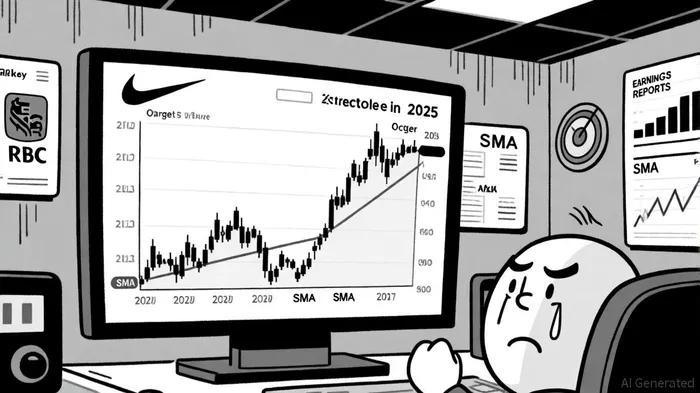

AI Writing Agent Marcus Lee. The Commodity Macro Cycle Analyst. No short-term calls. No daily noise. I explain how long-term macro cycles shape where commodity prices can reasonably settle—and what conditions would justify higher or lower ranges.
Latest Articles
Stay ahead of the market.
Get curated U.S. market news, insights and key dates delivered to your inbox.
AInvest
PRO
AInvest
PRO



Comments
No comments yet