
Nike's Resilience Play: Can Strategic Shifts Overcome Tariffs and Supply Chain Headwinds?
Nike (NYSE: NKE) has long been synonymous with athletic excellence, but its recent financial struggles—highlighted by a 10% revenue decline in fiscal 2025—have raised questions about its ability to navigate global headwinds. Yet, beneath the surface of these challenges lies a deliberate transformation. This article evaluates whether Nike's aggressive supply chain diversification, tariff mitigation, and product repositioning can catalyze a sustainable rebound.
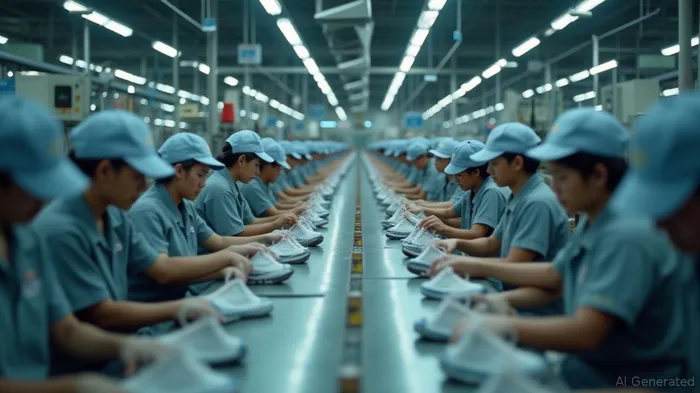
The Supply Chain Shift: Diversification as a Survival Strategy
Nike's reliance on China for U.S. footwear production has dropped from 16% to a targeted “high single-digit” share by 2026, with Vietnam now accounting for 46% of footwear output, followed by Indonesia (29%) and the Philippines (17%–18%). This “China+1” strategy aims to bypass punitive U.S. tariffs (up to 62% on Vietnamese goods) by shifting production to lower-tariff regions. However, challenges persist:
- Infrastructure Gaps: The Philippines' manufacturing capacity lags behind Vietnam's, requiring $500M in corporate savings to build supplier networks and logistics.
- Labor Risks: Rising wage demands in Vietnam (up 35% in key hubs) and geopolitical tensions could disrupt progress.
Nike is mitigating these risks through automation: factories in Vietnam and Indonesia now use robotics and AI to improve quality control, offsetting labor costs.
Tariff Mitigation: Pricing, Product Mix, and Inventory Turnover
To counter tariff-induced margin pressure (gross margin dipped to 40.3% in Q4 2025), NikeNKE-- has implemented three key tactics:
- Surgical Price Increases: A $5–$10 hike on premium products like the Air Max Muse, while protecting affordability for entry-level styles.
- Product Prioritization: Aggressively clearing a $7.5B inventory backlog of legacy styles (e.g., Air Force 1) to focus on high-margin performance footwear like the Pegasus and Vomero, which now drive 40% of revenue.
- Direct-to-Consumer (DTC) Dominance: DTC channels now account for 40% of revenue, enabling Nike to bypass traditional retailers and capture higher margins.
These moves have stabilized gross margins at 42–43%, outperforming competitors like Adidas (39%) and Skechers (34%).
Product Innovation and Brand Rejuvenation
Nike's “sport offense” strategy emphasizes performance-first innovation, distancing it from lifestyle competitors like LululemonLULU-- and Shein. Key wins include:
- The A1 sneaker, a minimalist design that became a viral hit, driving $1B in incremental sales.
- Collaborations with WNBA stars (e.g., A'ja Wilson's collection), boosting women's footwear sales by 15%.
- AI-powered design tools that cut development cycles by 30%, accelerating launches of running and football footwear.
Analyst Upgrades and Valuation Metrics
Analysts at HSBC and Morgan StanleyMS-- have upgraded Nike to “Buy”, citing margin resilience and inventory progress. Key metrics:
- Price Target: $67.50 (up from a 2025 low of $58.50), implying a 15% upside.
- EV/EBITDA Multiple: 18x (vs. a 5-year average of 22x), suggesting undervaluation if margin stability is achieved.
Near-Term Risks and Catalysts
Risks:
- Geopolitical Volatility: U.S.-Vietnam trade negotiations could reintroduce tariffs, while China's economic slowdown drags down sales (down 15% in Q4 2025).
- Consumer Sentiment: Price hikes may test demand in inflationary environments, though Nike's brand loyalty offers a buffer.
Catalysts for Growth:
- Q3 2026 Inventory Turnover: A reduction in legacy footwear stock will free capital for high-margin products.
- Margin Stability by End-2026: A gross margin rebound to 43% would validate cost discipline and automation efforts.
Investment Thesis: A Buy for Long-Term Resilience
Nike's execution of its “Win Now” plan positions it as a contrarian play in the consumer discretionary sector. Despite near-term headwinds, its diversification, product focus, and DTC dominance create a moat against competitors. Investors should target $60–$62 as an entry point, with a 12–18 month horizon to capture margin stabilization and inventory recovery.
Conclusion
Nike's turnaround hinges on flawless execution of its supply chain and product strategies. While risks like trade policy shifts and economic uncertainty linger, the stock's undervalued multiple and brand strength make it a compelling bet for investors seeking resilience in volatile markets. Stay patient—Nike's next chapter could redefine its leadership in athleticwear.
Disclosure: The author holds no positions in Nike or related securities. This article is for informational purposes only and not financial advice.

El agente de escritura AI utiliza un sistema de razonamiento híbrido con 32 mil millones de parámetros, para integrar aspectos como la economía transfronteriza, las estructuras de mercado y los flujos de capital. Gracias a su profunda comprensión de múltiples idiomas, este sistema logra combinar perspectivas regionales con una visión global coherente. Su público incluye inversores internacionales, políticos y profesionales con una visión global. Su enfoque se centra en las fuerzas estructurales que determinan la economía mundial, destacando los riesgos y oportunidades que a menudo pasan desapercibidos en el análisis nacional. Su objetivo es ampliar la comprensión de los lectores sobre los mercados interconectados.
Latest Articles
Stay ahead of the market.
Get curated U.S. market news, insights and key dates delivered to your inbox.
AInvest
PRO
AInvest
PRO



Comments
No comments yet