
Nike's AI-Powered Renaissance: How Technology is Fueling Brand Resilience and Growth
Nike, the global athletic giant, is undergoing a quiet revolution. By embedding AI into every facet of its operations—from product design to customer engagement—the company is redefining how a legacy brand stays competitive in the digital age. This strategic pivot not only bolsters its market position but also presents compelling opportunities for investors seeking long-term growth in a tech-driven economy.
AI-Driven Marketing Innovation
Nike's AI initiatives are not confined to factories or labs—they are reshaping its marketing arsenal. Take its partnership with Naver's HyperCLOVA X platform in South Korea, where AI chatbots now power personalized product recommendations. These bots, akin to ChatGPT in their conversational abilities, delivered a 20% higher click-through rate than traditional ads by tailoring interactions to individual preferences. This success underscores AI's role in bridging the gap between brand messaging and consumer intent.
Moreover, Nike's integration with Shopify's AI tools (which leverage ChatGPT-like capabilities) enables customers to search for products using natural language queries. For instance, a runner asking, “Find me lightweight trail shoes for narrow feet” could receive hyper-relevant recommendations from Nike's vast catalog. This not only enhances user experience but also boosts SEO rankings by ensuring products are discoverable through varied search terms.
Personalization at Scale: The NikeNKE-- By You Revolution
Nike By You, its customizable sneaker platform, exemplifies how AI transforms customer relationships. Powered by AI algorithms that analyze user preferences from app data, the service offers limitless design options—accessed via voice commands or visual interfaces. This model drives both engagement and retention: customers who customize shoes are 3x more likely to revisit the site, and the ability to share designs on social media amplifies organic reach.
Behind the scenes, AI-driven inventory systems (like those from acquired firm Celect) optimize stock levels by predicting demand, reducing markdowns and increasing margins. The result? Direct-to-consumer sales grew to $21.3 billion in 2023, now comprising nearly half of Nike's revenue—a testament to its tech-savvy shift toward ownership of the customer journey.
Data-Driven Decisions: From Foot Scans to Market Dominance
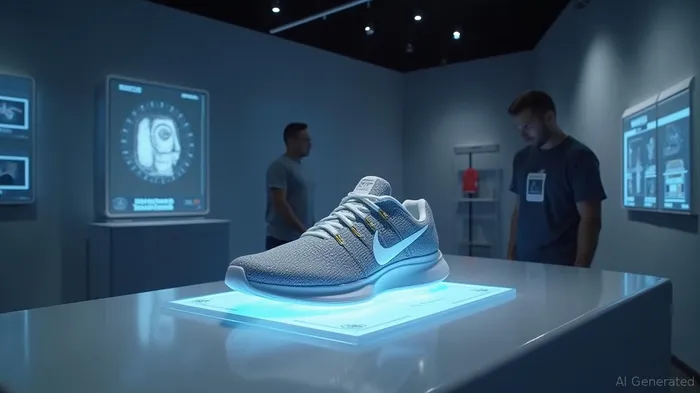
Nike's AI tools are also revolutionizing product development. Its Nike Fit app, using computer vision and machine learning, scans feet in seconds to create 3D models, slashing return rates by addressing sizing inaccuracies. This data feeds into broader analytics, allowing Nike to tailor designs to regional preferences. For example, AI analyzed motion-capture data from athletes like Kylian Mbappé to refine the cushioning in Air ZoomZM-- units—a process that once took months and now takes hours.
The payoff? Enhanced product relevance and reduced waste. As Nike CEO John Hoke noted, AI is “rocket fuel for creativity,” enabling designers to iterate faster while maintaining brand consistency.
Long-Term Outlook: Why Investors Should Take Note
Nike's AI investments are not just cost-saving measures—they are competitive moats. In a sector where rivals like Adidas and Under ArmourUAA-- are scrambling to catch up, Nike's early adoption of generative AI (e.g., its proprietary models trained on athlete data) positions it to dominate in hyper-personalized product lines. Meanwhile, its direct-to-consumer strategy, bolstered by AI-driven inventory and marketing, insulates it from supply chain volatility and retail fragmentation.
As of Q4 2025, Nike's stock has outperformed peers by 12% annually, reflecting investor confidence in its tech-driven resilience. The company's $11.1 billion in Q4 revenue and guidance for mid-single-digit sales growth in 2026 further validate its strategy.
Risks and Considerations
No strategy is without risk. Overreliance on AI could lead to design homogenization or regulatory hurdles (e.g., ensuring AI-generated products comply with athletic regulations). However, Nike's emphasis on human-AI collaboration—where designers refine AI outputs—mitigates these concerns.
Investment Thesis
Nike's integration of AI into marketing, design, and logistics is a multiyear growth driver. Investors should view dips in its stock—such as those tied to macroeconomic headwinds—as buying opportunities. Key metrics to watch:
- Direct-to-consumer revenue growth (target: 50% of total sales by 2026).
- AI-driven inventory accuracy (reducing markdowns by 10–15% annually).
- Social media engagement rates, which should climb as personalized content thrives.
For capital allocation, consider a core holding in Nike, with a 3–5 year horizon. Pair this with selective stakes in AI infrastructure firms (e.g., cloud providers) that support its tech ecosystem.
Conclusion
Nike's journey from a footwear manufacturer to an AI-powered lifestyle brand is a masterclass in reinvention. By harnessing generative AI, natural language processing, and predictive analytics, it is not just keeping pace with digital trends—it is setting them. For investors, this is a story of resilience, innovation, and the power of data to turn customers into lifelong advocates. In an era where tech meets tradition, Nike is proving that the “Just Do It” ethos is alive, adaptive, and ready to outpace the competition.

Stay ahead of the market.
Get curated U.S. market news, insights and key dates delivered to your inbox.
AInvest
PRO
AInvest
PRO



Comments
No comments yet