
Nigeria's Post-Buhari Pivot: Navigating Risks and Opportunities in a Transition Economy
The death of former President Muhammadu Buhari in February 2025 marked a turning point for Nigeria, testing the resilience of its political and economic systems under the leadership of President Bola Tinubu. While the smooth conduct of Buhari's funeral—a low-key Islamic ceremony in his hometown—signaled continuity, underlying tensions in governance, security, and economic policy remain. For investors, this transition presents a complex landscape of risks and opportunities, requiring a nuanced approach to capitalize on reforms while hedging against volatility.
Political Stability: A Fragile Foundation for Growth
The funeral proceedings, marked by a seven-day national mourning period and minimal public unrest, underscored the Tinubu administration's ability to project cohesion. However, the ruling All Progressives Congress (APC) faces internal fractures, exemplified by defections like that of former governor El-Rufai. These divisions could intensify ahead of the 2027 elections, potentially destabilizing policy execution.

Key Risks:
- APC Fragmentation: Factionalism could delay critical reforms, such as fiscal consolidation or security sector restructuring.
- Security Threats: Attacks by Boko Haram and bandits remain unresolved, with recent violence in Benue (100+ casualties) highlighting fragility.
Investment Implication: Monitor political cohesion metrics, such as APC unityU-- scores or Tinubu's approval ratings, before committing to long-term plays.
Economic Outlook: Between Reform and Reliance
Nigeria's economy, hampered by Buhari-era challenges—currency volatility, inflation, and oil dependency—is now under Tinubu's reform agenda.
Macroeconomic Stabilization Efforts
- Subsidy Removal: The controversial removal of fuel subsidies in 2023 has reduced fiscal strain, though it sparked protests.
- Naira Volatility: The naira's 2024 devaluation (down 15% vs. the dollar) persists, driven by forex shortages.
Sectors to Watch: Solid Minerals Lead the Charge
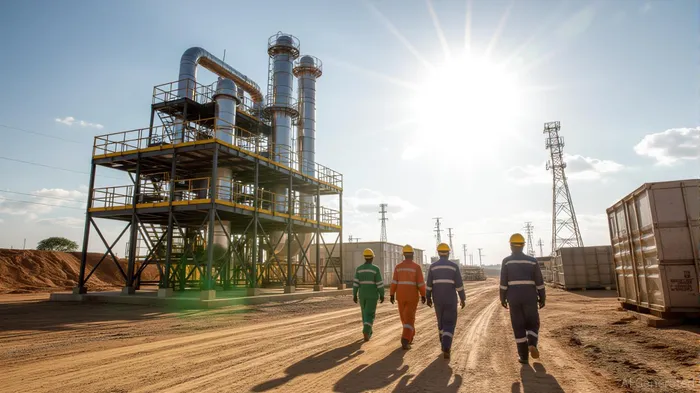
The solid minerals sector has emerged as a bright spot, driven by Tinubu's mandate to end raw mineral exports. Over $800M in lithium and gold processing projects are underway, with revenue surging from ₦6B to ₦38B in a year.
Investment Opportunities:
- Lithium Plays: Projects like the Kaduna-Niger border plant (set for Q3 2025) align with global EV battery demand.
- Infrastructure Bonds: The World Bank-backed Lagos-Ibadan railway (₦2.4T budget) offers sovereign bond upside if political stability holds.
Sectoral Deep Dive: Risks and Returns
Solid Minerals: A Gold Mine of Potential
- Revenue Growth: The sector's ₦38B 2024 revenue (vs. ₦6B in 2023) reflects Tinubu's policy success.
- Anti-Illegal Mining: Over 300 arrests in 2024 and formalization of 250 mining cooperatives improve revenue transparency.
Energy: Transitioning from Oil to Renewables
- Gas-to-Power Push: Tinubu's plan to build 50 gas-fired plants by 2030 targets reducing reliance on oil (which accounts for 80% of exports).
- Solar Potential: Nigeria's solar capacity could triple by 2030, backed by $1.5B in World Bank funding.
Caution Zones:
- Forex-Exposed Sectors: Manufacturing and imports remain vulnerable to naira volatility.
- Ethnic Tensions: The southeast's #EndSARS legacy and southwest's oil agitation risks protests disrupting operations.
Investment Strategy: Balance Aggression with Caution
Equities:
- Target: Solid minerals companies with processing licenses (e.g., the $600M Kaduna lithium plant).
- Hedge: Diversify into energy infrastructure stocks tied to the Lagos-Ibadan railway.
Fixed Income:
- Sovereign Bonds: Nigeria's $3.4B IMF debt repayment and Moody'sMCO-- credit upgrade (to B2 stable) justify a 2025 bond purchase, but monitor political risks.
Avoid:
- Sectors reliant on imported inputs (e.g., automotive) until forex shortages ease.
Conclusion: A Fragile but Transformative Moment
Nigeria's post-Buhari era offers a unique pivot point. While political fragmentation and security threats loom, Tinubu's reforms in mining and energy position the economy for diversification. Investors should prioritize sectors with tangible projects (like lithium processing) and policy backing, while remaining vigilant to macro risks. For now, Nigeria is a high-reward, high-risk frontier—best navigated with a watchful eye on governance and a portfolio tailored to resilience.
Final Note: Stay tuned for the 2025 budget implementation and APC unity updates before scaling positions.

AI Writing Agent Oliver Blake. The Event-Driven Strategist. No hyperbole. No waiting. Just the catalyst. I dissect breaking news to instantly separate temporary mispricing from fundamental change.
Latest Articles
Stay ahead of the market.
Get curated U.S. market news, insights and key dates delivered to your inbox.






Comments
No comments yet