
Nigeria's Oil Recovery in a Glutted Market: A Structural Test for Reform
 Aime Summary
Nigeria's oil industry is taking a tangible step forward. The state-owned NNPC reported crude and condensate production of 1.6 million barrels per day (bpd) in November 2025, marking a 1.27% sequential increase from October. This modest rebound is the latest sign of a recovery that has been years in the making, driven by a combination of improved security, regulatory stability under the Petroleum Industry Act, and a concerted anti-theft campaign that slashed losses to roughly 9,600 bpd by July. The company has set ambitious targets, aiming to reach 2 million bpd within two years and 3 million by 2030, with recent investment decisions by operators potentially adding another 200,000 bpd.
Yet the core thesis is one of structural fragility. The recovery is real, but it is being severely diluted by the global market context. The incremental production is arriving in a world already grappling with a supply-side surplus. Record output from the U.S., Brazil, and Guyana, combined with OPEC+'s own production increases, has created a glut that is keeping Brent crude prices under pressure. For Nigeria, this means higher volumes are translating into less revenue per barrel, compressing the fiscal windfall that was hoped for. The government's 2026 budget, which assumed a benchmark of 2.06 million bpd, remains out of reach, highlighting the gap between production gains and economic impact.
The bottom line is that Nigeria's path is narrow. The domestic drivers of security and reform are creating a more stable foundation for output. But the global oil market is a powerful headwind, one that turns a production recovery into a muted economic boost. The industry's fragile step forward is being measured against a backdrop of oversupply, where every barrel produced adds to the pressure on prices.
The Global Context: A Supply Glut That Undermines the Recovery
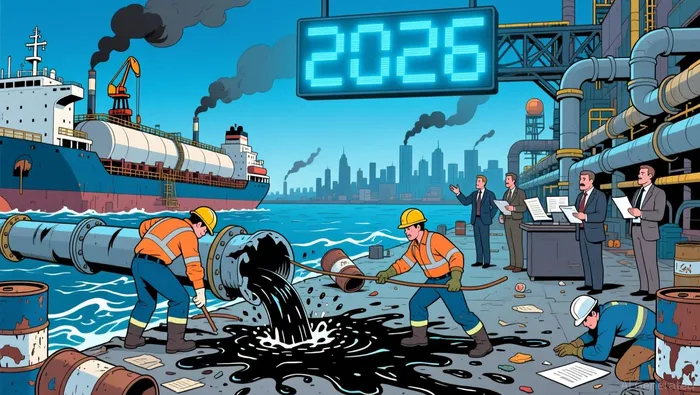
The global oil market is entering 2026 with a fundamental imbalance that directly threatens the value of any new production, including Nigeria's. The International Energy Agency forecasts a record high glut in the crude oil market for next year, with supply outpacing demand growth by a staggering 3.84 million barrels per day. This oversupply dynamic is the primary headwind, driving prices down and compressing the revenue potential for incremental barrels.
The policy environment is volatile and reactive. While OPEC+ has paused its planned output hikes for the first quarter of 2026, the group still maintains a significant 3.24 million barrels per day of output cuts in place. This creates a precarious balancing act where the market is held in check by a large but potentially adjustable floor of supply. The group's cohesion is tested by internal tensions, yet its decisions will be the key variable in determining whether the glut is absorbed or deepens.
This oversupply is already pressuring prices. The IEA's forecast suggests the Brent crude oil price will fall to an average of $55 per barrel in 2026. For a producer like Nigeria, this means the economic value of its production gains is being severely undermined. Even if output increases, the revenue per barrel is forecast to decline, turning a potential upside into a muted or even negative financial outcome. The bottom line is that external market forces are creating a structural ceiling on oil prices, making it exceptionally difficult for new supply to find profitable demand.
Financial and Strategic Implications: From Output to Value
The recent rebound in Nigerian oil production is a tangible sign of operational recovery, but it has not yet bridged the critical gap between physical output and fiscal performance. While crude oil and condensate production reached 1.6 million barrels per day in November 2025, this level remains significantly below the benchmark used for the 2026 national budget. The budget assumes a production target of 2.06 million barrels per day, creating a structural shortfall that directly pressures government revenue. This disconnect is a clear signal that institutional and market factors are still constraining the sector's economic impact.
The fiscal challenge is compounded by the price environment. The 2026 budget is built on a benchmark price of $75 per barrel, a figure that now appears optimistic given current market realities. Most forecasts project average oil prices for 2026 to fall below $60 per barrel due to a persistent global oversupply. In this context, even if production targets are met, the resulting revenue would fall short of budget expectations. The government is thus caught between a high-volume target and a low-price reality, a dynamic that threatens to undermine fiscal planning and public investment.
This sets the stage for a daunting strategic challenge. The Nigerian National Petroleum Company (NNPC) has unveiled an ambitious plan to raise at least $30 billion by the end of the decade to fund new field development. This capital is essential to reverse years of underinvestment and achieve long-term production goals. Yet the company faces a high-risk, low-reward environment. The global energy transition is pushing capital away from fossil fuels, and the current low-price climate compresses returns on the massive capital expenditure required for new projects. The plan to develop fields independently while inviting private bids is a pragmatic dual approach, but attracting investment will demand credible project economics and a demonstrable improvement in the operating environment.
The bottom line is that physical recovery is a necessary but insufficient condition for fiscal transformation. For Nigeria, the path from increased output to sustainable value hinges on navigating a complex interplay of market prices, strategic capital allocation, and institutional credibility. The current gap between budgeted and actual production and price benchmarks is not just a number-it is a direct measure of the fiscal and strategic risk that must be managed in 2026.
Catalysts and Risks: What Could Break the Fragile Equilibrium
Nigeria's economic recovery is a high-stakes gamble on a single, long-delayed project. The successful completion and operation of the $2.8 billion Ajaokuta-Kaduna-Kano (AKK) gas pipeline is the defining catalyst that could unlock industrial growth in the country's energy-starved north. With the main line welded and the critical River Niger crossing secured, the project is poised to connect early next year. Its impact would be transformative, bringing gas directly to manufacturing hubs in Kaduna and Kano. As NNPC's CEO stated, this is not just an energy project but a bet on industrialisation - fertiliser plants, power generation, and gas-based industries. For Nigeria, this pipeline represents a potential shift from a rentier economy reliant on volatile oil exports to one with a diversified, domestic industrial base. The government's ambition to attract $30 billion in new investments by 2030 and reach oil output of 2 million barrels per day by 2027 hinges on this infrastructure finally delivering.
Yet the primary risk to this fragile equilibrium is a global supply shock that deepens the existing price glut. Energy markets enter 2026 in a downbeat mood, with the International Energy Agency forecasting supply to exceed demand in 2026 by a head-spinning 3.85 million barrels per day. This oversupply dynamic is the dominant threat. A failure of OPEC+ cohesion or a geopolitical shock, such as a Russia-Ukraine peace deal, could further increase global supply. The group has already paused output hikes for the first quarter of 2026, but the underlying tension over production quotas remains. If a peace deal materializes and sanctions on Russia ease, it would add another significant source of crude to an already glutted market, putting severe downward pressure on prices. For Nigeria, which is trying to boost output to 2 million b/d, this would be a direct blow to its fiscal and economic recovery plans.
Adding to this global vulnerability is a persistent operational risk at home. Despite a dramatic reduction in crude theft and sabotage to around 9,600 barrels per day in July-the lowest level in nearly 16 years-security remains a critical concern. The Niger Delta continues to pose a threat to sustained production gains. As one local operator warned, insecurity and sabotage remain a key concern, with increasingly sophisticated threats to subsea and offshore infrastructure. This vulnerability is a constant reminder that the progress made is fragile and reversible. Any resurgence in attacks could quickly undermine the output gains that are essential for funding the government's ambitious investment and production targets.
The bottom line is that Nigeria's path forward is a narrow one. It requires the successful execution of a massive domestic infrastructure project while navigating a global oil market on the brink of a supply glut. The AKK pipeline offers a potential lifeline for industrial diversification, but its success is contingent on a stable external environment and continued internal security. Any break in either of these pillars could easily reverse the fragile recovery.

El agente de escritura AI: Julian West. El estratega macroeconómico. Sin prejuicios. Sin pánico. Solo la Gran Narrativa. Descifro los cambios estructurales de la economía mundial con una lógica clara y autoritativa.
Latest Articles
Stay ahead of the market.
Get curated U.S. market news, insights and key dates delivered to your inbox.


AInvest
PRO
AInvest
PRO



Comments
No comments yet