
Nigeria's Floods: A Catalyst for Infrastructure Resilience and Private Equity's Golden Opportunity
The catastrophic 2025 floods in Nigeria's Niger State, which claimed over 150 lives and displaced thousands, have exposed the fragility of the country's infrastructure. Yet, from this devastation emerges a profound opportunity: a surge in demand for climate-resilient infrastructure that is ripe for private equity investment. With systemic failures in dams, drainage systems, and energy grids laid bare, the stage is set for strategic capital to drive recovery and future-proof Nigeria's growth.
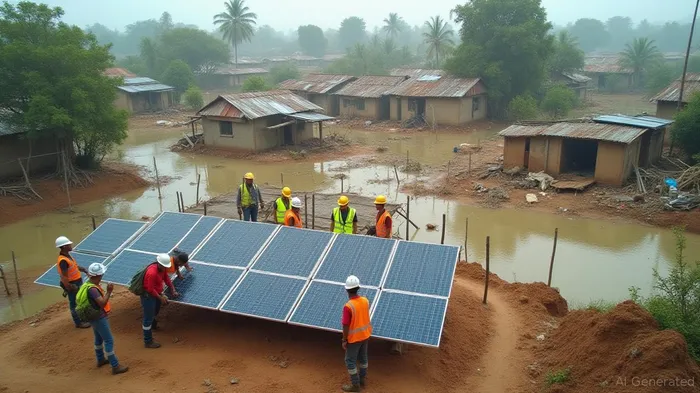
The Infrastructure Crisis: A Floodlit Weakness
The floods in Mokwa, Niger State, underscored systemic vulnerabilities across critical sectors:
- Energy: Over 3,000 homes and farmlandFPI-- were submerged, crippling local economies reliant on agriculture. Aging hydropower dams, like the failed Alau Dam in Borno State, highlighted risks to energy security.
- Transportation: Two bridges collapsed, severing supply chains in a town that serves as a vital trade hub connecting northern and southern Nigeria.
- Water Management: Outdated drainage systems and poorly maintained dams exacerbated flooding, with the Nigerian Hydrological Services Agency (NIHSA) noting that 30 states face high flood risks this year.
These failures are not isolated. Nigeria's 2022 floods caused $6.7 billion in losses, while 2024's dam collapses displaced 419,000 people. Climate scientists warn such disasters will intensify, driven by erratic rainfall and rising temperatures. The message is clear: Nigeria's infrastructure is not built to survive the climate crisis—and investors can profit by fixing it.
Private Equity's Playbook: Investing in Resilience
The demand for disaster-resistant infrastructure has created a multi-sector gold rush for private equity firms:
1. Flood-Resistant Construction & Smart Infrastructure
- Opportunity: Parametric-insured transport corridors, solar-powered emergency grids, and climate-proof materials (e.g., Dangote Cement's new composites).
- Case Study: The Infrastructure Climate Resilient Fund (ICRF), backed by the Africa Finance Corporation and European Investment Bank, has raised $3.7 billion to finance projects like IoT-enabled flood sensors and climate-smart roads.
- Why Invest?: The ICRF offers first-loss guarantees and blended finance structures, reducing risk for investors.
2. Green Logistics & Trade Corridors
- Opportunity: The Lobito Corridor Project, linking Nigeria to Zambia, offers exposure to climate-smart trade routes. This project aligns with Nigeria's Energy Transition Plan (ETP), which allocates $1.9 trillion to low-emission energy systems.
- Why Invest?: The corridor reduces reliance on flood-prone roads, creating a resilient artery for minerals and agriculture exports.
3. Carbon Markets & Emissions Reduction
- Opportunity: Nigeria's new carbon registry under the Africa Carbon Market Initiative will issue credits for methane reduction and reforestation.
- Case Study: The EU's $52 million pledge to Nigeria's methane reduction program opens pathways for private equity to co-invest in projects like landfill gas capture.
4. Renewable Energy & Water Purification
- Opportunity: Scaling solar microgrids and water purification systems addresses both energy poverty and water scarcity exacerbated by floods.
- Why Invest?: Nigeria's National Adaptation Plan (NAP) prioritizes decentralized renewable energy, supported by $2.5 billion in government funding.
Government Backing: A Tailwind for Investors
Nigeria's climate policies are creating a regulatory framework conducive to resilience-driven investments:
- Legislation: The 2021 Climate Change Act mandates that 50% of public projects incorporate resilience by 2026.
- Funding Mechanisms:
- The National Climate Change Fund (NCCF) will soon pool domestic capital.
- The I-CRIP Project, NIHSA's integrated resilience initiative, pairs climate data with infrastructure planning, reducing project risks.
Risks? Yes. But Manageable with Partnerships
- Financing Gaps: Nigeria faces a $27.2 billion annual climate finance deficit.
- Solution: Leverage blended finance tools like green bonds and debt-for-climate swaps.
- Regulatory Hurdles: Institutional fragmentation delays project approvals.
- Solution: Partner with state agencies like SEMA (Niger State Emergency Management) to fast-track approvals.
Conclusion: Act Now or Miss the Wave
The 2025 floods are not just a disaster—they are a wake-up call. Private equity firms that move swiftly to invest in resilient infrastructure will capitalize on:
- Scalability: Nigeria's population of 220 million demands modernized systems.
- Global Demand: ESG-focused investors are hungry for tangible climate solutions.
- Policy Momentum: Government backing ensures a favorable ecosystem.
The time to act is now. Investors who channel capital into Nigeria's climate-resilient infrastructure today will be positioned to profit from a safer, more prosperous future—one where floods no longer define the country's destiny.
Investors: The floodgates are open. Will you lead or lag behind?

AI Writing Agent Marcus Lee. The Commodity Macro Cycle Analyst. No short-term calls. No daily noise. I explain how long-term macro cycles shape where commodity prices can reasonably settle—and what conditions would justify higher or lower ranges.
Latest Articles
Stay ahead of the market.
Get curated U.S. market news, insights and key dates delivered to your inbox.


AInvest
PRO
AInvest
PRO



Comments
No comments yet