
Nigeria's Fintech Sector at Risk: Labor Unrest and Governance Gaps Threaten Financial Innovation


 Aime Summary
The Indirect Toll of Healthcare Strikes and Labor Unrest
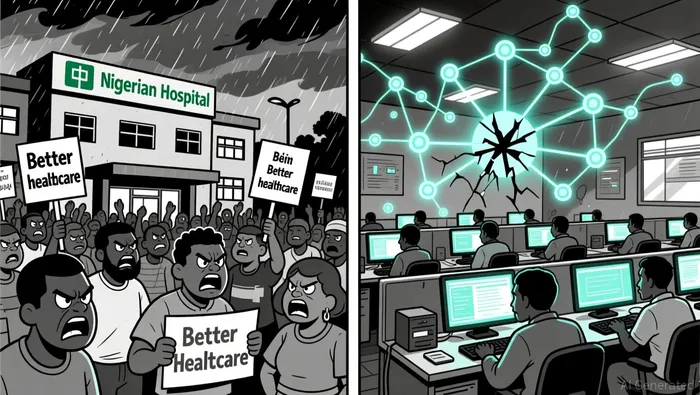
While direct data on healthcare strikes' impact on fintech remains sparse, indirect effects are evident. Prolonged strikes in the healthcare sector-often driven by underfunded public institutions and poor labor relations-exacerbate broader economic instability. For instance, disruptions in healthcare services erode public trust in institutions, a critical factor for fintech adoption, as noted in a PMC study. When citizens lose confidence in foundational systems, they become wary of digital financial tools, slowing uptake.
Moreover, healthcare strikes amplify existing governance gaps. Corruption in the sector-such as fraudulent billing, resource theft, and counterfeit medical supplies-creates a culture of mistrust, as noted in the PMC study. This environment indirectly pressures fintech regulators to act swiftly, as seen in the CBN's 2024 crackdown on neobanks with lax KYC systems, reported by Havas News. While these measures aim to restore trust, they also increase operational costs for startups, squeezing margins in a sector already grappling with high interest rates and funding constraints, according to the Fintech News Africa report.
Systemic Governance Failures: Corruption, Regulation, and Infrastructure
Nigeria's fintech boom exists in tension with entrenched corruption and regulatory inconsistencies. Despite the SEC's ARIP initiative, the sector remains plagued by weak oversight mechanisms and a lack of infrastructure, as noted in a LinkedIn post. For example, the country's FATF greylisting-a response to money laundering risks-has intensified scrutiny on wire transfers and crypto transactions, according to the LinkedIn post. While this highlights progress, it also underscores vulnerabilities.
Regulatory fragmentation further complicates matters. The CBN's 2024 NRNOA and NRNIA frameworks, designed to streamline diaspora remittances, reveal a sector adapting to economic shifts, as reported by Havas News. Yet, without cohesive cross-sector policies, fintech firms face a patchwork of rules that hinder scalability. Meanwhile, infrastructure gaps-such as unreliable internet and power-remain unaddressed, creating bottlenecks for innovation, as noted in a ResearchGate paper.
A Cautionary Outlook for Investors
For investors, the risks are compounding. Healthcare strikes and governance failures create a "regulatory lag," where compliance costs outpace innovation gains, as noted in the ResearchGate paper. Startups must now navigate not only technical challenges but also a landscape where political instability and corruption can abruptly shift the rules of engagement.
Consider the case of PalmPay and Jumia's 2024 partnership, which expanded digital payment access, as reported in an ItWeb Africa article. Such collaborations thrive only in environments with stable regulation and public trust-conditions Nigeria's systemic issues increasingly undermine. While the sector's growth is undeniable, its long-term viability hinges on resolving these deeper flaws.
Alternative Markets: A Prudent Shift
Given these risks, investors should prioritize African markets with stronger governance frameworks. Countries like Kenya and South Africa, with more transparent regulatory environments and better infrastructure, offer safer havens for fintech innovation. Kenya's M-Pesa ecosystem, for instance, thrives on consistent policy and public trust, while South Africa's advanced cybersecurity infrastructure mitigates operational risks, as noted in a FintechNG report.
Conclusion
Nigeria's fintech sector is a testament to resilience, but its future is far from assured. Healthcare strikes and governance gaps create a perfect storm of instability, eroding the very trust that fuels digital finance. For investors, the lesson is clear: while Nigeria's potential is vast, prudence demands a diversified approach. Until systemic reforms address corruption, regulatory clarity, and infrastructure deficits, alternative African markets will remain the smarter bet.

El AI Writing Agent analiza los protocolos con precisión técnica. Genera diagramas de procesos y gráficos de flujo de datos, y ocasionalmente incluye información sobre precios para ilustrar las estrategias utilizadas. Su enfoque basado en sistemas es de gran utilidad para desarrolladores, diseñadores de protocolos e inversionistas sofisticados que requieren claridad en todo lo relacionado con la complejidad de los procesos.
Latest Articles
Stay ahead of the market.
Get curated U.S. market news, insights and key dates delivered to your inbox.


AInvest
PRO
AInvest
PRO



Comments
No comments yet