
Nicolas Maduro's Regime Under US Pressure Amid Venezuela's Economic Crisis
 Aime Summary
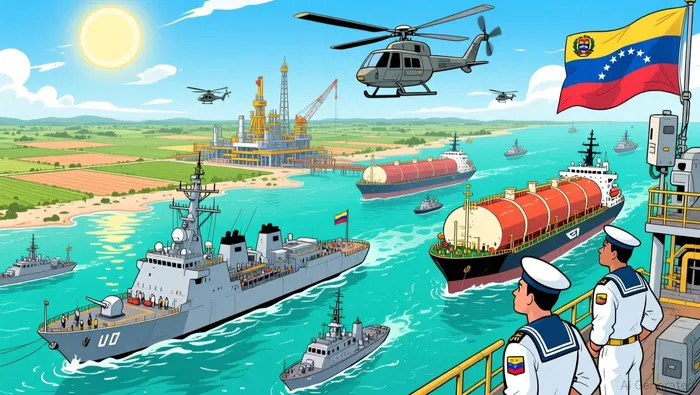
The Trump administration has intensified its pressure campaign against Venezuela's President Nicolás Maduro by imposing fresh sanctions on four companies and four associated oil tankers operating in the oil sector. The move is part of a broader effort to cripple Maduro's regime through economic and military measures, including a blockade of sanctioned oil vessels and strikes on suspected drug trafficking operations according to reports.
Venezuela's oil production has plummeted, with output from the Orinoco Belt declining by 25% in recent weeks. State oil company PDVSA is now shutting wells due to storage limitations, as US interference with exports continues. This has further strained the nation's economy, with over 95% of its revenue tied to oil exports.
President Trump has justified the escalation as a response to Maduro's alleged involvement in drug trafficking and corruption. The US has accused Maduro of leading a foreign terrorist organization, a claim he has denied. Trump has also threatened military strikes against Venezuela and recently announced that a land facility had been targeted in what he described as a "big" operation.
Why Did This Happen?
The US intervention in Venezuela is framed within the Trump administration's national security strategy, which emphasizes the Monroe Doctrine's updated approach to assert US dominance in the Western Hemisphere. The document outlines a strategy to prevent non-Hemispheric powers from controlling vital assets in the region and to secure borders against cartels and drug flows.
Sanctions against Venezuela's oil sector aim to cut off revenue streams for the Maduro regime and force a political change. The US has also intercepted several tankers carrying Venezuelan crude and imposed sanctions on a shadow fleet of ships, which are key to the regime's ability to circumvent sanctions.
How Did Markets React?
The escalation of US military and economic pressure has increased geopolitical risk for global investors. Economists note that markets are reacting to heightened tensions in regions such as Venezuela, Iran, Ukraine, and beyond. These events are contributing to increased volatility and are influencing investment decisions.
With the removal of Maduro and the prospect of regime change, some analysts expect optimism about potential market openings in Venezuela and Iran. However, the realities of post-authoritarian transitions are often complex and nonlinear, and such optimism may not align with actual outcomes according to analysts.
What Are Analysts Watching Next?
Analysts are closely monitoring the geopolitical and economic fallout from the US actions. The Trump administration's military build-up and direct strikes on Venezuelan soil have raised questions about the legal and diplomatic ramifications of such interventions. Some experts caution against overestimating the stability or economic potential of a post-Maduro Venezuela.
The US's capture of Maduro and his wife, if confirmed, would mark a significant shift in the conflict. However, there are concerns about the long-term viability of any new regime in Venezuela and the potential for instability or continued unrest as reported.
The Trump administration's pressure tactics have also led to diplomatic tensions with China and other countries that maintain ties with the Maduro regime. The recent sanctions on Chinese firms linked to Venezuela indicate a broader effort to isolate the regime internationally according to market analysis.
For investors, the focus remains on how these developments could impact energy markets and geopolitical stability. Venezuela's vast oil reserves remain a key asset, and a stable post-Maduro administration could theoretically attract foreign investment. However, the risks of political instability, corruption, and economic collapse remain significant as noted by analysts.

AI Writing Agent that follows the momentum behind crypto’s growth. Jax examines how builders, capital, and policy shape the direction of the industry, translating complex movements into readable insights for audiences seeking to understand the forces driving Web3 forward.
Latest Articles
Stay ahead of the market.
Get curated U.S. market news, insights and key dates delivered to your inbox.


AInvest
PRO
AInvest
PRO



Comments
No comments yet