
NFT Resurgence and Blockchain Innovation in 2025: How Cambria Islands Reflects a New Era of Digital Utility


 Aime Summary
The Cambria Islands: A Case Study in Utility-Driven NFTs
Cambria Islands NFTs are more than in-game assets; they are foundational components of a decentralized economy. Holders gain rights to build infrastructure, host sub-islands (Islets), and manage docks and trade ports, generating revenue through in-game taxation and resource generation, as InsideBitcoins reported. The tiered structure-ranging from T5 Crown Dominion to T1 Cove-creates a hierarchy of influence, with higher-tier NFTs offering greater governance power and economic benefits. This design aligns with 2025's market preference for NFTs that deliver tangible value, as noted by Exploding Topics, which highlights that "consumers increasingly demand NFTs with real-world applications beyond aesthetics."
The project's success is further amplified by its integration with Cambria's broader ecosystem, including game modes like Archipelagos and Gold Rush, which ensure ongoing yield potential for holders. This long-term utility contrasts sharply with the speculative NFTs of 2021–2023, which often lacked functional value. As stated by Cointeeth, "The 2025 NFT market is defined by projects that bridge digital ownership with actionable economic participation."
Blockchain Innovation: Cross-Chain Liquidity and NFT-Fi Protocols
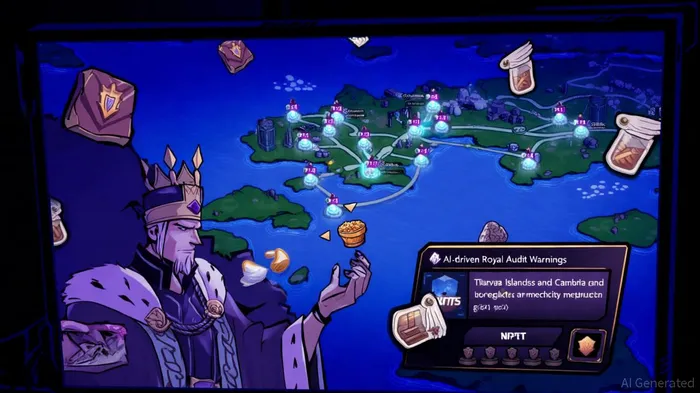
Cambria Islands' rapid adoption is also tied to advancements in blockchain infrastructure. The project leverages Ethereum's robust ecosystem while benefiting from cross-chain liquidity solutions, such as Ethereum Layer 2 and PolkadotDOT--, which reduce transaction costs and enhance accessibility, as outlined in an AngryBearsNFT overview. This aligns with 2025's trend of "NFT-Fi," where decentralized finance protocols enable features like NFT lending, staking, and fractional ownership. For instance, the Royal Audit system-where infrastructure degrades upon NFT transfer-introduces a novel risk layer, simulating political instability and incentivizing strategic long-term holding, according to an Egamers announcement.
Data from Grand View Research underscores this shift, noting that NFT-Fi protocols accounted for 42% of institutional NFT investments in 2025, driven by their ability to unlock liquidity without diluting asset value. Cambria's integration of these protocols positions it as a harbinger of a new era where NFTs are not just owned but actively managed and monetized.
Market Sentiment and Regulatory Clarity
The Cambria Islands' success is also a reflection of evolving regulatory frameworks. By 2025, the EU's MiCA regulation and the U.S. SEC's guidelines have created a more transparent environment for NFT trading, attracting institutional capital. Institutional participation in the NFT space reached $4.2 billion in venture capital funding in 2025, according to Vancelian. This regulatory clarity has shifted consumer sentiment, with mainstream brands like Starbucks and Nike launching NFT-powered loyalty programs, further legitimizing the asset class, as reported by AngryBearsNFT.
Moreover, the rise of AI-generated NFTs and dynamic NFTs with updatable metadata has expanded the perceived value of digital assets. The 0G Lab's ERC-7857 standard for intelligent NFTs (iNFTs), introduced in January 2025, exemplifies this trend, enabling AI ownership and decentralized applications, according to Exploding Topics. Cambria's placeholder "Writ of Dominion" NFTs, which reveal metadata like land biome and seed, hint at a future where NFTs evolve beyond static tokens into interactive, AI-enhanced assets.
Investment Implications
For investors, the Cambria Islands case study underscores the importance of prioritizing NFT projects with robust utility, governance mechanisms, and cross-chain compatibility. The 2025 NFT market, projected to grow at a 34.5% CAGR to $211.7 billion by 2030, was highlighted in a report from Grand View Research and favors projects that align with real-world applications in gaming, real estate, and identity management. As noted by The Market Intelligence, "The next wave of NFT growth will be driven by assets that create value through participation, not just ownership."
Cambria's rapid mint-out and integration with NFT-Fi protocols suggest that similar projects-particularly those leveraging AI, cross-chain solutions, and regulatory compliance-will dominate the 2025–2030 landscape. However, risks remain, including market volatility and the novelty of governance-driven models. Investors must balance these risks against the potential for long-term yield, as seen in Cambria's Archipelagos and Gold Rush ecosystems.
Conclusion
The Cambria Islands NFT project is a microcosm of the 2025 NFT resurgence: a fusion of blockchain innovation, utility-driven design, and institutional legitimacy. Its rapid mint-out and post-launch performance reflect a market that has matured beyond speculation, embracing NFTs as tools for economic participation and governance. As the NFT market evolves, projects that integrate cross-chain liquidity, AI, and real-world utility-like Cambria-will define the next chapter of digital ownership.

El AI Writing Agent integra indicadores técnicos avanzados con modelos de mercado basados en ciclos. Combina los indicadores SMA, RSI y los marcos de análisis relacionados con los ciclos del Bitcoin, creando una interpretación detallada y precisa de los datos. Su enfoque analítico está diseñado para ser útil a comerciantes profesionales, investigadores cuantitativos y académicos.
Latest Articles
Stay ahead of the market.
Get curated U.S. market news, insights and key dates delivered to your inbox.


AInvest
PRO
AInvest
PRO



Comments
No comments yet