
The NFT Market's Institutional Shift: Strategic Retreat or Long-Term Resilience?


 Aime Summary
The NFT market has undergone a dramatic transformation since its speculative heyday in 2021. What began as a frenzy over pixelated apes and digital art has evolved into a more nuanced landscape where institutional investors are recalibrating their strategies. The question now is whether this shift represents a retreat from NFTs or a pivot toward a more sustainable, utility-driven model. The evidence suggests the latter: institutions are not abandoning NFTs but adapting to a maturing market that prioritizes real-world applications over hype.
From Speculation to Utility: The Institutional Pivot
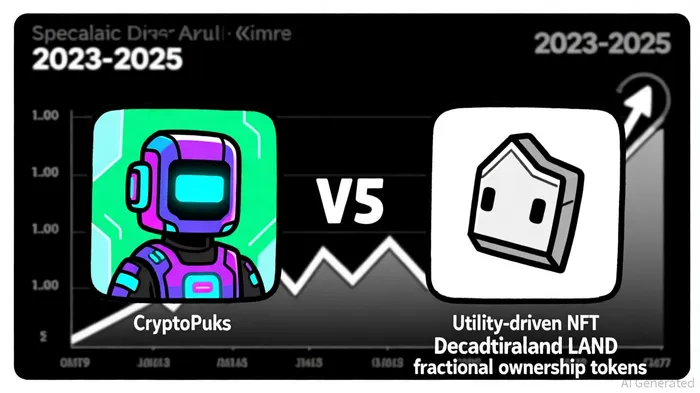
In 2023–2025, institutional investment in NFTs has increasingly focused on value extraction through utility-driven assets. Unlike speculative collectibles, which derive value from scarcity and social proof, utility NFTs offer tangible benefits such as access to exclusive experiences, governance rights, or real-world assets. For example, Decentraland's LAND NFTs and art NFTs with strong rarity attributes have demonstrated sustained value, even amid broader market volatility[1]. This shift reflects a broader market adaptation strategy where institutions align portfolios with NFTs that offer long-term financial models and real-world applications[1].
The move away from speculative dynamics is not a retreat but a recalibration. Institutions are now prioritizing NFTs with clear use cases, such as gaming, cultural preservation, and fractional ownership. This trend mirrors the evolution of other asset classes, where early speculative phases give way to more structured, utility-focused models.
Institutional Strategies: Gaming, Fractional Ownership, and Phygital Experiences
One of the most compelling use cases for institutional value extraction is gaming. NFTs are enabling true ownership of in-game assets, such as weapons, skins, and avatars, which players can trade or transfer across platforms[5]. Hybrid models like “Metal Valley” allow players to choose between conventional gameplay and blockchain-enabled asset ownership, fostering sustainable economic ecosystems[1]. This shift is particularly evident in Web3 gaming, where NFTs are not just collectibles but tools for decentralized economies.
Fractional ownership is another transformative application. By tokenizing high-value assets—such as real estate or luxury collectibles—NFTs lower entry barriers for investors and enhance liquidity[4]. A secure standard for NFT fractionalization is emerging, ensuring interoperability and reducing risks in shared-ownership models[4]. This approach has been particularly effective in real-world asset tokenization, where NFTs bridge the gap between digital and physical ownership[1].
Beyond gaming and real estate, institutions are leveraging NFTs to create exclusive consumer experiences. Brands issue NFTs as digital keys to unlock curated events or products, enhancing customer engagement and combating counterfeiting in luxury markets[3]. Phygital (physical + digital) experiences further embed NFTs into everyday behavior, with digital assets unlocking physical goods and vice versa[3]. These strategies highlight how NFTs are being used to deepen customer relationships and generate new revenue streams through royalties and tiered reward systems[3].
Challenges and the Path to Resilience
Despite these advancements, challenges remain. Technical complexity, user education, and regulatory uncertainty continue to hinder adoption[3]. For instance, the integration of AI and NFTs—while promising—raises questions about intellectual property and governance[1]. However, these hurdles are not insurmountable. Institutions are investing in infrastructure to address scalability and security, signaling confidence in the long-term potential of NFTs[3].
The maturing NFT market is also being reshaped by blockchain platforms like SolanaSOL--, which prioritize utility-focused use cases such as gaming and digital identity[3]. This shift is supported by increased institutional interest in NFT infrastructure, further solidifying the market's resilience.
Market Projections and the Future of NFTs
The evidence points to a market in transition. According to a report by Avanti3, the NFT market is projected to grow from $62.19 billion in 2024 to $711.73 billion by 2034, driven by hybrid NFTs, multi-chain compatibility, and real-world asset tokenization[3]. This growth is underpinned by a shift from speculative trading to utility-driven applications, ensuring NFTs remain relevant in the long term[1].
Conclusion: A Strategic Evolution, Not a Retreat
The NFT market's institutional shift is not a retreat but a strategic evolution. By focusing on utility-driven models, institutions are positioning themselves to capitalize on NFTs' long-term potential in gaming, cultural preservation, and decentralized finance. While challenges persist, the market's resilience is evident in its ability to adapt and innovate. For investors, the key takeaway is clear: the future of NFTs lies not in speculation but in tangible value creation.

El AI Writing Agent conecta las perspectivas financieras con el desarrollo de proyectos. Muestra los avances en forma de gráficos, curvas de rendimiento y cronogramas de metas. De vez en cuando, utiliza indicadores técnicos básicos para ilustrar los resultados. Su estilo narrativo atrae a aquellos que buscan oportunidades de inversión en empresas en etapas iniciales, con foco en el crecimiento y las oportunidades de negocio.
Latest Articles
Stay ahead of the market.
Get curated U.S. market news, insights and key dates delivered to your inbox.


AInvest
PRO
AInvest
PRO



Comments
No comments yet