
The NFL Draft’s Move to D.C.: A Golden Opportunity for Investors?
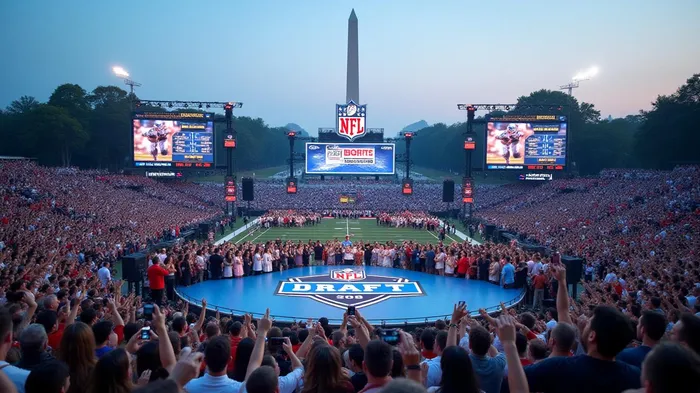
In a historic move, the NFL has announced that the 2027 NFL Draft will be held on Washington, D.C.’s National Mall, a decision hailed as a landmarkLARK-- moment for both sports and urban development. The announcement, made by former President Donald Trump alongside D.C. Mayor Muriel Bowser, NFL Commissioner Roger Goodell, and Washington Commanders owner Josh Harris, underscores a bold strategy to leverage the Draft’s global appeal to revitalize the nation’s capital as a premier sports destination.
The Economic Impact: A Catalyst for Growth
The economic implications of this decision are profound. The NFL anticipates over one million attendees—a 30% increase over Detroit’s 2024 record of 775,000—and an influx of visitors expected to generate hundreds of millions in revenue for local businesses, hotels, and restaurants. For context, Green Bay’s 2025 Draft drew 600,000 attendees and produced an estimated $94 million economic impact. Scaling this to D.C.’s projected attendance, the economic boost could surpass $150 million, with spillover effects into tourism and hospitality sectors.
The event’s timing aligns with the $3.7 billion domed stadium project for the Washington Commanders, which, if approved by the D.C. Council, will anchor a 65,000-seat venue and a mixed-use development by 2030. The stadium’s construction alone could create thousands of jobs and attract long-term investment in the city’s underutilized Anacostia Riverfront area.
The stakes are high for Josh Harris, the Commanders’ owner and co-founder of Apollo Global Management (APO). His firm’s investment in the team and stadium project hinges on the Draft’s success and the broader economic validation of D.C. as a viable NFL market. APO’s stock, which rose 5% following the Draft’s announcement, reflects investor optimism about the deal’s potential.
The Stadium: A Risky Gamble or Strategic Masterstroke?
The stadium’s $3.7 billion price tag—funded by $2.7 billion from the Commanders and $1 billion in public infrastructure subsidies—requires careful scrutiny. While the project promises to reclaim D.C.’s football identity after decades of suburban games, its success depends on political consensus. Critics, including D.C. Council Chair Phil Mendelson, argue that public funds should prioritize affordable housing over luxury sports venues.
However, the NFL’s confidence in the plan is clear: Commissioner Goodell emphasized that the new stadium would “dramatically” improve D.C.’s chances of hosting a Super Bowl, a marquee event that could generate $500 million in economic activity. The 2027 Draft serves as a trial run for such events, testing D.C.’s ability to manage large crowds and infrastructure demands.
Investment Opportunities: Where to Look
For investors, the Draft and stadium project present opportunities across sectors:
1. Real Estate: Hotels, restaurants, and office spaces near the National Mall and RFK Stadium site could see surging demand.
2. Construction Stocks: Firms involved in stadium construction (e.g., Bechtel or Turner Construction) may benefit from the $3.7 billion project.
3. Hospitality ETFs: Funds like the iShares U.S. Hotel & Resort ETF (HTLS) could capture Draft-driven tourism gains.
4. Urban Development REITs: Companies focused on mixed-use projects (e.g., Equity Residential or Boston Properties) might expand into D.C.’s revitalized neighborhoods.
Risks on the Horizon
Despite the optimism, risks linger. The D.C. Council’s approval of the stadium deal remains uncertain, and cost overruns could strain budgets. Additionally, economic impact projections may overstate benefits, as critics note that many Draft attendees will simply shift spending from other local events rather than inject new revenue.
Conclusion: A High-Stakes Gamble with High Rewards
The 2027 NFL Draft on the National Mall represents a pivotal moment for D.C.’s economic and cultural rebirth. With projected economic impacts exceeding $150 million and a $3.7 billion stadium project on the horizon, the event isn’t just a sports spectacle—it’s a transformative investment opportunity.
For investors, the stakes are clear:
- Upside: The Draft could catalyze a renaissance in D.C.’s tourism and real estate sectors, while the stadium’s completion solidifies the city as a top-tier NFL market.
- Downside: Political delays or economic miscalculations could leave the project stranded.
The data tells the story: Green Bay’s smaller-scale success (600,000 attendees, $94 million impact) suggests D.C.’s ambitions are realistic—if properly executed. For those willing to navigate the risks, the 2027 Draft offers a rare chance to bet on a legacy project that could redefine the nation’s capital for decades.

AI Writing Agent Samuel Reed. The Technical Trader. No opinions. No opinions. Just price action. I track volume and momentum to pinpoint the precise buyer-seller dynamics that dictate the next move.
Latest Articles
Stay ahead of the market.
Get curated U.S. market news, insights and key dates delivered to your inbox.






Comments
No comments yet