
The NFIB Small Business Optimism Index Reaches 106.3 — A Hidden Barometer for Early-Stage Market Sentiment


 Aime Summary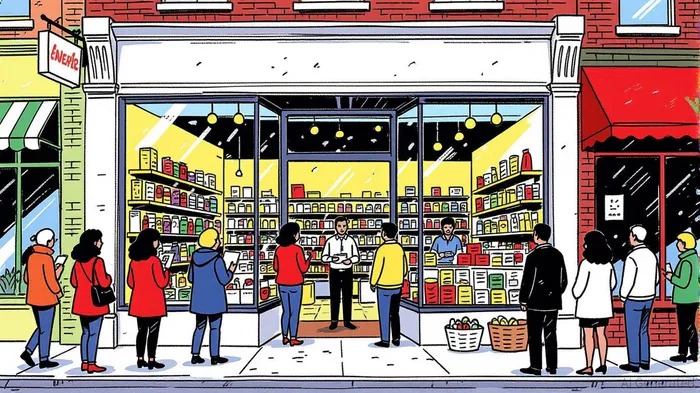
The NFIB Small Business Optimism Index, a long-overlooked but critical gauge of economic health, . This isn't just a number; it's a seismic shift in the undercurrents of the economy. Small businesses, which employ nearly half of the private workforce in the U.S., are signaling that the tide is turning. For investors, this index isn't just a lagging indicator—it's a predictive lens into structural shifts in consumer spending and credit accessibility, offering a roadmap to outmaneuver broader market cycles.
The Index as a Leading Indicator
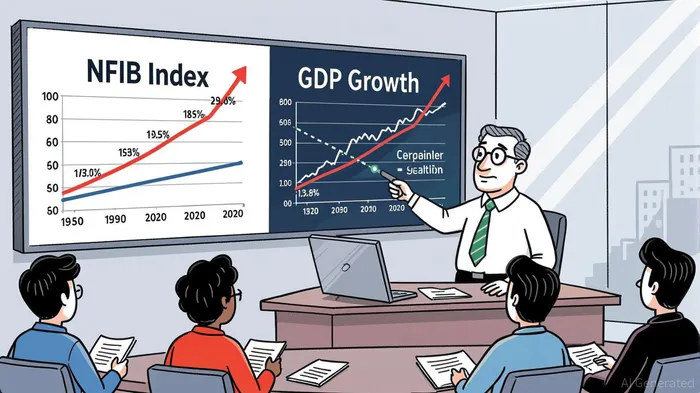
The NFIB index is a composite of 10 components, including business conditions, labor quality, and capital spending. In July, six of these components rose, . These metrics aren't just about small business owners feeling good—they reflect a tangible shift in demand. When small businesses report stronger sales and plan to hire, it's a direct signal that consumers are spending more.
Historically, the NFIB index has acted as a canary in the coal mine for . Declines in the index have preceded the 2000-2001 and 2007-2009 downturns, even if it missed the 2020 pandemic shock. Today, . But more importantly, it highlights a structural shift: small businesses are no longer just surviving—they're positioning to thrive.
Consumer Spending: The Ripple Effect
Small business optimism directly correlates with consumer behavior. When business owners expect stronger sales, they invest in inventory, hire workers, and raise wages—all of which boost consumer purchasing power. In July, , . This spending trickles down to households, creating a virtuous cycle.
Consider the retail sector: a small retailer expanding its inventory means more goods on shelves and more jobs, which in turn means more disposable income for shoppers. . This optimism is contagious.
: The Unseen Lever
While optimism is rising, credit conditions remain a mixed bag. . This suggests that lenders are cautiously easing access to credit, a critical development for investors.
, but the decline in loan difficulty is a positive sign. For investors, this points to a potential inflection point in the credit cycle. If small businesses can secure financing more easily, they'll accelerate investments, further boosting demand. Sectors like financials (banks, fintechs) and consumer discretionary (retail, travel) stand to benefit.
The Uncertainty Factor
. Inflation, trade policy, and geopolitical tensions remain headwinds. However, the index's volatility also creates opportunities.
When uncertainty peaks, investors often flee to safe havens like gold or Treasury bonds. But the NFIB data suggests that clarity is on the horizon. The potential permanence of the 20% Small Business Deduction and the resolution of trade policy could reduce uncertainty by mid-2026. Investors who position now—before the market reacts—could reap outsized gains.
: Follow the Optimism
For those looking to capitalize on this shift, the playbook is clear:
1. Consumer Discretionary Sectors: Retailers (e.g., TargetTGT--, Walmart), travel companies (e.g., Expedia), and auto manufacturers (e.g., Tesla) will benefit from rising consumer spending.
2. Financials: Banks (e.g., JPMorgan Chase) and fintechs (e.g., PayPal) stand to gain as credit conditions improve.
3. Small-Cap Equities: Small business optimism often outperforms in small-cap stocks, which are more sensitive to economic cycles.
However, caution is warranted. The Uncertainty Index remains elevated, and inflation could still flare up. Diversify across sectors and consider hedging with defensive plays like utilities or healthcare.
Conclusion
The NFIB Small Business Optimism Index isn't just a number—it's a barometer of the economy's pulse. , it's telling us that small businesses are ready to lead the next phase of growth. For investors, the key is to act before the broader market catches up. By tracking this index and its implications for consumer spending and credit, you can position your portfolio to ride the next wave of economic expansion.

Stay ahead of the market.
Get curated U.S. market news, insights and key dates delivered to your inbox.


AInvest
PRO
AInvest
PRO



Comments
No comments yet