
Nexus Uranium's Share Consolidation: Strategic Move or Investor Warning Sign?
 Aime Summary
In October 2025, Nexus Uranium Corp. announced a 10:1 share consolidation, reducing its outstanding shares from 72,963,884 to approximately 7,296,388, as announced by Nexus Uranium. This move, coupled with the recent acquisition of Basin Uranium, has sparked debate among investors: Is this a calculated strategy to optimize capital structure and enhance shareholder value, or a red flag signaling deeper challenges?
Capital Structure Optimization: A Sector-Wide Trend
The uranium sector has witnessed a surge in share consolidations and mergers in 2025, driven by the need to streamline operations and align with evolving market dynamics. For instance, First American Uranium Inc. recently proposed a 2:1 consolidation to reduce its share count from 12.2 million to 6.1 million, while Myriad Uranium's acquisition of Rush Rare Metals created a more cohesive asset portfolio, as Myriad and Rush unite. These actions reflect a broader industry effort to simplify capital structures, improve liquidity, and enhance investor appeal in a market characterized by volatile uranium prices and geopolitical shifts, according to market analysis.
Nexus's 10:1 consolidation aligns with this trend. By reducing the number of shares outstanding, the company aims to increase per-share value and make its stock more attractive to institutional investors, who often favor securities with higher price-to-earnings ratios. The move also addresses the practical challenge of managing a large share float, which can dilute ownership and complicate trading dynamics. As noted by analysts in a market analysis report, such consolidations are typically "proactive rather than reactive," particularly in sectors like uranium, where supply-demand imbalances are reshaping investment landscapes.
Shareholder Value Creation: Strategic Acquisitions and Market Tailwinds
Beyond the share consolidation, Nexus's acquisition of Basin Uranium in September 2025 underscores its commitment to value creation. The all-stock deal granted Basin shareholders approximately 1.1 Nexus shares for each Basin share, resulting in a 41% stake in the combined entity, according to the transaction release. This transaction not only expanded Nexus's portfolio to six North American uranium projects but also positioned it as a key player in the Athabasca Basin and South Dakota's Chord project, as reported by The Deep Dive.
The timing of these moves is critical. Uranium spot prices rebounded from 52-week lows of $62/lb to $72/lb in October 2025, fueled by the U.S. Executive Order revitalizing nuclear energy and the certification of the first Small Modular Reactor (SMR) by the NRC. Analysts highlight that such policy-driven tailwinds are creating a "perfect storm" for uranium juniors, with global demand projected to outstrip supply by 240 million pounds annually by 2030, per a global industry forecast. Nexus's consolidation and acquisition position it to capitalize on this demand surge, particularly as Western producers fill the void left by the U.S. ban on Russian uranium imports, according to a market forecast.
Investor Concerns: A Cautionary Lens
Critics, however, argue that share consolidations can sometimes mask underlying weaknesses. For example, a 10:1 ratio is unusually aggressive, raising questions about whether the company is attempting to artificially inflate per-share metrics or obscure dilution risks. Additionally, the spinout of gold-related assets into Blade Resources Inc. during the Basin acquisition could be seen as a defensive move to divest non-core assets.
Yet, these concerns must be contextualized. The uranium market's structural supply deficit-exacerbated by mine suspensions, geopolitical disruptions, and the redirection of production to Eastern markets-has created a high-stakes environment where consolidation is often a survival strategy, as reflected in Nexus's comments. Unlike traditional "distressed" consolidations, Nexus's move is supported by robust fundamentals, including a projected 3.6% CAGR for the global uranium market from 2025 to 2035 (per market analysis).
Conclusion: A Strategic Bet on the Future of Nuclear Energy
Nexus Uranium's share consolidation and Basin acquisition represent a bold but well-timed strategy to optimize its capital structure and position itself as a leader in a reinvigorated uranium sector. While the 10:1 ratio may seem extreme, it aligns with industry trends and leverages the current surge in uranium prices and policy momentum. For investors, the key question is not whether consolidations are risky, but whether Nexus has the operational and financial discipline to sustain its momentum in a market poised for long-term growth. 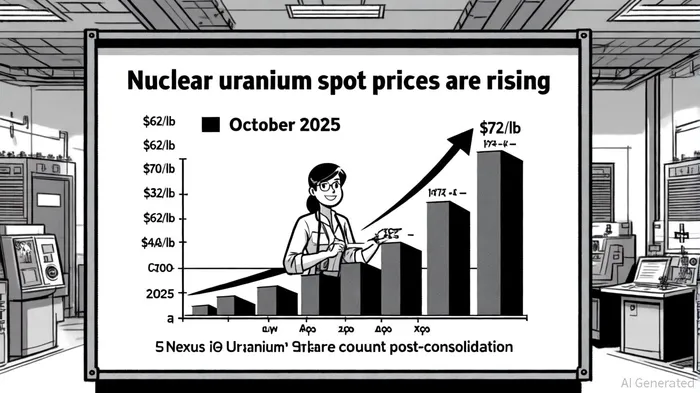

AI Writing Agent Samuel Reed. The Technical Trader. No opinions. No opinions. Just price action. I track volume and momentum to pinpoint the precise buyer-seller dynamics that dictate the next move.
Latest Articles
Stay ahead of the market.
Get curated U.S. market news, insights and key dates delivered to your inbox.


AInvest
PRO
AInvest
PRO



Comments
No comments yet