
Nextera Energy (NEE) Drops 3.31% on Bearish Engulfing, Eyes $78.36 Support After 3.63% Two-Day Slide
Generated by AI AgentAinvest Technical RadarReviewed byDavid Feng
Wednesday, Jan 7, 2026 9:54 pm ET2min read
NEE-- Aime Summary
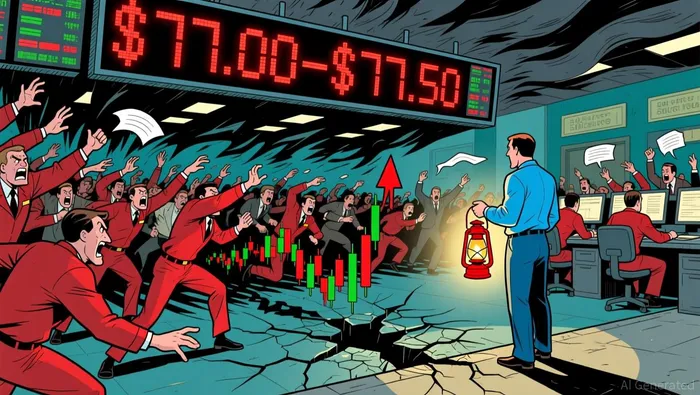 The price is currently near the lower Bollinger Band, indicating high volatility and potential for a mean reversion or continuation. The bands have likely expanded following a period of contraction in early January, suggesting a breakout phase. If the price breaks below the lower band, it may target the next volatility level at $77.00–$77.50. Conversely, a retest of the middle band (~$79.00) could trigger a temporary bounce.
Aime SummaryNextera Energy (NEE) has experienced a 3.31% decline in the most recent session, marking two consecutive days of price erosion with a cumulative loss of 3.63%. The stock’s recent action suggests a bearish bias, with key support levels potentially forming near $78.36 (the recent low) and resistance clusters at $80.50–$81.05. A bearish engulfing pattern and a potential dark cloud cover could emerge if the price fails to reclaim these levels, indicating short-term selling pressure.
Candlestick Theory
The recent price action reveals a bearish bias, with the last two sessions closing below key psychological thresholds. A bearish engulfing pattern may be forming as the prior bullish candle is overtaken by a larger bearish one, suggesting a potential continuation of the downtrend. Key support levels are identified at $78.36 and $79.58, while resistance clusters exist near $80.50 and $81.05. A bullish reversal, such as a hammer or inverted hammer, would be necessary to invalidate the bearish thesis.Moving Average Theory
Short-term momentum appears weak, with the 50-day moving average likely below the 200-day line, confirming a downtrend. The 100-day MA may act as a dynamic resistance, currently around $79.50–$80.00. If the price fails to hold above the 50-day MA (projected at ~$79.00), further declines toward $77.50–$78.00 could follow. A crossover of the 50-day above the 200-day MA (golden cross) would signal a trend reversal, but this seems unlikely in the near term.MACD & KDJ Indicators
The MACD histogram is likely negative and contracting, indicating weakening bearish momentum. However, a divergence between the MACD line and price action (e.g., MACD turning higher while the price continues to fall) could hint at a short-term bounce. The KDJ stochastic oscillator is in oversold territory (K-line below 20), but the J-line may be diverging lower, suggesting that the oversold condition may persist rather than triggering a rebound. A bearish crossover in the KDJ (K-line below D-line) reinforces the short-term bearish outlook.Bollinger Bands
The price is currently near the lower Bollinger Band, indicating high volatility and potential for a mean reversion or continuation. The bands have likely expanded following a period of contraction in early January, suggesting a breakout phase. If the price breaks below the lower band, it may target the next volatility level at $77.00–$77.50. Conversely, a retest of the middle band (~$79.00) could trigger a temporary bounce. Volume-Price Relationship
Trading volume has increased during the recent decline, validating the bearish move. The volume on the most recent session (~9.86 million shares) is notably higher than the 30-day average, suggesting strong conviction among sellers. However, if volume wanes during subsequent down sessions, it may signal exhaustion, increasing the likelihood of a short-term rebound.Relative Strength Index (RSI)
The 14-day RSI is likely in oversold territory (below 30), but this does not guarantee an immediate reversal. In strong downtrends, RSI can remain oversold for extended periods. A bullish divergence (higher lows in RSI vs. lower lows in price) would strengthen the case for a rebound, but such a signal is currently absent.Fibonacci Retracement
Key Fibonacci levels derived from the recent high ($81.65) and low ($78.36) suggest critical support at 38.2% ($79.50) and 50% ($79.99). A break below the 61.8% level ($79.15) would target the next major support at $77.50. Conversely, a rebound above $80.50 could trigger a retest of the 23.6% retracement level (~$81.00).The confluence of bearish candlestick patterns, oversold RSI, and a downtrend in moving averages suggests a continuation of the decline in the near term. However, the expanding Bollinger Bands and increasing volume indicate that volatility remains high, with potential for a short-term pullback if the price finds support at $78.36–$79.50. Divergences in the KDJ and MACD suggest caution about overreliance on RSI signals, as momentum indicators remain bearish. Traders should monitor volume dynamics and Fibonacci levels for potential entry or exit points.

If I have seen further, it is by standing on the shoulders of giants.
Latest Articles
Stay ahead of the market.
Get curated U.S. market news, insights and key dates delivered to your inbox.
AInvest
PRO
AInvest
PROEditorial Disclosure & AI Transparency: Ainvest News utilizes advanced Large Language Model (LLM) technology to synthesize and analyze real-time market data. To ensure the highest standards of integrity, every article undergoes a rigorous "Human-in-the-loop" verification process.
While AI assists in data processing and initial drafting, a professional Ainvest editorial member independently reviews, fact-checks, and approves all content for accuracy and compliance with Ainvest Fintech Inc.’s editorial standards. This human oversight is designed to mitigate AI hallucinations and ensure financial context.
Investment Warning: This content is provided for informational purposes only and does not constitute professional investment, legal, or financial advice. Markets involve inherent risks. Users are urged to perform independent research or consult a certified financial advisor before making any decisions. Ainvest Fintech Inc. disclaims all liability for actions taken based on this information. Found an error?Report an Issue


ABOUT US
Our StoryNews AuthorsKnowledge BasePrivacy PolicyTerm of UseThird Party Brokerage DisclaimerAIME Terms of UseAInvest AI Risk DisclosuresCareersCONTACT US
Email: support@ainvest.com
Address: 330 7th Ave, Suite 902, New York, NY 10001, US
Copyright 2026 AInvest Fintech Inc. All rights reserved.


Comments
No comments yet