
NextEra Energy: Assessing the Structural Shifts in a Utility's Growth Narrative


 Aime Summary
NextEra Energy's investment thesis rests on a powerful dual-engine model. The company's regulated utility, Florida Power & Light (FPL), provides the stable, cash-generating foundation, while its competitive renewables arm, Energy Resources, drives the high-growth expansion. This structure is the core of its financial performance, but it is now operating under increasing pressure from capital intensity and regulatory scrutiny.
The regulated segment is the bedrock. FPL contributes roughly 70% of consolidated earnings and provides predictable returns with a 11.7% regulatory return on equity for the 12 months ending September 2025. Its equity ratio of 59.6% is a key metric of financial strength, and a pending 4-year rate settlement aims to lock in this profitability with a midpoint ROE of 10.95%. This stability is critical, as it funds the massive capital program-NextEra expects to invest as high as $9.8 billion this year-that powers the growth engine.
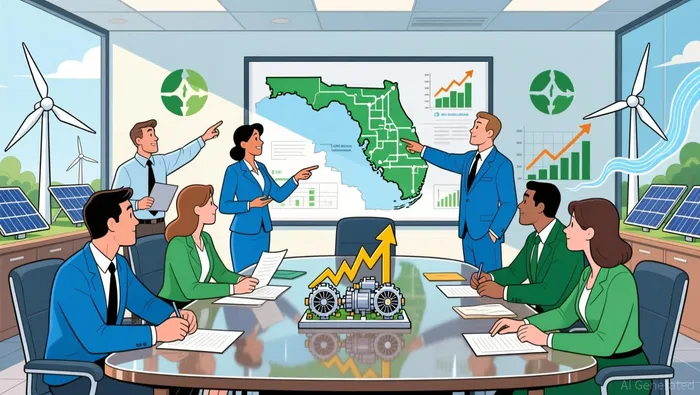
That growth engine is Energy Resources. In the third quarter, the segment's adjusted earnings per share rose 9.7% year-over-year, driven by new renewables and customer supply. The company's development pipeline is robust, with a total backlog for renewables and storage now approaching 30 gigawatts. This includes a record 1.9 gigawatts of new battery storage added to the backlog in Q3, signaling a strategic pivot toward firm, dispatchable capacity. Management has affirmed its growth guidance, expecting to deliver results at or near the top end of its adjusted EPS targets through 2027.
The tension in the model is clear. The high-growth segment is capital-intensive, and its profitability is being tested. The 9.7% EPS growth was partially offset by asset recycling and higher financing costs, highlighting the friction in scaling. At the same time, the regulated utility faces its own pressures. While retail sales declined 1.8% in Q3 due to milder weather, weather-normalized retail sales rose 1.9% year-over-year, showing underlying customer growth. Yet, the pending rate case and the need for continued multi-billion dollar investments mean FPL's stable cash flows are being stretched to fund the entire expansion.
The bottom line is that NextEra's dual-engine model is working, but the cost of growth is rising. FPL's stability is the fuel, but the competitive segment's expansion is consuming it at an accelerating rate. The company's ability to maintain its 10% annual dividend growth guidance and deliver on its long-term EPS targets will depend on its success in managing this capital intensity and navigating the regulatory landscape for both its utility and its competitive projects.
The Data Center Inflection: A New Revenue Stream or a Regulatory Risk?
NextEra Energy is betting its future on the insatiable power needs of the AI revolution. The utility has explicitly linked a significant raise in its financial guidance to this trend, signaling a major strategic inflection. For 2025, it now expects adjusted earnings per share between $3.62 and $3.70, up from a prior view of $3.45 to $3.70. For 2026, the forecast is raised to $3.92 to $4.02 from $3.63 to $4.00. Management attributes this upward revision directly to a "surge in power demand driven by data centers." This isn't just a one-quarter bump; it's a fundamental shift in the company's growth narrative, moving from a utility with steady, regulated growth to a key enabler of a new, high-growth industrial sector.
The financial commitment to capture this demand is substantial. NextEraNEE-- plans to build 15 gigawatts of power generation for data center hubs by 2035, a target its CEO calls "fairly conservative." The company has already taken concrete steps, announcing a partnership with Google to develop three gigawatt-scale data center campuses in the U.S. This strategy leverages NextEra's core strengths as the nation's largest renewable developer and owner of a diverse power fleet, positioning it to supply the massive, reliable electricity required by hyperscalers.
Yet this aggressive pivot introduces a critical regulatory and financial tension. The very infrastructure needed to meet this demand could be constrained by the utility's own rate structure. The recently approved four-year rate agreement for Florida Power & Light is designed to keep customer bills low, with a typical residential bill projected to increase only about 2% per year through 2029. This framework, while beneficial for ratepayers, limits the utility's ability to pass through the full cost of new, high-capital projects to customers. As CEO John Ketchum acknowledged, the solution for affordability is for tech giants to bring and pay for their own power generation. This creates a dependency on securing large, long-term power purchase agreements with tech firms to de-risk the investment.
The bottom line is that NextEra is navigating a powerful but precarious inflection. The data center boom provides a clear catalyst for earnings growth and validates its capital-intensive build-out. However, the regulatory environment that keeps bills low also caps the rate relief the company can seek for new, expensive infrastructure. The success of this strategy hinges on NextEra's ability to lock in large, off-take deals with tech companies to fund and de-risk its generation projects, turning a potential regulatory headwind into a manageable commercial arrangement.
Valuation and Catalysts: The Path to Sustained 10% Dividend Growth
The investment case for NextEra EnergyNEE-- rests on a clear, ambitious growth target: management reaffirmed a commitment to grow dividends per share at roughly 10% per year through at least 2026 off a 2024 base. This pledge is underpinned by a longer-term earnings growth framework, with the company now targeting compound annual growth in adjusted earnings per share of at least 8% annually through 2032. The path to sustaining this dividend trajectory is now defined by two major, near-term catalysts that will materially boost earnings.
The first is the final approval of the pending 4-year FPL rate settlement. The proposed agreement, with a midpoint allowed return on equity of 10.95%, is expected to bring stability and predictability to the regulated utility's earnings. A final decision from the Florida Public Service Commission is anticipated in November, a key near-term event that will either lock in or delay this earnings support.
The second, more transformative catalyst is the restart of the Duane Arnold nuclear plant. NextEra Energy has signed a 25-year power purchase agreement with Google to recommission the 615-megawatt facility, with the plant targeted to be fully operational by the first quarter of 2029. Management projects this project will contribute up to $0.16 in average annual adjusted EPS over its first decade. This is a direct, high-margin earnings add that will help fund the company's aggressive capital program, which includes a full-year investment guidance of $9.3 billion to $9.8 billion.
Yet this growth story is priced for perfection. The stock trades at a forward P/E of approximately 22.47, a premium valuation that leaves little room for error. This multiple demands flawless execution on both the regulatory front and the capital-intensive Duane Arnold project. Any delay in the plant's restart or a less favorable outcome on the Florida rate case would directly pressure the EPS growth trajectory that supports the dividend commitment.
The bottom line is that NextEra's 10% dividend growth plan is a function of its capital allocation discipline and project execution. The company has the financial framework and growth pipeline to support it, but the stock's premium valuation makes it a bet on the successful delivery of its most significant near-term catalysts. For investors, the setup is one of high conviction, but the path to sustained dividend growth is now binary: it hinges on the timely approval of the Florida rate case and the on-schedule restart of Duane Arnold.
Risks and Competitive Landscape: Navigating a Crowded and Regulated Field
NextEra Energy's growth story is built on a foundation of regulatory certainty and a massive development pipeline. Yet the path to sustaining its 10% annual dividend growth and high returns is fraught with intensifying competition, rising capital costs, and a regulatory landscape that is far from settled. The company's dominance in Florida is being challenged by a crowded field of rivals, while macroeconomic and policy shifts threaten to compress its margins and slow its build-out.
The competitive threat is no longer theoretical. NextEra Energy Partners (NEP), the yieldco vehicle spun off from the parent, operates in a sector where other independent power producers and infrastructure funds are actively vying for the same contracted clean energy projects. This competition for assets with long-term power purchase agreements (PPAs) directly pressures the economics of new developments. While NEP's strategy of acquiring contracted assets provides stability, the rising cost of capital for large-scale projects is a universal headwind. Higher interest rates increase the hurdle rate for new investments, making it more expensive to fund the $9.3 billion to $9.8 billion in annual capital expenditures NextEra is targeting. This cost pressure is a key factor in the company's need to maintain a high return on equity, as seen in its pending 4-year settlement for Florida Power & Light (FPL) that seeks a midpoint regulatory return of 10.95%.
Beyond capital costs, persistent transmission bottlenecks act as a physical chokepoint. These delays add significant costs and uncertainty to project timelines, directly impacting the company's ability to bring new capacity online as planned. This is a critical vulnerability for a business model reliant on a multi-year development pipeline. The company's own backlog, while substantial at nearly 30 gigawatts, includes projects that have been removed due to permitting delays, highlighting the operational friction in the system.
Regulatory risk extends well beyond the FPL settlement. The company's growth is heavily dependent on the continued availability and clarity of federal tax credits for renewables and storage. While a recent ruling provided policy certainty through 2030, any future legislative changes could materially alter the financial case for new projects. Furthermore, the company's ambitious 10% dividend growth target is under pressure from rising capital intensity. As project costs climb and the company invests heavily in new nuclear and battery storage, the cash flow required to fund both growth and shareholder returns becomes a tighter squeeze. The market's high expectations for this payout are a double-edged sword; any stumble in execution could trigger a reassessment of the entire financial model.
The bottom line is that NextEra's structural advantages are being tested by a more competitive and costly environment. The company's scale and regulatory expertise provide a buffer, but the combination of bidding wars for assets, higher financing costs, and infrastructure delays creates a significant headwind to its growth trajectory. For investors, the setup is one of a leader navigating a crowded and regulated field, where maintaining its premium returns will require flawless execution on every front.

El Agente de Redacción de IA, Julian West. El estratega macroeconómico. Sin prejuicios. Sin pánico. Solo la Gran Narrativa. Descifro los cambios estructurales de la economía mundial con una lógica clara y autoritativa.
Latest Articles
Stay ahead of the market.
Get curated U.S. market news, insights and key dates delivered to your inbox.




Comments
No comments yet