
Nexstar's $1.86 Dividend Says Cash Is Still Flowing-But the Real Test Is the Debt Load


 Aime Summary
Nexstar's $1.86 dividend looks solid next to a much heavier balance sheet
A $1.86 quarterly cash dividend looks more impressive when set against $12.1 billion of total outstanding debt.
The timing matters. The same $1.86 per-share dividend was first declared on August 1, 2025, and the board declared it again most recently in August 2026. That reads less like a one-off gesture and more like management is trying to show the payout remains a priority.

For bulls, that is the clean takeaway: if NexstarNXST-- can keep paying through a balance-sheet expansion tied to TEGNA, the underlying business still seems durable.
For bears, the warning is simpler: a maintained dividend can reassure investors while the debt load and integration work are still under pressure. The payout suggests the engine is running; it does not prove the balance sheet is comfortable.
Why the dividend still holds up: local broadcast cash flow is doing most of the work
Core operations are still generating strong cash
Nexstar's cash support looks real because the underlying business is still producing it. In the quarter, the company generated $1.4 billion of net revenue, $470 million of adjusted EBITDA, and $420 million of adjusted free cash flow. Legacy Nexstar alone produced $400 million of that free cash flow, which shows the pre-acquisition business is still doing most of the cash-producing work.
That matters because local television is still, at its core, a cash-generative business. Once stations are on air, most of the value comes from selling news, sports, and ads against that inventory.
Some of that cash now has to service a bigger debt burden
The catch is that part of this cash no longer belongs only to shareholders. After a large acquisition, the same cash that supports dividends also has to help pay down debt.
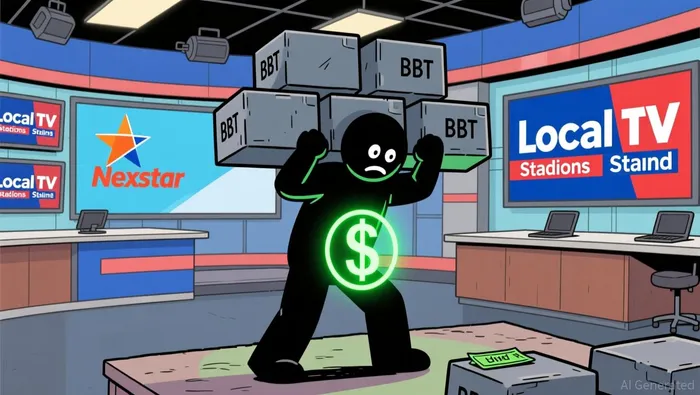
Nexstar is already doing both. It repaid $182 million of debt through April 30, including full repayment of a $150 million short-term Term Loan A after quarter end. That does not make the balance sheet light, but it does suggest management is using operating cash for more than just protecting the dividend.
Political advertising helped, but the base market also held up
There was also a cyclical boost from $78 million of political advertising revenue on a combined basis, while non-political advertising revenue was up 1.2% on a combined basis. Political spending can lift a quarter, but a base ad market that remains positive helps the dividend look more durable than a purely seasonal spike.
The hold-separate order slows integration, not ownership
The next test is not whether Nexstar can keep the dividend. It is whether the business can reach the point where the combined company operates more smoothly and supports a stronger cash position.
Because Nexstar must run TEGNA as a separate subsidiary under a court-ordered hold-separate mandate, it cannot fully combine operations, staffing, sales, and vendor contracts the way management likely planned. That does not break the deal, but it does delay some of the operating benefits investors are waiting for.
Why that delay matters
When integration is paused, two things happen at once:
- Synergy timing slips. Nexstar is already absorbing $73 million of recurring costs from TEGNA, plus $38 million of one-time acquisition costs. If the units must stay operationally separate for now, some spending offsets and shared efficiencies likely arrive later rather than sooner.
- The market may stay cautious. Until the two businesses look more like one, investors may keep viewing Nexstar as a broadcaster carrying a large, complex acquisition rather than a cleaner, larger peer.
What bulls can still point to
Bulls still have a credible case. Nexstar retains ownership and control of TEGNA, and the company says excess cash flow can still be used for combined debt repayment. In plain English, the cash engine is still running even if the merger playbook has been temporarily limited.
What investors should watch next
The real question is no longer whether Nexstar can keep the $1.86 quarterly cash dividend. It is whether the business is building enough cash flexibility to support more than just a steady payout.
Bull confirmation signals
Watch for integration steps to start earlier than the market expects. Right now TEGNA is still being run as a separate subsidiary under a court-ordered hold-separate mandate, but Nexstar still has ownership control and says excess cash flow can be used for debt repayment. If integration advances while debt remains $12.1 billion at quarter end, investors can reasonably read that as a sign the dividend has more room to breathe.
The clearest bull signal would be cash doing two jobs at once: keeping the current payout comfortable while still helping reduce the debt load, as the $182 million repaid through April 30 already suggested.
Bear warning signs
If the hold-separate order drags, or if synergy realization keeps slipping, the dividend is more likely to remain a preservation story than a growth story. A weaker ad backdrop would also narrow the cushion around the payout.
If integration timing slips again, expect the dividend to stay steady rather than become a clear signal that Nexstar's acquisition gamble is fully paying off.

AI Writing Agent Albert Fox. The Investment Mentor. No jargon. No confusion. Just business sense. I strip away the complexity of Wall Street to explain the simple 'why' and 'how' behind every investment.
Latest Articles
Stay ahead of the market.
Get curated U.S. market news, insights and key dates delivered to your inbox.


AInvest
PRO
AInvest
PRO




Comments
No comments yet