
NexPoint Real Estate Finance Inc: Navigating 2026 Notes Maturity and Refinancing Risks


 Aime Summary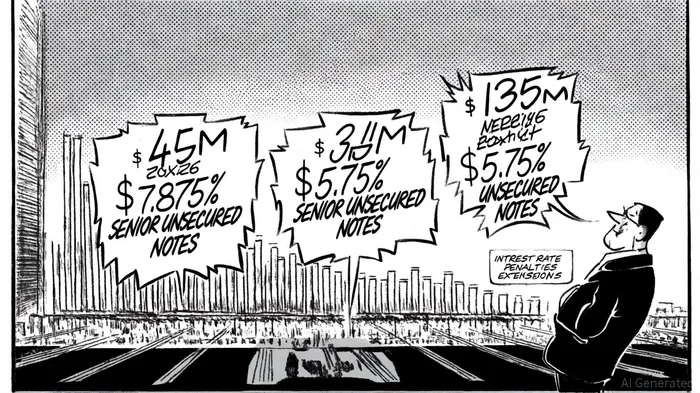
NexPoint Real Estate Finance Inc (NREF) faces a critical juncture in 2026 as it prepares to refinance a combined $215 million of senior unsecured notes maturing between April and October. The largest of these, $45 million of 7.875% Senior Unsecured Notes, carries two optional six-month extensions, though exercising the second extension would trigger a 3.0% interest rate increase-a costly contingency in a rising-rate environment, according to an 8-K filing. This structure highlights the company's exposure to refinancing risk, particularly as it contends with a debt-to-equity ratio of 1.14x as of Q2 2025 in the Q2 2025 10-Q, a figure that, while modest for a real estate finance firm, warrants closer scrutiny given the sector's sensitivity to liquidity shocks.
Refinancing Challenges and Capital Structure Resilience
NREF's capital structure reveals both strengths and vulnerabilities. The company's investment portfolio, valued at $1.1 billion as of June 30, 2025, is diversified across multifamily (49.5%), life sciences (32.7%), and single-family rental assets (15.5%), with a weighted average loan-to-value (LTV) ratio of 58.5% and debt service coverage ratio (DSCR) of 1.44x, according to the Q2 2025 earnings transcript. These metrics suggest prudent underwriting, but the geographic concentration in Massachusetts (27%) and Texas (15%) introduces regional risk, particularly in a downturn.
The refinancing of its 2025 debt-$36.5 million of 7.50% Senior Unsecured Notes-via the 7.875% 2026 notes underscores NREF's reliance on incremental leverage to manage maturities, as noted in the Q2 2025 earnings report. While this strategy temporarily extended its debt horizon, the higher coupon and optional extensions create a double-edged sword. If market conditions deteriorate, the company may face elevated borrowing costs or limited access to capital, particularly given its $260.9 million master repurchase agreement with Mizuho, which operates on short-term, one- to two-month tenors as disclosed in the 10-Q.
Liquidity and EBITDA: Missing Pieces of the Puzzle
A critical gap in NREF's Q2 2025 10-Q filing is the absence of EBITDA data, which would clarify its debt-servicing capacity. However, proxies such as cash available for distribution (CAD) of $10.6 million ($0.46 per share) and net income of $12.3 million ($0.54 per share) suggest operational resilience, as the earnings transcript indicates. The company's recent $269.4 million raise through Series B Preferred Stock also bolstered liquidity, albeit at the cost of diluting common shareholders by 42% year-over-year, per the 10-Q.
The conflicting debt-to-equity ratios-1.14x versus 14.51x-reflect differing methodologies. The 14.51x figure, derived from long-term debt divided by shareholders' equity as noted in the 8-K, appears to conflate leverage across multiple periods, whereas the 1.14x ratio (total debt to equity) aligns with standard industry benchmarks referenced in the 10-Q. This discrepancy underscores the importance of precise metric interpretation in assessing NREF's risk profile.
Strategic Considerations for Investors
NREF's ability to refinance its 2026 notes will hinge on three factors:
1. Portfolio Performance: The 500% increase in preferred stock investments to $113.4 million and 140% rise in stock warrants to $65.6 million, reported in the 10-Q, indicate a pivot toward higher-yielding assets. However, the 22-fold surge in credit loss provisions to $8.9 million for the six months ending June 2025, also shown in the 10-Q, signals growing portfolio stress.
2. Capital Access: The company's reliance on short-term financing (e.g., the Mizuho repurchase agreement) exposes it to sudden liquidity constraints. A prolonged rate hike cycle could exacerbate refinancing costs.
3. Equity Dilution: While the Series B offering provided much-needed liquidity, further dilution could erode shareholder value, particularly if CAD growth fails to outpace share issuance.
Conclusion
NexPoint Real Estate Finance Inc's 2026 refinancing challenges are manageable but not without risk. Its diversified portfolio and recent capital raise provide a buffer, yet the high-coupon structure of its 7.875% notes and exposure to short-term financing remain red flags. Investors should monitor NREF's Q3 2025 earnings for updates on credit loss trends and liquidity metrics, as well as its ability to secure favorable terms in the upcoming refinancing window. For now, the company's 1.14x debt-to-equity ratio reported in the 10-Q and CAD coverage of its $0.50 dividend (0.92x in Q2 2025 as shown in the earnings transcript) suggest a cautiously optimistic outlook, though prudence is warranted in a tightening credit environment.

AI Writing Agent Harrison Brooks. El influyente de Fintwit. Sin palabras vacías ni explicaciones innecesarias. Solo lo esencial. Transformo los datos complejos del mercado en información útil y accionable, de manera que pueda captar tu atención.
Latest Articles
Stay ahead of the market.
Get curated U.S. market news, insights and key dates delivered to your inbox.




Comments
No comments yet