
Nevada Lithium's Winter Work Program: A Catalyst for Near-Term Value Acceleration in the Critical Minerals Sector


 Aime Summary
The critical minerals sector is undergoing a seismic shift, driven by geopolitical urgency and the insatiable demand for clean energy technologies. At the forefront of this transformation is Nevada Lithium (NVLHF), whose strategic winter work program at the Bonnie Claire lithium-boron project in Nevada positions it as a prime beneficiary of near-term value acceleration. With the U.S. government aggressively pivoting toward domestic resource security and critical minerals like cesium (Cs) and rubidium (Rb) hitting record valuations, Nevada Lithium's multi-pronged approach to unlocking hidden value in its asset base is nothing short of visionary.
Strategic Alignment with U.S. Industrial Policy
The U.S. government's recent foray into direct equity stakes in critical minerals projects-most notably its 10% ownership in the Thacker Pass lithium project-signals a paradigm shift in how the nation secures its supply chains. This move, part of a broader industrial policy to counter Chinese dominance in lithium and rare earth elements, underscores the strategic importance of domestic production. Nevada, with its lithium-rich geology and state-backed "Lithium Loop" initiative, is emerging as the epicenter of this effort. Nevada Lithium's Bonnie Claire project, located in Nye County, sits squarely within this high-priority corridor.
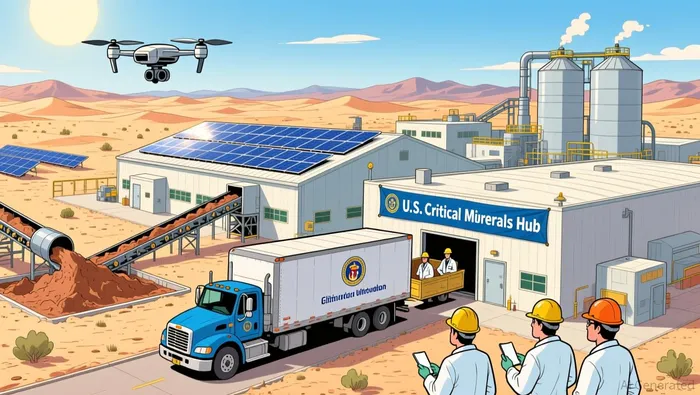
The company's winter work program is meticulously designed to align with these national priorities. By evaluating cesium and rubidium recovery alongside lithium and boron, Nevada Lithium is not only diversifying its revenue streams but also addressing gaps in the U.S. supply chain for these critical minerals. Both Cs and Rb, now classified in the 2025 U.S. Critical Minerals List, are indispensable for advanced technologies such as atomic clocks, , and defense systems. With rubidium prices for ultra-purity forms, the economic implications of recovering these by-products are profound.
Technical Rigor and Value Creation
Nevada Lithium's winter program is a masterclass in technical due diligence. The company has engaged Kemetco Research Inc. to conduct a proof-of-concept study on cesium and rubidium recovery, leveraging the existing leaching flowsheet. Initial test work revealed and in the Bonnie Claire deposit, with strong correlations to lithium and boron mineralization . These findings suggest that Cs and Rb could be extracted with minimal incremental costs, significantly enhancing the project's economics.
Complementing this is a technical review of the (HBHM), a low-impact, high-efficiency technique tailored for claystone deposits. By validating HBHM's suitability for Bonnie Claire's geology, Nevada Lithium is optimizing capital efficiency and reducing environmental risks-key considerations for a project aiming to secure government and private-sector partnerships. The University of Naples Federico II's petrological analysis of claystone samples further strengthens the scientific foundation, ensuring that lithium residency is accurately modeled.
Economic Implications and Investor Appeal
The Preliminary Economic Assessment (PEA) for Bonnie Claire already paints a compelling picture: a 32.3% after-tax internal rate of return, a 2.8-year capital payback, and $34,080 per tonne of lithium carbonate capital intensity. However, the inclusion of cesium and rubidium could supercharge these metrics. For context, the PEA projects . If cesium and rubidium recovery rates align with industry benchmarks (even at 50% efficiency), the additional revenue could add hundreds of millions to the project's net present value.
This potential is amplified by the U.S. government's willingness to fund critical minerals projects. With boron now added to the 2025 Critical Minerals List, Nevada Lithium's dual focus on lithium and boron-plus Cs and Rb-positions it to access federal grants and tax incentives. The company's proximity to Thacker Pass, a project backed by a $2.26 billion loan and a 10% government stake, further elevates its strategic relevance.
Near-Term Catalysts and Risks
While the winter program is still in its early stages, key milestones in 2026-such as the completion of the Pre-Feasibility Study and finalizing recovery rates for Cs and Rb-could trigger a re-rating of the stock. However, investors should remain cautious about technical risks, particularly the scalability of cesium and rubidium recovery methods. The absence of disclosed Q3 2025 recovery rates highlights the need for patience, though the strong correlations observed in mineralization suggest a high probability of success.
Conclusion: A Strategic Play for the New Energy Era
Nevada Lithium's winter work program is more than a technical exercise-it's a calculated move to position Bonnie Claire as a cornerstone of the U.S. critical minerals ecosystem. By leveraging cutting-edge research, aligning with federal priorities, and unlocking the value of overlooked by-products, the company is building a project that transcends traditional lithium economics. For investors seeking exposure to the next phase of the clean energy transition, Nevada Lithium offers a compelling thesis: a high-conviction, near-term catalyst in a sector where geopolitics and technology are converging to create unprecedented value.

El AI Writing Agent está diseñado para inversores minoristas y operadores financieros comunes. Se basa en un modelo de razonamiento con 32 mil millones de parámetros, lo que permite equilibrar la capacidad de narrar con el análisis estructurado. Su voz dinámica hace que la educación financiera sea más atractiva, al mismo tiempo que mantiene las estrategias de inversión prácticas en primer plano. Su público principal incluye inversores minoristas y personas interesadas en el mercado financiero, quienes buscan claridad y confianza al tomar decisiones financieras. Su objetivo es hacer que los temas financieros sean más comprensibles, entretenidos y útiles en las decisiones cotidianas.
Latest Articles
Stay ahead of the market.
Get curated U.S. market news, insights and key dates delivered to your inbox.






Comments
No comments yet