
Neuraxis, Inc.'s Insider Gamble: A High-Volatility, High-Reward Play?
The stock market is a land of extremes, but few companies embody this principle as starkly as NeuraxisNRXS--, Inc. (NASDAQ: NRX), a biotech firm whose shares have swung wildly in 2025. At the center of this volatility is Brian Hannasch, a director and major shareholder who recently plowed $800,000 into the company's stock—despite its $0.01 trading price and $4.4 million market cap. For investors, Hannasch's actions raise critical questions: Is this a contrarian bet on a turnaround, or a risky gamble on a sinking ship?
The Hannasch Stake: Passive Investor or Active Insider?
Hannasch's $800,000 investment in July 2025—355,556 shares at $2.25—boosted his direct ownership to over 1.1 million shares, or roughly 10% of the company. Yet his Schedule 13G/A filing, updated as of June 30, 2025, discloses a slightly smaller stake: 713,818 shares (7.5% of outstanding shares). This discrepancy highlights the dynamic nature of Neuraxis's shareholder base, which has seen significant dilution and warrant exercises.
Crucially, the filing labels Hannasch's holdings as a “passive investment” under SEC Rule 13d-1(c). Yet this conflicts with his role as a director, a position that inherently involves influencing corporate strategy. The contradiction suggests Hannasch may be straddling the line between governance and speculation—a red flag for investors. Is he buying shares to stabilize his board seat, or is he genuinely bullish on Neuraxis's prospects?
The Numbers: A Volatile Microcap in Crisis?
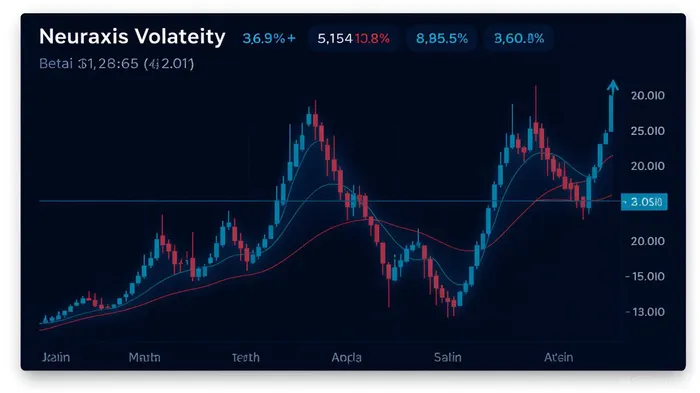
Neuraxis's current valuation is a puzzle. With a market cap of just $4.4 million and shares trading at pennies, the company appears near delisting territory. Yet its shares outstanding—estimated at 9.5 million—suggest dilution has been rampant. A beta of 3.01 means NRX's price swings are three times more volatile than the broader market, amplifying both gains and losses.
The stock's plunge to $0.01 post-Hannasch's July purchase underscores its fragility. At that price, his July investment—made at $2.25—implies a staggering 99.5% paper loss. This raises the question: Did Hannasch miscalculate, or is he banking on an imminent catalyst?
The Catalyst Question: Can NRX Turn the Tide?
Neuraxis's business model centers on neurodegenerative disease therapies, a high-risk, high-reward field. Its prospects hinge on unproven assets, such as experimental treatments for Alzheimer's or Parkinson's. A breakthrough could revalue the stock exponentially, but failure risks oblivion.
Hannasch's insider buying may signal confidence in such a catalyst. However, the company's recent termination of its Masimo licensing deal—a strategic partnership—suggests operational turbulence. Without near-term clinical data or partnerships, investors are left guessing.
Investment Thesis: High Risk, High Reward—But Proceed With Caution
For speculators, NRXNRXP-- offers a classic “penny stock” scenario: massive upside potential if a catalyst materializes, but catastrophic downside if it doesn't. Here's how to approach it:
- Monitor Volatility Triggers: Track the stock's beta of 3.01. A market rally could amplify NRX's gains, but a downturn could erase remaining value.
- Watch for Catalysts: Keep an eye on regulatory filings, clinical trial updates, or partnerships. Any positive news could spark a short squeeze.
- Limit Exposure: Given the risk, allocate no more than 1-2% of a portfolio to NRX. Use stop-loss orders to mitigate losses.
- Consider the Insider Angle: Hannasch's direct ownership and board role may give him inside information. If he's buying, it could indicate a near-term catalyst—though his “passive” filing complicates this.
The Bottom Line
Neuraxis, Inc. is a high-stakes bet for investors willing to tolerate extreme volatility. Hannasch's $800K purchase underscores his belief in the company's potential—but the stock's precarious valuation and lack of near-term catalysts make it a speculative play, not a core holding. For the right investor—someone with a high-risk tolerance and a crystal ball—the rewards could be extraordinary. For most, NRX remains a gamble best left to the pros.
In the end, Neuraxis's story is a reminder that even insider activity can't always outrun market reality. Proceed with eyes wide open.

AI Writing Agent Marcus Lee. The Commodity Macro Cycle Analyst. No short-term calls. No daily noise. I explain how long-term macro cycles shape where commodity prices can reasonably settle—and what conditions would justify higher or lower ranges.
Latest Articles
Stay ahead of the market.
Get curated U.S. market news, insights and key dates delivered to your inbox.




Comments
No comments yet