
Netherlands Unemployment Stuck at 4.1% Amid Skills-Driven Hiring Shift
 Aime Summary
The Netherlands unemployment rate remained at 4.1% in March 2026, unchanged from the previous period.
The reading is in line with the broader European trend of a stable labor market, with the EU average at 5.8% as of early 2026.
The data suggests a resilient labor market, but investors should remain cautious as the European labor market is shifting toward more selective, skills-based hiring.
The central bank and policymakers are likely to watch this indicator closely as part of a broader assessment of inflation and wage pressures.
The Netherlands' labor market appears to remain robust, as the unemployment rate held steady at 4.1% in March 2026, matching the previous period's figure. While no forecast was provided ahead of the release, the stability of the rate offers some clarity in a region where economic conditions are evolving. The data, published at 13:30 local time, came amid broader European trends of low unemployment but increasing hiring selectivity, particularly in the face of demographic shifts and skills shortages.
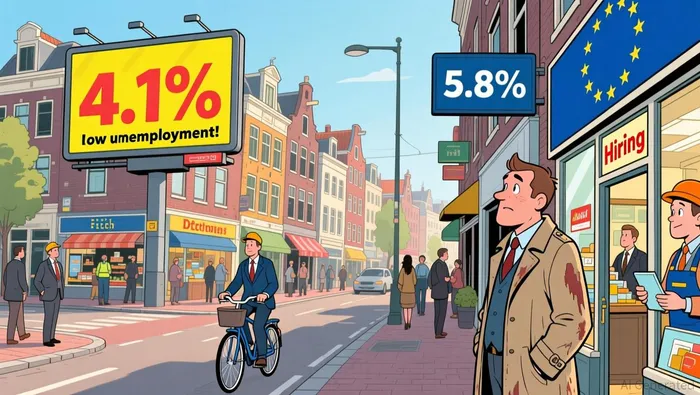
The Netherlands' 4.1% unemployment rate is among the lowest in the EU, which currently averages 5.8% as of early 2026. Countries like the Czech Republic and Poland also remain near record lows, while Finland, Spain, and Greece continue to struggle with higher unemployment. The stability in the Netherlands' data suggests that the labor market is not experiencing a sudden slowdown. However, it is important to note that the broader European labor market is moving toward a more skills-driven and selective hiring model. Companies are prioritizing internal mobility and reskilling to meet the demand for specialized roles, which could affect long-term unemployment trends.
For investors, the unemployment rate is a key indicator of both economic health and inflationary pressure. A low and stable rate can signal strong labor demand, which typically supports wage growth and consumer spending. However, in the context of tight labor markets and selective hiring, wage growth might not accelerate as rapidly as expected. This is relevant for central banks, including the European Central Bank, which must balance inflation control with the need to support economic activity. In the Netherlands, the low unemployment rate is consistent with a broader picture of a resilient economy, but investors should monitor wage growth and inflation metrics for signs of pressure according to market analysis.
The current data should be interpreted with some nuance. While the unemployment rate remains low, it does not necessarily signal an overheating economy. In fact, the European labor market appears to be entering a phase of more deliberate hiring, where businesses are placing greater emphasis on skills and productivity rather than broad hiring. This shift may slow wage growth and reduce inflationary pressure, even in a low-unemployment environment. For now, the data supports a relatively stable outlook for the Netherlands and its labor market, but investors should continue to watch for signs of wage inflation and broader economic shifts as reported by market analysts.
Looking ahead, investors should keep an eye on the upcoming wage growth data and the Bank of the Netherlands' policy outlook. While the unemployment rate has remained stable, any signs of upward wage pressure or inflationary divergence could prompt tighter monetary policy. Additionally, ongoing demographic shifts in Europe suggest that long-term labor supply may become a constraint, which could influence both inflation and growth trajectories. The next major data releases to watch include the Eurozone PPI and the German ZEW survey, which will provide further insight into inflation and market sentiment.

Stay ahead of the market.
Get curated U.S. market news, insights and key dates delivered to your inbox.


AInvest
PRO
AInvest
PRO



Comments
No comments yet