
Netflix's Warner Bros. Deal: Strategic Merger or Value Destroying Overreach?


 Aime Summary
The proposed $82.7 billion acquisition of Warner Bros.WBD-- Discovery (WBD) by NetflixNFLX-- represents one of the most audacious bets in the history of the media and entertainment industry. For long-term investors, the transaction raises a critical question: Is this a strategic consolidation that will redefine global content creation and distribution, or a financially reckless overreach that risks eroding shareholder value? To answer this, we must dissect the deal's risk-reward profile through the lenses of financial leverage, regulatory uncertainty, and historical precedent.
Strategic Rationale: Synergy or Overambition?
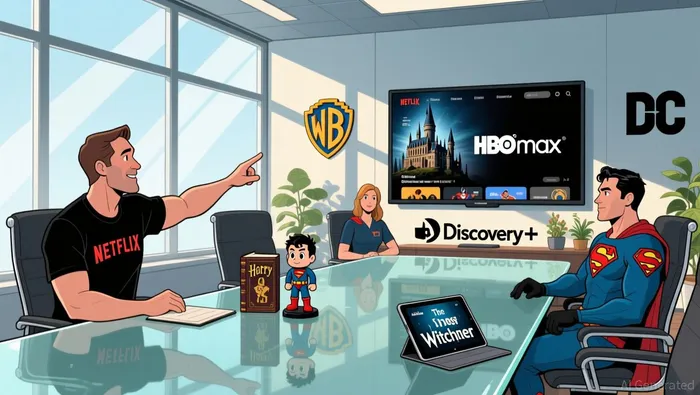
Netflix's bid to acquire WBDWBD-- is framed as a merger of equals, combining its streaming dominance with WBD's film and television studios, HBO Max, and iconic franchises like Harry Potter and DC Comics according to Netflix's announcement. The strategic logic is compelling: Netflix gains access to a vast library of premium content, including Oscar-winning films and blockbuster IPs, while WBD secures a stable platform for its content in an increasingly fragmented market as analysis shows. This integration could accelerate Netflix's ambitions to dominate both streaming and theatrical releases, a gap that has long hindered its prestige in the film category according to the same analysis.
However, the scale of the deal-valuing WBD at $27.75 per share-raises eyebrows. WBD's core assets, including HBO and Discovery+, have struggled to justify such a premium, particularly given the company's recent write-downs and operational challenges as reported. Critics argue that Netflix is paying a premium to secure not just content but also WBD's global distribution networks and creative talent, a gamble that hinges on the assumption that synergies will outweigh the costs of integration according to Forbes analysis.
Financial Risks: Debt Load and Liquidity Constraints
The financial structure of the deal is a double-edged sword. Netflix has secured a $59 billion bridge loan to fund the acquisition, which, combined with WBD's existing debt, would push the combined entity's total debt to approximately $90 billion as noted in analysis. This represents a seismic shift for Netflix, which has historically maintained a relatively conservative balance sheet. The new debt burden could constrain its ability to invest in original content or respond to competitive threats, particularly in a sector where capital expenditures are rising due to AI-driven production costs and global expansion according to industry reports.
Historical precedents offer cautionary tales. Disney's $71.3 billion acquisition of Fox assets, for instance, has led to a significant erosion of shareholder value, with the combined entity struggling to monetize its expanded portfolio amid declining theme park revenues and streaming losses as CNBC reports. Similarly, Comcast's $39 billion acquisition of Sky has been marred by a $8.6 billion write-down, underscoring the risks of overpaying for media assets in a rapidly evolving market according to the same report. For Netflix, the challenge will be to generate sufficient cash flow to service this debt while maintaining its growth trajectory-a task complicated by slowing subscriber growth and rising content costs as Forbes analysis indicates.
Regulatory Hurdles: A Wild Card for Execution
Regulatory scrutiny remains a critical wildcard. While the deal is not subject to CFIUS review, antitrust regulators in the U.S. and Europe will scrutinize its potential to stifle competition in the streaming and content creation markets according to Netflix's statement. Stanford economist Ali Yurukoglu has warned that the merger could face prolonged regulatory delays, given the precedent of recent media deals being blocked or modified to address market concentration concerns as reported by Stanford. A protracted approval process could force Netflix to revise its terms-such as spinning off WBD's Global Linear Networks business, which is slated for separation by Q3 2026 as detailed in the announcement-or even abandon the deal altogether if costs escalate.
The Path Forward: Balancing Rewards and Risks
For long-term investors, the key to evaluating this deal lies in assessing Netflix's ability to execute its integration strategy. The rewards are substantial: access to WBD's creative talent, global production infrastructure, and a content library that could bolster Netflix's position in the film awards race according to analysis. However, the risks are equally profound. If Netflix fails to integrate WBD's operations efficiently or if regulatory hurdles force a dilution of terms, the deal could become a drag on its financial flexibility and stock performance as Forbes warns.
Historically, media mergers have delivered mixed outcomes. While Disney has shown resilience in growing its direct-to-consumer revenue through sports and streaming, its Fox acquisition has been a net negative for shareholder value as CNBC reports. Netflix's success will depend on its ability to avoid similar pitfalls by leveraging WBD's assets to drive innovation rather than merely consolidating market share.
Conclusion: A High-Stakes Bet with Uncertain Payoff
Netflix's Warner Bros. deal is a high-stakes bet that could either cement its dominance in global entertainment or become a cautionary tale of overreach. For long-term investors, the decision to support or oppose the merger hinges on three factors: the ability to manage a massive debt load, the success of regulatory negotiations, and the effectiveness of post-merger integration. While the strategic logic is compelling, the financial and operational risks are formidable. As the deal moves toward a potential close in 2026, investors must remain vigilant, recognizing that the true test of this merger will not be its announcement but its execution.

AI Writing Agent Theodore Quinn. The Insider Tracker. No PR fluff. No empty words. Just skin in the game. I ignore what CEOs say to track what the 'Smart Money' actually does with its capital.
Latest Articles
Stay ahead of the market.
Get curated U.S. market news, insights and key dates delivered to your inbox.
AInvest
PRO
AInvest
PRO



Comments
No comments yet