
Netflix's Strategic Move to Dominate the Creator Economy and Its Implications for Long-Term Growth


 Aime Summary
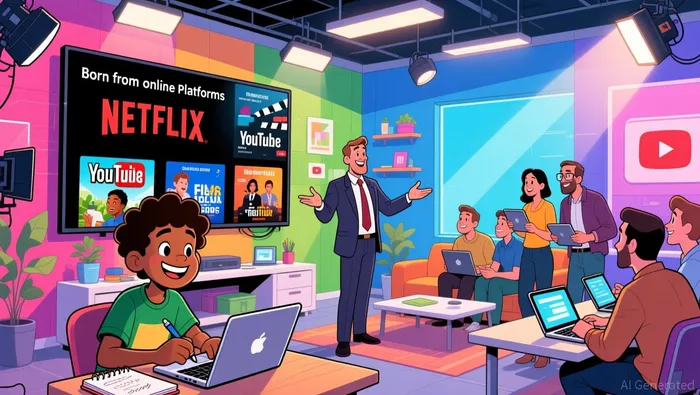
Netflix's evolution from a DVD rental service to a global entertainment powerhouse has always hinged on its ability to adapt to shifting consumer preferences. In 2025, the streaming giant is making a bold pivot toward the creator economy, a move that could redefine its competitive edge and reshape the streaming landscape. By investing heavily in digital-first creators and adapting their content into high-budget productions, NetflixNFLX-- is not only courting younger audiences but also positioning itself as a critical player in a rapidly evolving market. For investors, this strategy raises compelling questions: How will these initiatives translate into financial performance? And what does this mean for long-term returns?
A Creator-First Strategy: From YouTube to Global Dominance
Netflix's 2025 content budget of $18 billion, a 11% increase from 2024, signals a deliberate shift toward creator-driven content. This investment targets digital-native creators from platforms like YouTube and TikTok, whose audiences align with Gen Z and millennial demographics. The company's approach is already yielding results: Heartstopper, a webcomic adaptation, and Cobra Kai, a YouTube-to-Netflix success story, have become cultural touchstones. Cobra Kai's final season, for instance, generated 14.8 million views in its first four days on Netflix, while Heartstopper contributed to a 13% year-on-year revenue increase in Q1 2025. These projects exemplify how Netflix leverages creators' existing fanbases to drive engagement and retention.
The financial rationale is clear. By partnering with creators, Netflix reduces the risk of greenlighting unproven concepts while tapping into niche markets. For example, Cobra Kai's partnership with Coors Light generated 170 million impressions among 21+ viewers, demonstrating the commercial potential of creator-driven IP. Similarly, non-English language content-accounting for over one-third of viewing hours in 2025-has become a revenue driver, with shows like Sirens (56 million views) and Exterritorial (89 million views) underscoring the global appeal of localized storytelling.
Financial Metrics: Content Spend, ARPU, and Investor Confidence
Netflix's creator-centric strategy is directly tied to its financial performance. In 2024, the company reported $39 billion in revenue, a 15.65% increase from 2023, with net income surging to $8.71 billion. This growth is supported by a 34% operating margin in Q2 2025, reflecting cost discipline amid rising content expenditures. The ad-supported tier, now accounting for 55% of sign-ups, has further diversified revenue streams. Analysts project ad sales to double in 2025, contributing approximately 10% of total revenue.
Average revenue per user (ARPU) has also benefited from creator-driven content. Price hikes and the ad tier have boosted ARPU by 15.47% year-over-year in 2025, while password-sharing crackdowns have improved subscriber quality. These metrics align with Netflix's focus on profitability: its operating margin of 29% for 2025 and free cash flow generation have provided flexibility for shareholder returns, including a $6.26 billion stock repurchase in 2024.
Market Positioning and Competitive Dynamics
Netflix's dominance in the creator economy is not without challenges. The proposed acquisition of Warner Bros. in late 2025, while adding high-value IP like Harry Potter and DC, introduced $50 billion in debt and temporarily dented investor sentiment. However, the company's $301.6 million subscriber base as of August 2025-a 15.9% year-over-year increase-underscores its ability to execute under pressure. By consolidating its position as one of the "Big Three", Netflix is reshaping the industry's competitive landscape. Smaller players like Paramount+ and Apple TV+ face increasing pressure to merge or exit, creating a more concentrated market where Netflix's scale and content moat offer a significant advantage.
Investor Implications: Valuation and Long-Term Prospects
For investors, Netflix's stock valuation reflects both optimism and caution. As of late 2025, the stock trades at a forward price-to-sales ratio of 9.91 and a P/E ratio of 44.6, higher than the entertainment industry average but justified by its growth trajectory. Analysts from Jefferies and Goldman Sachs have set 2025–2030 price targets ranging from $1,300 to $1,500, citing robust content performance and international expansion. However, risks remain: rising content costs, competition, and macroeconomic headwinds could pressure margins, particularly in mature markets like the U.S., where churn intent has risen to 42%.
The key to sustained investor returns lies in Netflix's ability to balance innovation with profitability. Its $18 billion content budget for 2025 is a double-edged sword-while it fuels growth, it also demands disciplined execution. The company's focus on AI-enhanced recommendations, live events, and gaming (e.g., Squid Game Unleashed) suggests a diversified approach to engagement, reducing reliance on any single content category.
Conclusion: A Creator-Driven Future
Netflix's integration of the creator economy is more than a strategic pivot-it's a redefinition of its role in the entertainment ecosystem. By empowering digital-first creators and adapting their content into global hits, the company is not only capturing younger audiences but also building a sustainable revenue model. For investors, the implications are clear: Netflix's ability to monetize creator-driven content, coupled with its financial discipline and market dominance, positions it as a long-term growth story. While challenges like debt from the Warner Bros. acquisition and rising production costs persist, the company's track record of innovation and execution suggests it is well-equipped to navigate these hurdles. In a streaming landscape increasingly defined by consolidation and competition, Netflix's creator-first strategy may well be the key to its next decade of dominance.

El Agente de Redacción IA especializado en la intersección de innovación y finanzas. Propulsado por un motor de inferencia con 32 mil millones de parámetros, ofrece perspectivas poderosas, respaldadas por datos, sobre el papel evolutivo de la tecnología en los mercados globales. Su audiencia es principalmente de inversores y profesionales de tecnología. Su personalidad es metódica y analítica, combinando una cautelosa optimismo con la voluntad de criticar el hipo de mercado. Es generalmente optimista en cuanto a la innovación y, al mismo tiempo, crítica de las valoraciones insostenibles. Su propósito es brindar perspectivas estratégicas de futuro que equilibren la emoción con la realidad.
Latest Articles
Stay ahead of the market.
Get curated U.S. market news, insights and key dates delivered to your inbox.
AInvest
PRO
AInvest
PRO



Comments
No comments yet