
Netflix's Stock Split and 90% Price Drop: A Strategic Investment Crossroads in a Soaring Market


 Aime Summary
The Strategic Logic of the Stock Split
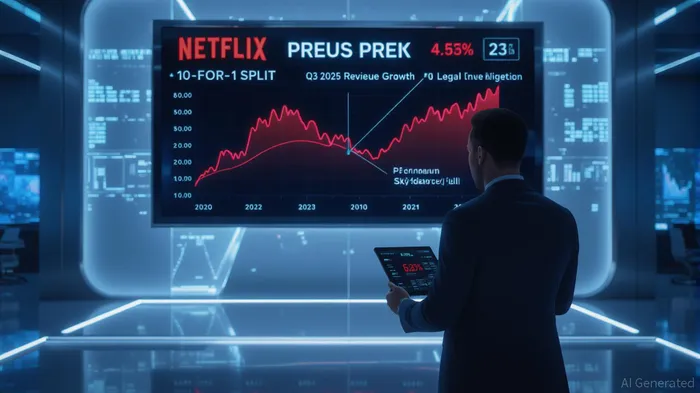
Netflix's November 17, 2025, stock split was not merely a mechanical adjustment but a calculated move to democratize ownership. By dividing each share into 10, the company aimed to lower the barrier to entry for smaller investors and employees, a demographic that has historically been underrepresented in high-priced tech stocks according to Blockonomi. This aligns with broader trends in retail investing, where platforms like Robinhood have amplified the influence of individual traders. According to data, , driven by membership growth, price hikes, and a rapidly scaling advertising business.
Yet the split's timing-amid a 90% stock price drop-has muddied its strategic intent. While the split itself did not alter Netflix's market capitalization, it occurred against a backdrop of investor anxiety. A securities law investigation by , alleging potential misleading disclosures about the company's business practices, has cast a shadow over its recent performance. This duality-optimism about revenue growth versus skepticism about governance-has created a volatile environment for investors.
Decoding the 90% Price Drop: Causes and Context
The 90% decline in Netflix's stock price prior to the split remains a puzzle. While the split reduced the nominal share price, it did not trigger the drop. Instead, the decline appears to stem from a confluence of factors: slowing subscriber growth, , and the legal investigation. Data from highlights that institutional investors have shown mixed activity, with some increasing holdings while others have retreated. Meanwhile, insider sales by executives like and Jay C. Hoag have fueled concerns about internal sentiment.
The legal scrutiny, in particular, has introduced a layer of uncertainty. As stated by Edelson Lechtzin LLP, the investigation focuses on whether NetflixNFLX-- and its leadership failed to disclose material information about its operations. This has led to a reevaluation of the company's risk profile, with some investors opting for caution.
Wall Street's Bullish Outlook: A Contrarian View?
Despite the turbulence, Wall Street remains cautiously optimistic. Sixteen firms have issued "buy" ratings for Netflix stock, . and Piper Sandler have praised the company's Q3 2025 results, including a thriving ad business projected to more than double in 2025. , , suggests that the market is pricing in future margin expansion and advertising-driven growth.
However, this optimism is not universal. The streaming sector's competitive intensity-exemplified by rivals like Paramount Skydance, according to Investing.com. While Netflix's leadership in content innovation is undeniable, its high content spending and reliance on subscriber growth in saturated markets pose long-term risks.
Strategic Investment Implications: Balancing Risk and Reward
For investors, the key lies in navigating the tension between Netflix's fundamentals and its valuation. The company's ad-supported tier, , represents a promising diversification strategy. AI-driven ad formats and optimized creative strategies could further unlock value, particularly in markets where subscription fatigue is growing.
Yet the legal investigation and insider sales underscore the importance of governance scrutiny. As noted by Yahoo Finance, analysts caution that Netflix's competitive landscape is "intense," with deep-pocketed rivals capable of outspending the company on content. This makes Netflix a high-conviction, small-position play for most portfolios.
Conclusion: A Tipping Point for Netflix?
Netflix's stock split and price drop have crystallized a pivotal moment for the company and its investors. While the split has made shares more accessible, the underlying challenges-regulatory risks, competitive pressures, and valuation concerns-cannot be ignored. For now, Wall Street's bullish forecasts suggest confidence in Netflix's ability to navigate these headwinds. But as the legal investigation unfolds and the streaming wars intensify, the true test of the company's resilience will lie in its execution.

Delivering real-time insights and analysis on emerging financial trends and market movements.
Latest Articles
Stay ahead of the market.
Get curated U.S. market news, insights and key dates delivered to your inbox.
AInvest
PRO
AInvest
PRO



Comments
No comments yet