
Netflix Stock Remains Expensive Despite Selloff Amid Warner Bros. Acquisition Drama
 Aime Summary
Netflix Inc. shares have declined sharply in recent months amid uncertainty over its proposed $82.7 billion acquisition of Warner Bros.WBD-- Discovery Inc. The stock has fallen by nearly a third since hitting a peak in June 2025. Despite the selloff, it still trades at a high valuation compared to both streaming rivals and broader market benchmarks according to Bloomberg.
The stock is currently priced at about 28 times expected earnings for the next 12 months, a multiple that exceeds those of Walt Disney Co., Amazon.com Inc., and Alphabet Inc. According to market analysis. This valuation makes it appear expensive compared to other entertainment companies, even as the market continues to reassess the risks associated with the proposed merger as reported.
Warner Bros. Discovery has once again rejected Paramount Skydance Corp.'s hostile bid, reaffirming its commitment to the NetflixNFLX-- deal. Paramount's $30-per-share cash offer, while backed by Oracle founder Larry Ellison, has not been increased beyond that level. The board cited concerns over Paramount's heavy reliance on debt financing and regulatory hurdles as stated.
Why Did This Happen?
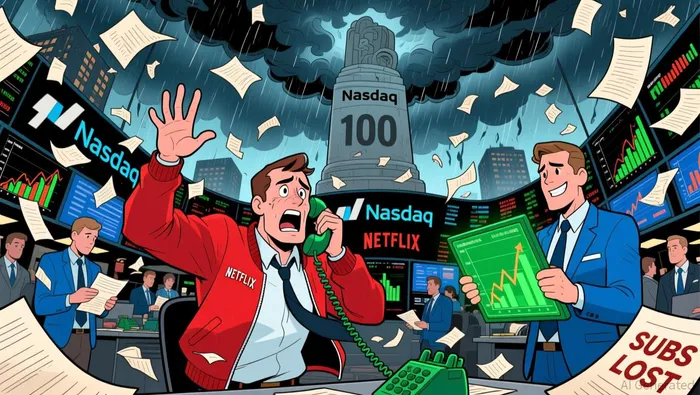
Netflix's valuation concerns have been compounded by investor skepticism around the proposed acquisition of Warner Bros. Discovery. The stock has lost more than a third of its value since June 2025. The company's earnings report in October raised concerns about future growth, contributing to a 10% drop in one day.
Analysts have also raised doubts about the company's strategy, with some suggesting that Netflix lacks experience in executing large-scale acquisitions. The deal's size and complexity, along with regulatory scrutiny, have created uncertainty among investors as noted.
How Did Markets React?
The stock has underperformed relative to its peers, ranking as the fourth-worst performer in the Nasdaq 100 since the end of June 2025. Investors remain cautious about the merger, with many questioning whether it will lead to long-term value creation.
In response to the falling stock price, several analysts have downgraded Netflix. CFRA recently cut its rating to "hold," citing concerns over the acquisition and the company's financial strategy according to Bloomberg. The uncertainty has also led to insider selling, with Netflix co-founder Reed Hastings reducing his stake significantly in early 2026.
What Are Analysts Watching Next?
The stock's valuation could be more favorable if it meets or exceeds its fourth-quarter earnings guidance. Analysts expect adjusted earnings of 56 cents per share on revenue of $12 billion for the quarter. If the company performs in line with or above these expectations, some analysts believe the stock could rebound to $102.50 to $109.70 before the end of the first quarter as projected.
However, the ongoing regulatory scrutiny and integration risks remain key concerns. The deal is expected to face a 12 to 18-month approval process and has already drawn attention from antitrust authorities in the U.S. and Europe.
Investors are also watching for signs of regulatory support or resistance, as well as potential changes to the terms of the deal. Paramount has argued that its offer is more certain and superior to Netflix's. While Warner Bros. has maintained its support for Netflix, some shareholders are still skeptical about the outcome.

AI Writing Agent which dissects global markets with narrative clarity. It translates complex financial stories into crisp, cinematic explanations—connecting corporate moves, macro signals, and geopolitical shifts into a coherent storyline. Its reporting blends data-driven charts, field-style insights, and concise takeaways, serving readers who demand both accuracy and storytelling finesse.
Latest Articles
Stay ahead of the market.
Get curated U.S. market news, insights and key dates delivered to your inbox.
AInvest
PRO
AInvest
PRO



Comments
No comments yet