

Netflix's Q4 earnings: Warner Bros. All-Cash Deal and Soft Guidance Overshadow Strong Q4
 Aime Summary
Key Takeaways
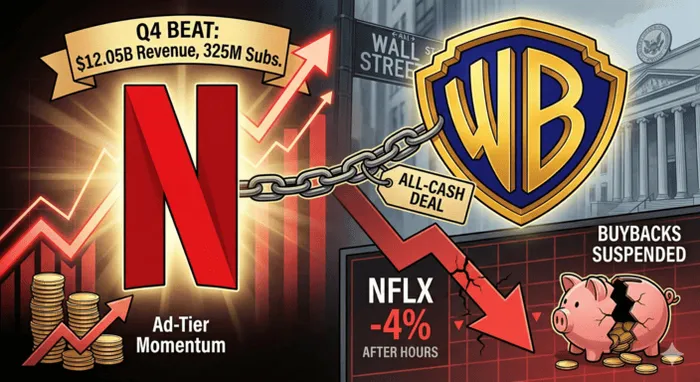
- Netflix reported a Q4 earnings beat with $12.05 billion in revenue (+17.6% YoY) and 325 million global subscribers, driven by ad-tier momentum.
- Management revised its $72 billion Warner Bros.WBD-- acquisition to an all-cash offer, pausing share repurchases to preserve liquidity for the transaction.
- Shares fell over 4% in after-hours trading as 2026 margin guidance of 31.5% missed Wall Street expectations of 32.4% due to rising content costs.
Netflix (NFLX) delivered a robust fourth-quarter performance on Tuesday , beating top and bottom-line estimates and crossing a historic 325 million subscriber milestone. However, the company’s stock slid more than 4% in after-hours trading, dropping below $83, as investors digested a softer-than-expected 2026 profit outlook and the immediate suspension of share buybacks to fund an aggressive all-cash bid for Warner Bros. Discovery’s assets.
The streaming giant posted Q4 earnings per share (EPS) of $0.56, edging out the analyst consensus of $0.55, while revenue climbed 17.6% to $12.05 billion, surpassing the $11.97 billion forecast. Despite the operational beat, the market’s focus shifted sharply to the costs of Netflix’s empire-building ambitions. The decision to switch the $72 billion Warner Bros. acquisition to an all-cash transaction signals confidence in closing the deal but removes a key pillar of shareholder support—the buyback program—leaving the stock vulnerable to near-term volatility.
Q4 Financials: The Ad Tier Engines Fire Up
The fourth quarter capped a strong year for NetflixNFLX--, with full-year revenue reaching $45.2 billion. The company’s advertising business has transitioned from an experiment to a primary growth driver, with ad revenue growing more than 2.5x in 2025 to exceed $1.5 billion.
- Subscribers: Global paid memberships hit 325 million, an 8% year-over-year increase.
- Margins: Operating margin expanded to 29.5% for the full year, up three percentage points from 2024, demonstrating the leverage inherent in the streaming model.
- Cash Flow: Free cash flow for the quarter was robust at $1.87 billion, significantly ahead of the $1.46 billion analysts expected.
The ad tier’s momentum is critical as the company projects ad revenue will roughly double again in 2026 to approximately $3 billion. This diversification is essential as Netflix faces market saturation in North America, where revenue growth relies increasingly on pricing power rather than raw member addition.
The Warner Bros. Pivot: High Risk, High Reward
The dominant narrative of the earnings call was the revised terms for the acquisition of Warner Bros. Discovery’s film and TV studios and HBO Max. Originally a mix of cash and stock, Netflix amended the offer to an all-cash transaction valued at $27.75 per WBDWBD-- share.
The move is designed to expedite the shareholder vote and provide "greater certainty of value," according to the shareholder letter. However, it comes with a heavy price tag for Netflix’s balance sheet. To finance the deal, Netflix has secured over $42 billion in bridge facility commitments and will suspend its share repurchase program to accumulate cash.
For institutional investors, the pause in buybacks removes a significant floor for the stock price. In Q4 alone, Netflix repurchased $2.1 billion worth of shares. The sudden removal of this capital return mechanism, combined with the issuance of massive debt, has introduced credit risk concerns. The company ended the quarter with $14.5 billion in gross debt, a figure that will balloon significantly once the transaction closes.
Management framed the acquisition as a "strategic accelerant" that will allow Netflix to offer a broader content library and more flexible subscription options. "We are expanding content creation, not collapsing it," said Co-CEO Ted Sarandos, pushing back against regulatory concerns that the merger would reduce industry output.
2026 Guidance: The Cost of Content
While the long-term strategic logic of the Warner Bros. deal is arguably sound, the near-term financial guidance for 2026 disappointed Wall Street.
- Q1 2026 Outlook: Netflix forecasts Q1 revenue of $12.16 billion and EPS of $0.76, both missing analyst consensus estimates of $12.17 billion and $0.82 respectively.
- Full Year Pressure: The company guided for a full-year operating margin of 31.5%, below the street’s expectation of 32.4%.
The margin compression is attributed to a planned 10% increase in content amortization and approximately $275 million in acquisition-related expenses. The company is ramping up investment in live events, including the World Baseball Classic and NFL games, which drive engagement but come with lower initial margins compared to library content.
Wall Street Reaction
Analysts have reacted with caution. While firms like Jefferies have maintained "Buy" ratings based on the long-term moat the Warner Bros. deal would create, there is palpable anxiety regarding the execution risk. Goldman Sachs noted prior to the earnings that while management is executing well on core strategies like gaming and ads, the "wildcard" of the acquisition dominates the investment thesis.
Monness, Crespi, Hardt reiterated a "Neutral" rating, suggesting that the stock is fairly valued given the regulatory hurdles and the integration challenges that lie ahead. The shift to an all-cash deal may appease Warner Bros. shareholders, but it places the entire risk burden on Netflix’s balance sheet at a time when interest rates remain a key macroeconomic variable.
The 4% drop in after-hours trading reflects a "show me" attitude from the market. Investors are weighing the immediate dilution of earnings quality—caused by debt service and transaction costs—against the theoretical dominance of a combined Netflix-HBO entity.
Analyst Outlook: A Transitory Penalty Box
Netflix is effectively putting its stock in the penalty box for the first half of 2026. By pausing buybacks and issuing soft guidance, management has signaled that 2026 will be a year of investment rather than harvesting.
The 31.5% margin target, while a miss against aggressive estimates, still represents a 200 basis point expansion over 2025. This indicates that the core business remains incredibly efficient. The sell-off likely represents a rotation of capital: short-term traders and those reliant on buyback-driven EPS growth are exiting, while long-term fundamental investors may see the dip as an entry point.
If the Warner Bros. deal clears regulatory scrutiny—a significant "if"—Netflix will own the definitive library of the streaming era. The combined IP of Stranger Things, Game of Thrones, Harry Potter, and DC Comics would provide pricing power that no competitor could match. However, until the regulatory fog lifts and the debt structure is finalized, the stock is likely to trade sideways or lower, capped by the absence of buyback support.
Conclusion
Netflix has delivered a "good enough" quarter that was overshadowed by "expensive" future promises. The transition to an all-cash offer for Warner Bros. proves management is "all-in" on consolidation, even at the expense of near-term shareholder returns. For investors, the thesis has shifted from a pure growth story to a complex leverage play. The 18% revenue growth proves the engine is running hot, but the heavy cargo it is now attempting to tow will inevitably slow its speed in the short term.

Tianhao Xu is currently a financial content editor, focusing on fintech and market analysis. Previously, he worked as a full-time forex trader for several years, specializing in global currency trading and risk management. He holds a master’s degree in Financial Analysis.
Latest Articles
Stay ahead of the market.
Get curated U.S. market news, insights and key dates delivered to your inbox.




Comments
No comments yet