
Netflix Earnings Tuesday: Breakout Bounce… or a Full-On “Puke” Below Support?


 Aime Summary
Netflix heads into Tuesday's earnings report with the stock already trading like investors are bracing for impact. Shares are down roughly 25% over the past three months and off about 6% YTD, putting NFLXNFLX-- in a clear downward trend even as the company’s fundamentals have remained broadly intact. That disconnect is what makes this setup so interesting: the business still looks healthy, but the market is demanding proof — again — that Netflix deserves to trade like the cleanest story in streaming.
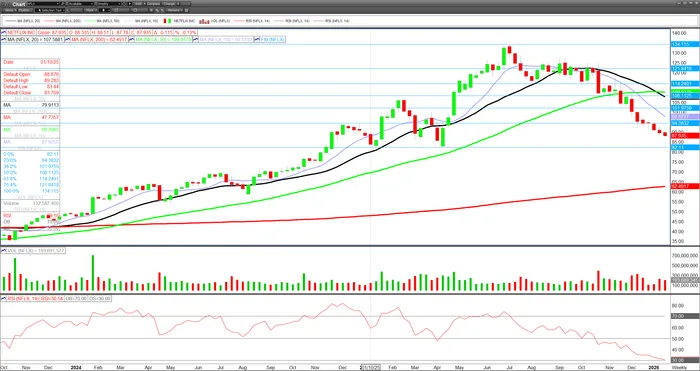
This isn’t just “another quarter.” The chart has tightened into what looks like a descending triangle pattern, which is the technical version of a pressure cooker. When a stock is trending lower and compressing into support, earnings often become the catalyst that either triggers a relief rally or forces the next leg down. In plain English: the report will either stabilize the tape and reset sentiment, or it becomes the excuse for a “puke” move that washes out the remaining dip buyers.
NFLX Weekly:
From an expectations standpoint , analysts are looking for a good quarter, but not a soft landing — more like a clean touchdown drive with no penalties. Consensus is roughly EPS of $0.55 on revenue around $11.97B, implying continued top-line growth and profitability, but also reinforcing that the bar remains elevated. Netflix has trained investors to focus on execution, and in this environment the market is less forgiving if anything feels even slightly “off,” whether it’s revenue, margins, free cash flow commentary, or forward guidance.
The bigger issue is that NFLX is no longer treated like a pure growth stock. It’s treated like a premium-quality compounder that has to deliver recurring margin expansion, strong free cash flow, and enough product innovation to keep engagement sticky. That means Netflix can beat and still sell off if guidance doesn’t confirm the trajectory. We’ve seen that dynamic across other mega-caps and financials this earnings season: the move isn’t about whether results are “good,” it’s whether they’re good enough to justify what investors have already been paying for.
Last quarter’s call is still the right anchor point for what management wants the market to believe. Co-CEO Greg Peters described the business as “very healthy,” highlighting record share of TV time in both the U.S. and the U.K., and what NetflixNFLX-- called its “best ad sales quarter ever.” Netflix also said it was on track to more than double ad revenue in 2025, which has become a key leg of the long-term upside story. The company’s argument is simple: Netflix still has enormous runway because it’s only a small fraction of total TV time and consumer entertainment spending, meaning the business can keep growing without needing the entire world to subscribe twice.
Management also leaned into the idea that Netflix is building optionality beyond traditional streaming — with live programming and gaming becoming increasingly real parts of the platform’s ecosystem. On the last call, Peters pointed to major engagement wins around live events and broader product expansion, framing Netflix as a company that can monetize attention across multiple formats rather than just competing for scripted series share. That’s critical because one of the Street’s biggest questions is whether Netflix’s next phase of growth is simply price increases, or whether the company can continue adding new revenue streams that don’t depend on raising subscription prices forever.
The one messy item last quarter was the Brazil tax issue, which management worked hard to downplay. CFO Spencer Neumann emphasized it was not an income tax, framing it as a “cost of doing business” item tied to certain payments made by Brazilian entities to companies outside Brazil. He also said that absent the expense, Netflix would have exceeded its operating income and margin forecast, and that the company did not expect the matter to be a material headwind going forward. Investors will want to see that theme continue this quarter: Netflix can tolerate some noise, but in a fragile tape the market punishes anything that smells like a structural cost creep.
The most important thing Tuesday won’t just be the quarter — it’s the forward posture. Netflix has conditioned investors to expect improving margins and rising free cash flow over time, and management reiterated last quarter that its financial objectives are unchanged: sustain healthy revenue growth, expand margins, and increase free cash flow. The market will be listening for whether the company remains comfortable with that path, especially given the shifting macro narrative around rates, inflation sensitivity in consumer spend, and the market’s broad rotation in and out of high-multiple names.
But the truly spicy part of this earnings preview is the deal chatter around Warner Bros. Discovery, PSKY, and the general M&A overhang. Netflix investors don’t usually have to worry about “big swing” acquisitions because the company’s identity has become operational discipline and organic growth. That’s why these headlines matter even if nothing happens: they introduce uncertainty around capital allocation, leverage tolerance, integration risk, and strategic focus.
From a strategy standpoint, the argument for Netflix doing something larger in M&A is that content libraries and franchise ecosystems still matter. Netflix can build hits internally, but owning deep IP at scale can change the economics of churn, merchandising, international licensing, and long-duration engagement. The counterargument is that acquiring legacy media assets can drag Netflix into old problems: expensive libraries, complicated rights structures, heavy production commitments, and — most importantly — balance-sheet baggage.
That’s where WBD specifically gets tricky. Warner Bros. Discovery’s valuation is attractive enough that it’s naturally going to show up in “who could buy this” conversations, but its debt load complicates everything. A Netflix + WBD scenario quickly turns from “synergy story” into “how much debt are you inheriting, what does the refinancing calendar look like, and is the market going to punish you for levering a premium asset to buy a stressed one?” Even if the deal math works on paper, the market is likely to focus on what it does to Netflix’s pristine narrative: high-margin scale + strong free cash flow + low drama.
This is also where the “hyperscaler vs. smaller players” dynamic in streaming and media comes into play. Netflix has the strongest global product, one of the best recommendation engines, and arguably the cleanest monetization model in the category. The last thing it wants is to be compared to a traditional media roll-up. So if M&A is addressed on the call, investors will want to hear discipline: targeted tuck-ins, partnerships, content rights optimization — not “we’re going full cable bundle in 2026.”
So what are investors most likely to be watching on Tuesday?
First, revenue growth quality. Netflix doesn’t necessarily need to blow the doors off the quarter, but investors want to see consistency. If revenue comes in clean and margins hold up, it supports the “steady compounder” view. If revenue misses or the trajectory looks uneven, the market will treat it as a sign the consumer is finally pushing back.
Second, advertising momentum. Netflix has been telling the market it is scaling the ad tier fast, and last quarter’s commentary around upfront commitments and doubling ad revenue momentum set a higher expectation bar. If management language softens — even slightly — it will be interpreted as “ad growth is harder than we thought,” which would hit sentiment quickly.
Third, engagement and share-of-TV metrics. Netflix highlighted record view share in the U.S. and U.K. last quarter, and that kind of metric is increasingly important because it reinforces that Netflix is not simply surviving the streaming wars — it’s still winning attention. In a world where consumers are overwhelmed with content, attention is the real currency.
Fourth, free cash flow and cash discipline. Even if Netflix doesn’t give a dramatic new guide, investors want to hear confidence in the cash trajectory: margin expansion continues, spending is disciplined, and there’s no surprise in content amortization or big expense acceleration. This becomes even more important if M&A chatter is in the background, because cash flow is the firewall that protects Netflix from strategic overreach.
Fifth, tone. This matters more than people admit. Netflix can print “fine” numbers, but if the call sounds cautious, the market will fade it. Conversely, a confident call — with clear visibility into ads, engagement, and 2026 priorities — can stabilize a battered chart even if the quarter isn’t perfect.
All of that brings us back to the stock setup. NFLX has become one of the cleaner “buy the dip if the story holds” names in large-cap tech/communication services, but it’s also the kind of stock that doesn’t get rescued if the market senses complacency. With the chart leaning bearish and the stock already down hard, the reaction function is pretty clear: a strong print with steady guidance can spark a snapback rally because positioning is likely defensive and sentiment is already bruised. But if the company disappoints on growth cadence or creates new uncertainty through deal talk, the stock is vulnerable to a flush through support as technical sellers press the breakdown.
Bottom line: Netflix’s earnings Tuesday are shaping up as a classic “fundamentals vs. tape” battle. The fundamentals still look healthy — management has been consistent on engagement strength, ad scaling, and margin/FCF objectives — but the stock is trading like investors want confirmation, not confidence. If Netflix delivers clean numbers, reinforces the advertising ramp, and avoids sounding distracted by M&A speculation, it has a real chance to reverse the three-month downtrend and reclaim investor trust. If not, the descending triangle does what descending triangles do — and the market turns “a fine quarter” into an expensive lesson in expectations management.

Senior Analyst and trader with 20+ years experience with in-depth market coverage, economic trends, industry research, stock analysis, and investment ideas.
Latest Articles
Stay ahead of the market.
Get curated U.S. market news, insights and key dates delivered to your inbox.




Comments
No comments yet