
Netflix Earnings: P/E Compression Is the Key Risk, Not the Business Model.
ByAinvest
Sunday, Jul 27, 2025 11:26 pm ET2min read
AMZN--
One of the standout points from the earnings report is Netflix's ability to raise guidance for calendar 2025, making it a "triple-play" company by beating on EPS and revenue consensus and then raising guidance for the calendar year. This indicates confidence in the company's ability to maintain its growth trajectory [3].
However, the risk lies in P/E compression. Despite the company's strong fundamentals, the stock's P/E ratio has compressed significantly, making it a riskier investment. The P/E ratio is now at 44.5, significantly higher than historical norms and peers like Disney and Amazon. This premium valuation is largely due to the market's pricing in continued high growth rates, which may be challenging to achieve given the company's anemic engagement growth of 1% year-over-year [1].
Netflix's recent earnings report has sparked a debate among investors and analysts. While the company's financials are strong, its valuation and macro risks demand caution. A misstep in content execution or a macro downturn could lead to further pain for investors [1]. The company's ability to raise full-year revenue guidance to $44.8–$45.2 billion, driven by pricing power and ad revenue growth, is impressive. However, the stock's valuation and macro risks are significant concerns [1].
Netflix's strategy to pivot toward live content and global partnerships to drive engagement is a strategic move in an increasingly competitive streaming landscape. The company's content spending in 2025 is projected to reach $11 billion annually, with a focus on original content production, live events, and globally appealing programming. However, the company's content asset value slightly declined from $32.5 billion to $32.1 billion in Q2 2025, indicating that amortization is outpacing new content investments [2].
Investors should proceed with caution. Netflix's recent rise has been cause for concern, and the company's valuation remains a hurdle. A misstep in content execution or a macro downturn could lead to further pain. Diversification is key: Pairing a Netflix position with lower-PEG peers like Disney or Amazon might balance risk [1].
In conclusion, Netflix's Q2 '25 earnings report shows that the company's business model is fine, but the risk lies in P/E compression. While the company's financials are strong, its valuation and macro risks demand caution. For contrarian investors, this could be an entry point if you're willing to bet that the content machine can justify the premium. For others, it's a reminder that high-growth stocks often trade on hope, not just fundamentals.
References:
[1] https://www.ainvest.com/news/netflix-overvaluation-revisited-cautionary-tale-investors-2507/
[2] https://www.ainvest.com/news/netflix-1h25-viewership-strategic-shift-content-engagement-2507/
[3] https://seekingalpha.com/article/4804977-netflix-earnings-summary-business-model-fine-pe-compression-risk
NFLX--
SCHL--
Netflix's Q2 '25 earnings report shows its business model is fine, but the risk lies in P/E compression. The company maintains a huge lead over competitors, with YouTube being the only one to challenge its dominance. Despite increased competition, Netflix continues to grow its subscriber base and revenue. The stock's P/E ratio has compressed significantly, making it a riskier investment.
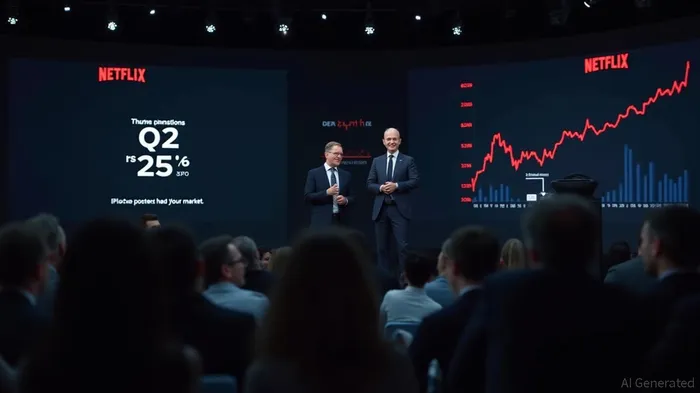
Netflix's Q2 '25 earnings report has provided a mixed bag of news for investors. The streaming giant reported robust financials, with earnings per share (EPS) and revenue beating estimates by +2% and fractionally, respectively, while operating income came in 3% ahead of consensus [3]. This performance has been driven by continued subscriber growth and increased revenue from its ad-supported tier. Despite these strong results, the stock has faced significant pressure due to its high price-to-earnings (P/E) ratio and valuation concerns.One of the standout points from the earnings report is Netflix's ability to raise guidance for calendar 2025, making it a "triple-play" company by beating on EPS and revenue consensus and then raising guidance for the calendar year. This indicates confidence in the company's ability to maintain its growth trajectory [3].
However, the risk lies in P/E compression. Despite the company's strong fundamentals, the stock's P/E ratio has compressed significantly, making it a riskier investment. The P/E ratio is now at 44.5, significantly higher than historical norms and peers like Disney and Amazon. This premium valuation is largely due to the market's pricing in continued high growth rates, which may be challenging to achieve given the company's anemic engagement growth of 1% year-over-year [1].
Netflix's recent earnings report has sparked a debate among investors and analysts. While the company's financials are strong, its valuation and macro risks demand caution. A misstep in content execution or a macro downturn could lead to further pain for investors [1]. The company's ability to raise full-year revenue guidance to $44.8–$45.2 billion, driven by pricing power and ad revenue growth, is impressive. However, the stock's valuation and macro risks are significant concerns [1].
Netflix's strategy to pivot toward live content and global partnerships to drive engagement is a strategic move in an increasingly competitive streaming landscape. The company's content spending in 2025 is projected to reach $11 billion annually, with a focus on original content production, live events, and globally appealing programming. However, the company's content asset value slightly declined from $32.5 billion to $32.1 billion in Q2 2025, indicating that amortization is outpacing new content investments [2].
Investors should proceed with caution. Netflix's recent rise has been cause for concern, and the company's valuation remains a hurdle. A misstep in content execution or a macro downturn could lead to further pain. Diversification is key: Pairing a Netflix position with lower-PEG peers like Disney or Amazon might balance risk [1].
In conclusion, Netflix's Q2 '25 earnings report shows that the company's business model is fine, but the risk lies in P/E compression. While the company's financials are strong, its valuation and macro risks demand caution. For contrarian investors, this could be an entry point if you're willing to bet that the content machine can justify the premium. For others, it's a reminder that high-growth stocks often trade on hope, not just fundamentals.
References:
[1] https://www.ainvest.com/news/netflix-overvaluation-revisited-cautionary-tale-investors-2507/
[2] https://www.ainvest.com/news/netflix-1h25-viewership-strategic-shift-content-engagement-2507/
[3] https://seekingalpha.com/article/4804977-netflix-earnings-summary-business-model-fine-pe-compression-risk
Stay ahead of the market.
Get curated U.S. market news, insights and key dates delivered to your inbox.
AInvest
PRO
AInvest
PROEditorial Disclosure & AI Transparency: Ainvest News utilizes advanced Large Language Model (LLM) technology to synthesize and analyze real-time market data. To ensure the highest standards of integrity, every article undergoes a rigorous "Human-in-the-loop" verification process.
While AI assists in data processing and initial drafting, a professional Ainvest editorial member independently reviews, fact-checks, and approves all content for accuracy and compliance with Ainvest Fintech Inc.’s editorial standards. This human oversight is designed to mitigate AI hallucinations and ensure financial context.
Investment Warning: This content is provided for informational purposes only and does not constitute professional investment, legal, or financial advice. Markets involve inherent risks. Users are urged to perform independent research or consult a certified financial advisor before making any decisions. Ainvest Fintech Inc. disclaims all liability for actions taken based on this information. Found an error?Report an Issue




Comments
No comments yet