
Netflix's Ad-Driven Surge: Can It Sustain the Growth Momentum?
Netflix's Q2 2025 earnings report has reignited optimism about its ability to navigate a crowded streaming landscape through strategic innovation. With subscriber growth surging past 300 million and margins holding firm, the company's pivot to ad-supported streaming is proving pivotal. But can this momentum translate into sustained valuation recovery and market dominance?
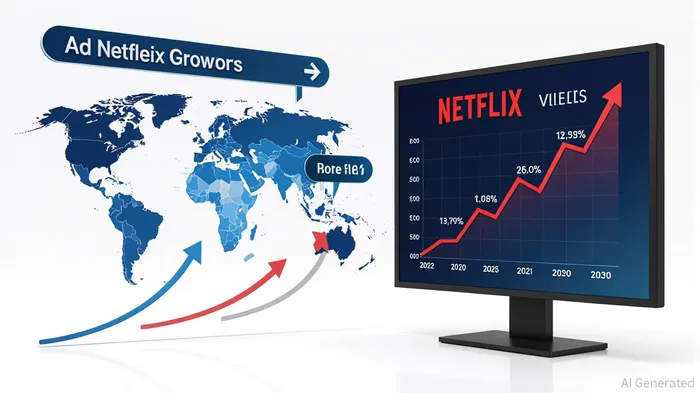
Subscriber Growth: A Shift from Survival to Dominance
Netflix added 32 million global subscribers in Q2, doubling the gains of rivals Disney+ and Warner BrosWBD-- Discovery (WBD). This brought its total subscriber base to 301.6 million, a 15.9% year-over-year jump. The growth is not merely about quantity—it's about leveraging strategic levers like its ad-supported tier and crackdown on password sharing.
The ad-supported plan, now boasting 94 million monthly active users (up from 40 million in 2024), has been a game-changer. By offering a lower-cost, ad-light experience, NetflixNFLX-- is capturing price-sensitive users while maintaining premium-tier retention. This hybrid model has also driven average revenue per user (ARPU) higher, as users opt for pricier tiers to avoid ads entirely.
Margin Resilience: Pricing Power and Operational Discipline
Despite rising content costs—particularly from live sports deals like NFL games and WWE matches—Netflix's Q2 operating margin hit 33%, exceeding its full-year 2025 target of 29%. This outperformance reflects disciplined pricing (e.g., recent price hikes in key markets) and cost controls.
However, risks linger. Analysts warn that 2025's second-half results could face headwinds from elevated marketing spend and content costs. The company's move into live sports, while strategically bold, requires sustained investment. Yet, the $8 billion free cash flow forecast for 2025 suggests Netflix can weather these pressures without sacrificing growth.
The Ad Strategy: A Dual Play on Revenue and Retention
Netflix's ad-supported tier is not just a cost-containment tool—it's a growth engine. By mid-2025, the tier's revenue contribution is estimated to hit $1.2 billion annually, with a target of $9 billion by 2030. The Netflix Ads Suite, which integrates third-party data for hyper-targeted ads, is critical here.
The platform's algorithmic recommendations—driving 80% of viewing choices—also create premium ad inventory. For advertisers, this means access to a highly engaged audience, while subscribers gain affordability. The result? A win-win that's hard for competitors like Hulu or Peacock to replicate at scale.
Competitive Positioning: Defying the Odds in a Crowded Market
Netflix's 21% share of the U.S. SVOD market (second only to AmazonAMZN-- Prime Video) underscores its dominance. Its global reach is equally striking: 101 million subscribers in EMEA and 57.5 million in Asia-Pacific, fueled by localized content like K-dramas and anime.
Rivals like Disney+ and Paramount+ are still playing catch-up. While they've invested in ad-supported tiers, none have Netflix's scale or user-centric ad strategy. Even in live sports—a traditional cable stronghold—Netflix's entry has broadened its appeal to casual sports fans, though this remains a nascent experiment.
Valuation: Overpriced or Undervalued?
Netflix's stock trades at $1,275, near its all-time high of $1,341, with a forward P/E of 48.6x. Some analysts argue this reflects excessive optimism, with JPMorganJPM-- recently downgrading the stock to “neutral.” Yet, 28 “buy” ratings from firms like Goldman SachsGS-- and BarclaysBCS-- suggest the bulls still hold sway.
The $1,500 price target by year-end hinges on execution: hitting ad revenue targets, maintaining margins, and sustaining subscriber growth. Technical analysts see resistance at $1,341 but note a bullish trend if the stock stays above $821.
Investment Takeaway: A Buy at Current Levels
Netflix's ad-supported model, margin resilience, and global expansion create a compelling case for investors. While risks like content costs and competition exist, the company's ability to innovate in a saturated market is unmatched.
For now, buy the dip below $1,200, with a $1,400–$1,500 target by end-2025. The stock's near-term catalysts include Q2's strong results and guidance, while long-term value hinges on executing its $9 billion ad revenue vision.
In a sector where execution is everything, Netflix's Q2 report reaffirms its status as a leader. For investors willing to look past valuation debates, this is a story worth betting on.

Delivering real-time insights and analysis on emerging financial trends and market movements.
Latest Articles
Stay ahead of the market.
Get curated U.S. market news, insights and key dates delivered to your inbox.




Comments
No comments yet