
Netflix's 10-for-1 Stock Split: A Retail Investor's Guide to Market Psychology and Long-Term Value


 Aime Summary
Netflix's 10-for-1 Stock Split: A Strategic Move for the Streaming Giant
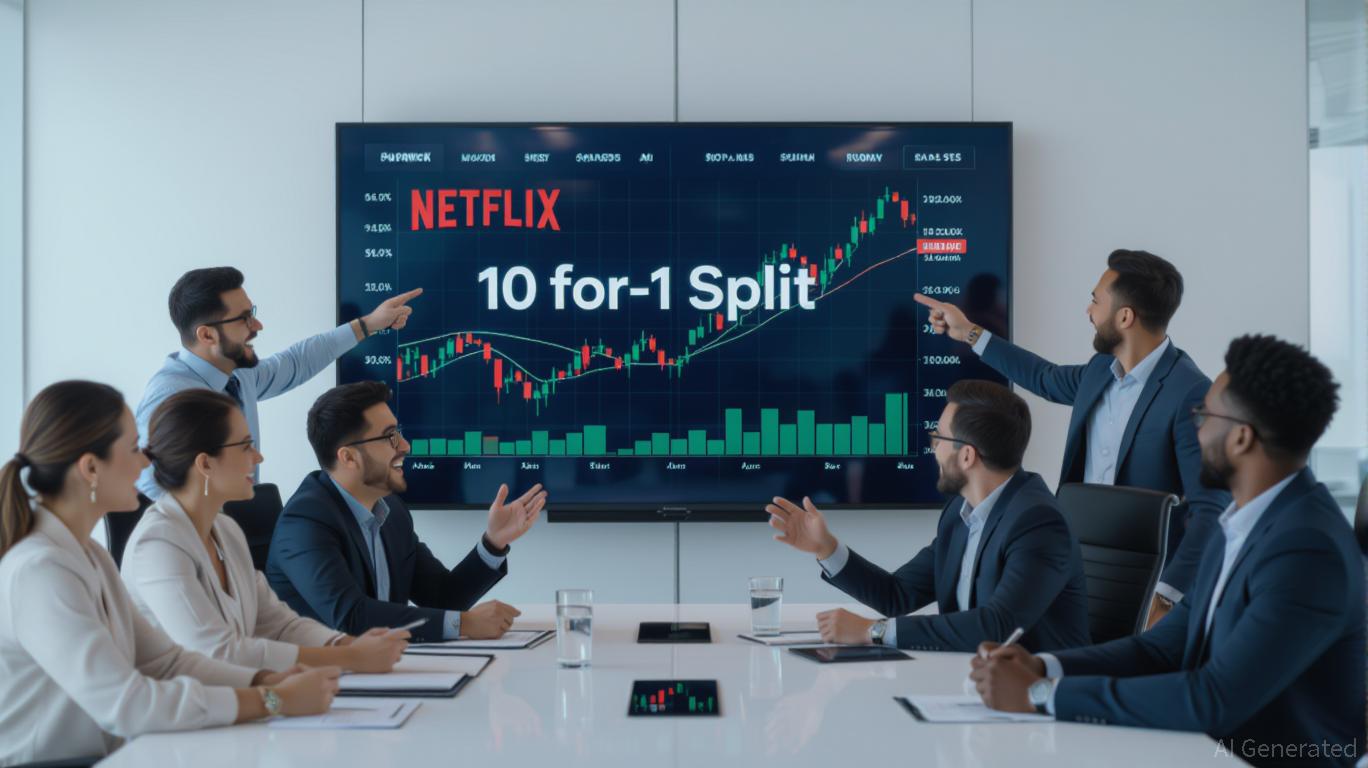
Netflix's 10-for-1 stock split, announced in 2025, marks a pivotal moment for the streaming giant and its shareholders. With the ex-dividend date set for November 10, 2025, and the split-adjusted trading commencing on November 17, the company's share price—previously hovering above $1,089—will drop to a more accessible range according to Blockonomi. This move, the first such split since 2015, aims to democratize ownership by reducing the psychological barrier for retail investors and employees exercising stock options according to GuruFocus. But what does this mean for market psychology and long-term investment value?
The Psychology of Splits: Liquidity, Perception, and Retail Behavior
Stock splits often act as a psychological trigger, reshaping investor behavior through perceived affordability. Netflix's split reduces the nominal price of its shares, a tactic that historically attracts smaller investors. According to a report by Blockonomi, this strategy aligns with broader trends where companies use splits to "signal confidence" and expand their shareholder base.
Academic research underscores this dynamic. A 2022 study by Cox et al. found that forward splits can temporarily boost liquidity, particularly in ETFs, by reducing bid-ask spreads. This liquidity effect is amplified when retail investors, who often favor lower-priced stocks, perceive splits as a sign of corporate optimism. For instance, Tesla's 5-for-1 split in 2020 saw a surge in retail buying, with platforms like Robinhood reporting a 300% increase in trading volume.
However, the impact is notNOT-- universal. Minnick and Raman's research highlights that retail participation in splits is often limited, especially in mature markets where institutional investors dominate. This suggests that while splits may attract attention, their success in broadening ownership depends on broader market conditions and investor sentiment.
Long-Term Value: Splits as a Signal, Not a Solution
While splits can enhance short-term liquidity, their long-term impact on corporate valuation remains nuanced. A 2023 study on Amazon and Google's 2022 1:20 splits revealed divergent outcomes: Amazon's stock outperformed post-split, while Google's lagged. This disparity underscores that splits are not a panacea for growth but rather a tool to amplify existing fundamentals.
For NetflixNFLX--, the split coincides with a period of revenue acceleration, driven by global subscriber growth and content innovation. Yet, as noted by NASDAQ, the true value of a split lies in its ability to reduce information asymmetry and diversify ownership, not in the mechanics of the split itself. This aligns with Netflix's stated goal of making shares more accessible to employees and retail investors—a demographic that often drives long-term loyalty through sustained ownership.
Critically, splits do not alter a company's intrinsic value. As GuruFocus explains, Netflix's market capitalization remains unchanged post-split; shareholders simply hold more shares at a lower price. This distinction is vital for investors: while splits may signal confidence, they do not guarantee future performance.
Retail Investor Takeaways: Caution and Context
For retail investors, Netflix's split presents both opportunities and risks. On one hand, the reduced price may lower entry barriers, particularly for younger or first-time investors. On the other, the split could fuel speculative buying, as seen in South Korea's record $3.63 billion in overseas stock purchases in November 2025. This surge, driven by aggressive retail strategies, highlights the emotional volatility splits can introduce.
Academic studies caution against overreliance on splits. A 2021 analysis of the Colombian Stock Exchange found that active retail traders often underperform, generating negative abnormal returns. This suggests that while splits may attract attention, they should not overshadow a company's fundamentals. For Netflix, this means evaluating its competitive position in streaming, content pipeline, and global expansion—not just the mechanics of a split.
Conclusion: A Step Toward Inclusivity, Not a Guarantee of Growth
Netflix's 10-for-1 stock split is a strategic move to broaden ownership and enhance liquidity. While it taps into the psychological appeal of lower-priced stocks, its long-term success hinges on the company's ability to sustain growth and innovate. For retail investors, the split offers a chance to participate in a high-profile stock but should be approached with a focus on fundamentals rather than the allure of a "split event."
As the market adjusts to this shift, investors must ask: Is Netflix's split a catalyst for broader retail engagement, or merely a symbolic gesture? The answer lies not in the split itself, but in the company's ability to deliver value over time.

Delivering real-time insights and analysis on emerging financial trends and market movements.
Latest Articles
Stay ahead of the market.
Get curated U.S. market news, insights and key dates delivered to your inbox.
AInvest
PRO
AInvest
PRO



Comments
No comments yet