
Netflix's 10-for-1 Stock Split and Its Implications for Retail Investors


 Aime Summary
Accessibility: Breaking Down Barriers to Ownership
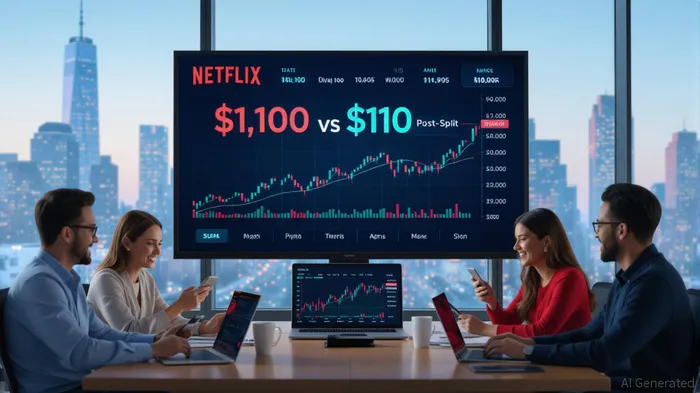
The primary rationale for the split, as stated by NetflixNFLX-- in its press release, is to democratize ownership by lowering the per-share price. For years, Netflix's stock had been priced well beyond the reach of many individual investors, particularly those with limited capital. By distributing ten new shares for every one held, the company is effectively reducing the cost barrier. For example, an investor who previously owned one share valued at $1,100 would now hold ten shares worth $110 each. This shift aligns with broader trends in retail investing, where platforms like Robinhood and Webull have empowered smaller investors to participate in markets that were once dominated by institutional players.
According to a report by Bloomberg, the split also addresses internal equity concerns. Employees with stock options, many of whom are mid-level workers, will now find it easier to exercise their options and convert their compensation into liquid assets. This could enhance employee retention and morale, indirectly supporting Netflix's long-term growth.
Market Psychology: Short-Term Boosts and Behavioral Biases
Stock splits often trigger psychological shifts in investor behavior, even when fundamentals remain unchanged. Morningstar senior analyst Matthew Dolgin notes that the split could generate short-term upward pressure on Netflix's stock due to increased demand from retail investors and call options traders according to Morningstar analysis. Lower-priced stocks tend to attract more buyers, particularly those who perceive them as "more affordable" or "less risky." This dynamic was evident in the immediate aftermath of the announcement, with Netflix's shares rising 4.2% on the day of the split.
However, the long-term impact of splits is less certain. While the split may temporarily boost liquidity and trading volume, it does not address structural challenges such as rising content costs or competitive pressures from platforms like Disney+ and Amazon Prime Video. As Dolgin emphasizes, "The split is a cosmetic change. Over time, Netflix's ability to sustain subscriber growth and profitability will determine its stock's trajectory" according to Morningstar.
Long-Term Value Perception: Balancing Optimism and Realism
Netflix's decision to split its stock comes amid strong financial performance. For the first nine months of 2025, the company reported a 15% year-over-year revenue increase to $33.1 billion and a 26% rise in earnings per share to $20.12. These figures, coupled with a projected 12% annual revenue growth over the next five years, have justified its premium valuation for some investors. Yet, others argue that the stock is currently overvalued.
Morningstar's analysis suggests that Netflix's shares trade at a 45% premium to their fair value, with a projected fair value of $1,350 per share by 2028 according to Morningstar analysis. While this implies a potential 21% upside, it also highlights the risks of overvaluation. Community forecasts for the stock's fair value range widely, from $797.74 to $1,825.07, underscoring the uncertainty surrounding Netflix's long-term prospects.
The split may also influence investor sentiment toward Netflix's new ventures, such as its advertising and gaming divisions. These segments, though still in their infancy, could diversify the company's revenue streams and reduce reliance on subscription growth alone. However, success in these areas will depend on execution, not just stock price dynamics.
Conclusion: A Strategic Move with Mixed Implications
Netflix's 10-for-1 stock split is a strategic response to both internal and external pressures. By making shares more accessible, the company is fostering inclusivity and potentially expanding its investor base. The split's psychological impact-driven by behavioral biases and increased liquidity-could provide a short-term tailwind. However, long-term value creation will hinge on Netflix's ability to navigate content costs, subscriber retention, and evolving market demands.
For retail investors, the split presents an opportunity to own a piece of a high-growth company at a more approachable price. Yet, it also serves as a reminder that stock splits are symbolic gestures. The real work lies in the fundamentals. As the streaming wars intensify, Netflix's ability to innovate and execute will ultimately determine whether this split proves to be a catalyst for sustained growth or a fleeting moment of optimism.

Delivering real-time insights and analysis on emerging financial trends and market movements.
Latest Articles
Stay ahead of the market.
Get curated U.S. market news, insights and key dates delivered to your inbox.




Comments
No comments yet